
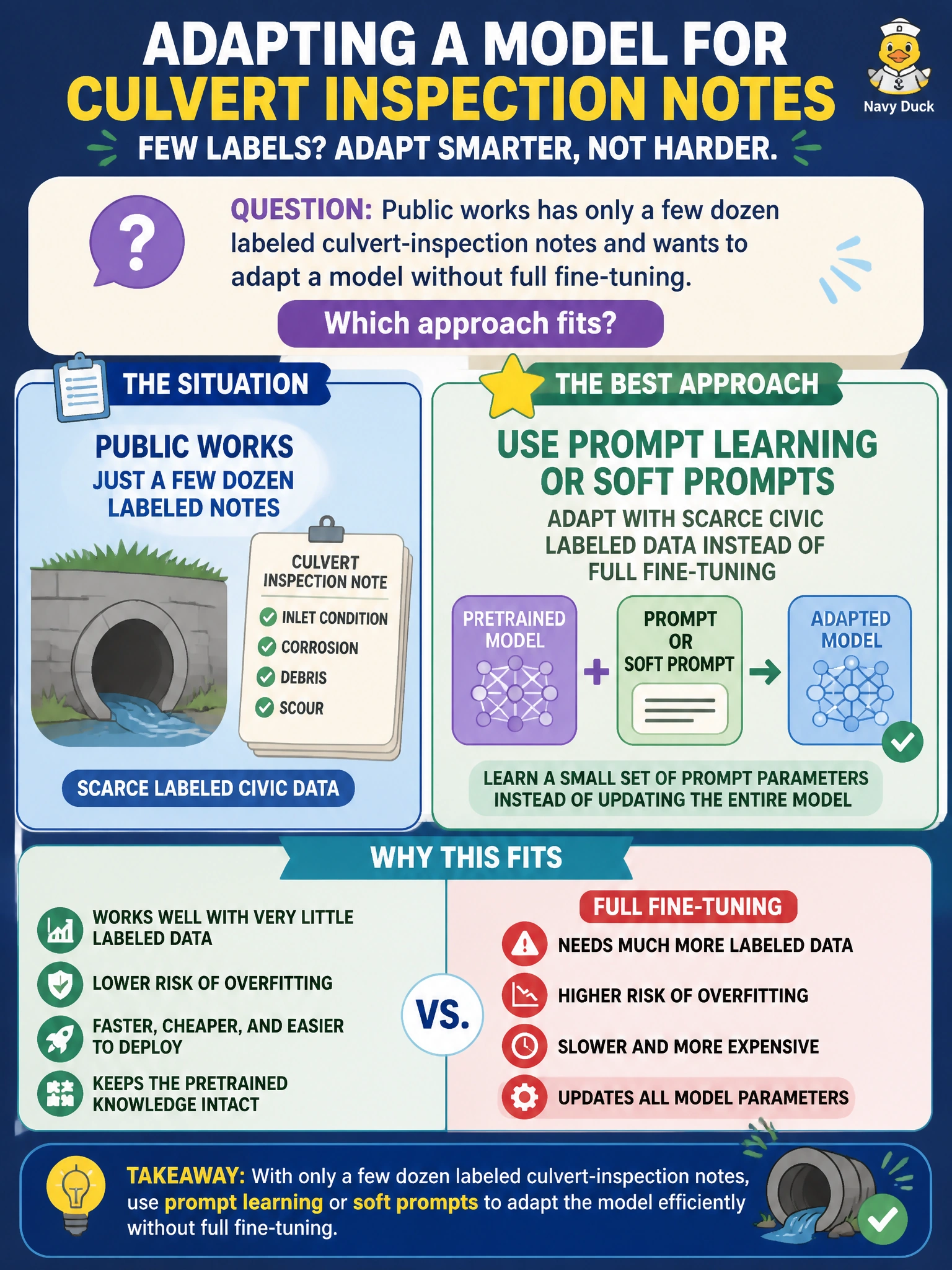
Public works has only a few dozen labeled culvert-inspection notes and wants to adapt a model without full fine-tuning. Which approach fits?
Select an answer to reveal the explanation.
Short Explanation
With only a shoebox of labeled culvert notes, you don’t need to retrain the whole skyscraper. Prompt learning or soft prompts let you adapt the model with a small learned prompt while leaving most of its weights alone. Training every weight from scratch on dozens of examples can quickly teach the model to memorize noise instead of generalizing.
Full Explanation
Public works with only a few dozen labeled culvert-inspection notes can adapt a model without full fine-tuning by using prompt learning or soft prompts. These methods add a small set of learned prompt parameters or embeddings, allowing the base model to adapt to scarce civic labels while leaving most weights unchanged; that suits a low-label municipal pilot where inspection notes are expensive to annotate. Training every model weight from scratch on the tiny set risks overfitting and poor generalization to new basins or storm events. Requiring tens of thousands of new labels before any pilot may be unnecessary and can delay operational value for flood mitigation. Fine-tuning every layer at the highest learning rate on dozens of notes can memorize noise and harm the model’s general language ability. Exam caveat: prompt learning is not magic; label quality and validation splits still matter, and the stem contrasts scarce-data prompt adaptation with full fine-tuning. Practical check: hold out culvert notes for validation, assess whether the adapted model generalizes beyond its training notes, watch for memorization of inspector IDs or site codes, and keep a human review loop for severity classifications.