
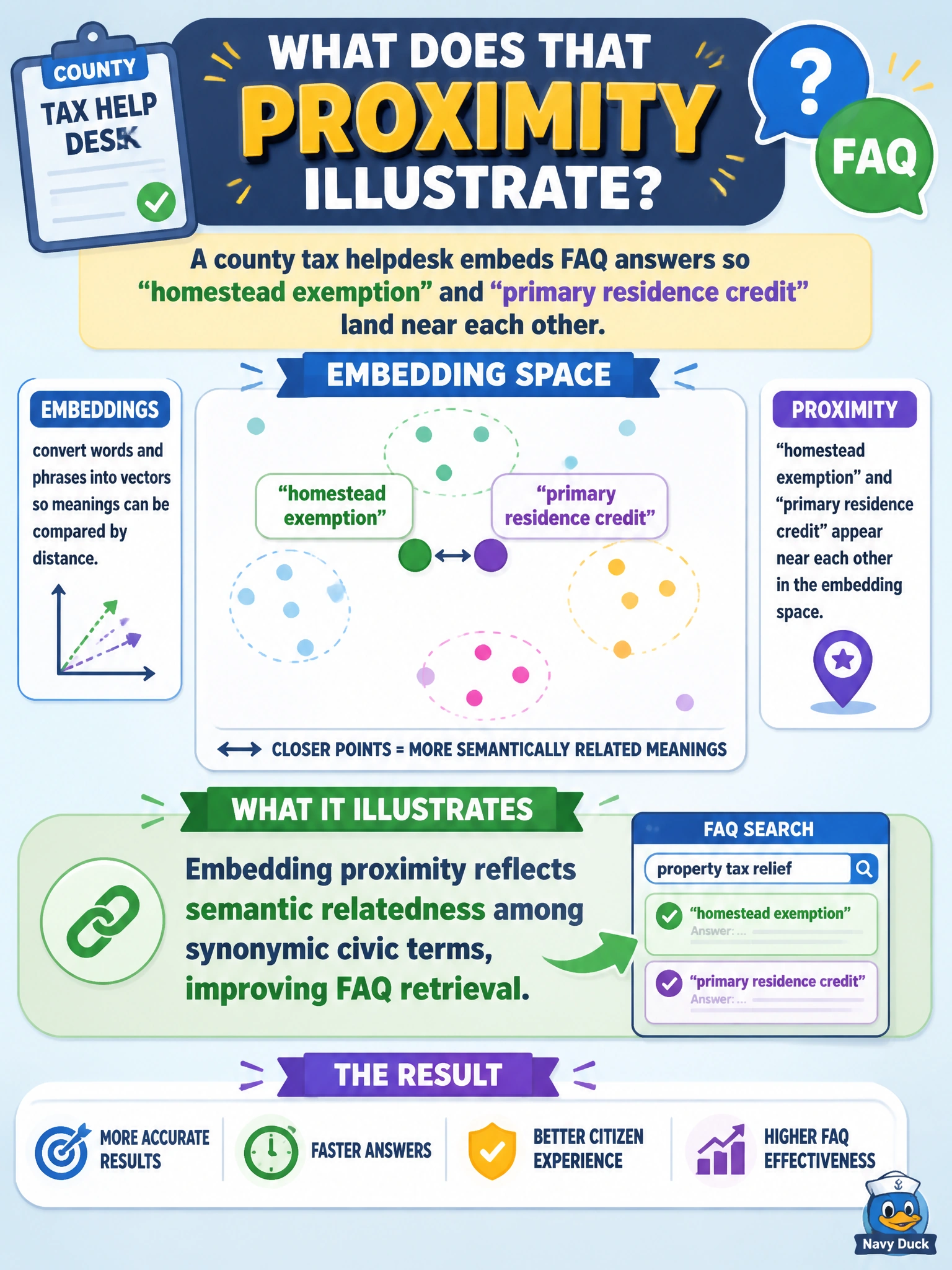
A county tax helpdesk embeds FAQ answers so ‘homestead exemption’ and ‘primary residence credit’ land near each other. What does that proximity illustrate?
Select an answer to reveal the explanation.
Short Explanation
Those two FAQ phrases are neighbors because they mean nearly the same tax break to residents—not because every character matches. Embedding proximity is a semantic hug between synonymic civic wording, which helps the helpdesk retrieve either phrase’s answer. It is not a delete order or a GPU scoreboard.
Full Explanation
When a county tax helpdesk embeds FAQ answers so ‘homestead exemption’ and ‘primary residence credit’ land near each other, that proximity illustrates semantic relatedness: synonymic or near-synonymic civic terms map to nearby vectors, improving retrieval when residents use either phrase. The helpdesk can surface the right exemption guidance despite varied wording across counties and informal resident language. Nearby vectors do not prove bitwise identity of FAQ files; different strings can still be semantic neighbors by design. Proximity does not mandate deleting one phrase from the corpus; keeping both improves coverage of how residents actually ask. Vector nearness is not a count of GPUs used to score a batch and should never be interpreted as infrastructure telemetry. Exam caveat: very close embeddings can also signal editorial redundancy worth consolidating, but consolidation is a content decision, not an automatic deletion rule implied by geometry alone. Operational check: query with both phrasings, confirm the same authoritative FAQ returns, periodically re-embed after tax-policy wording changes, and review false neighbors that might conflate unrelated credits with homestead rules.