
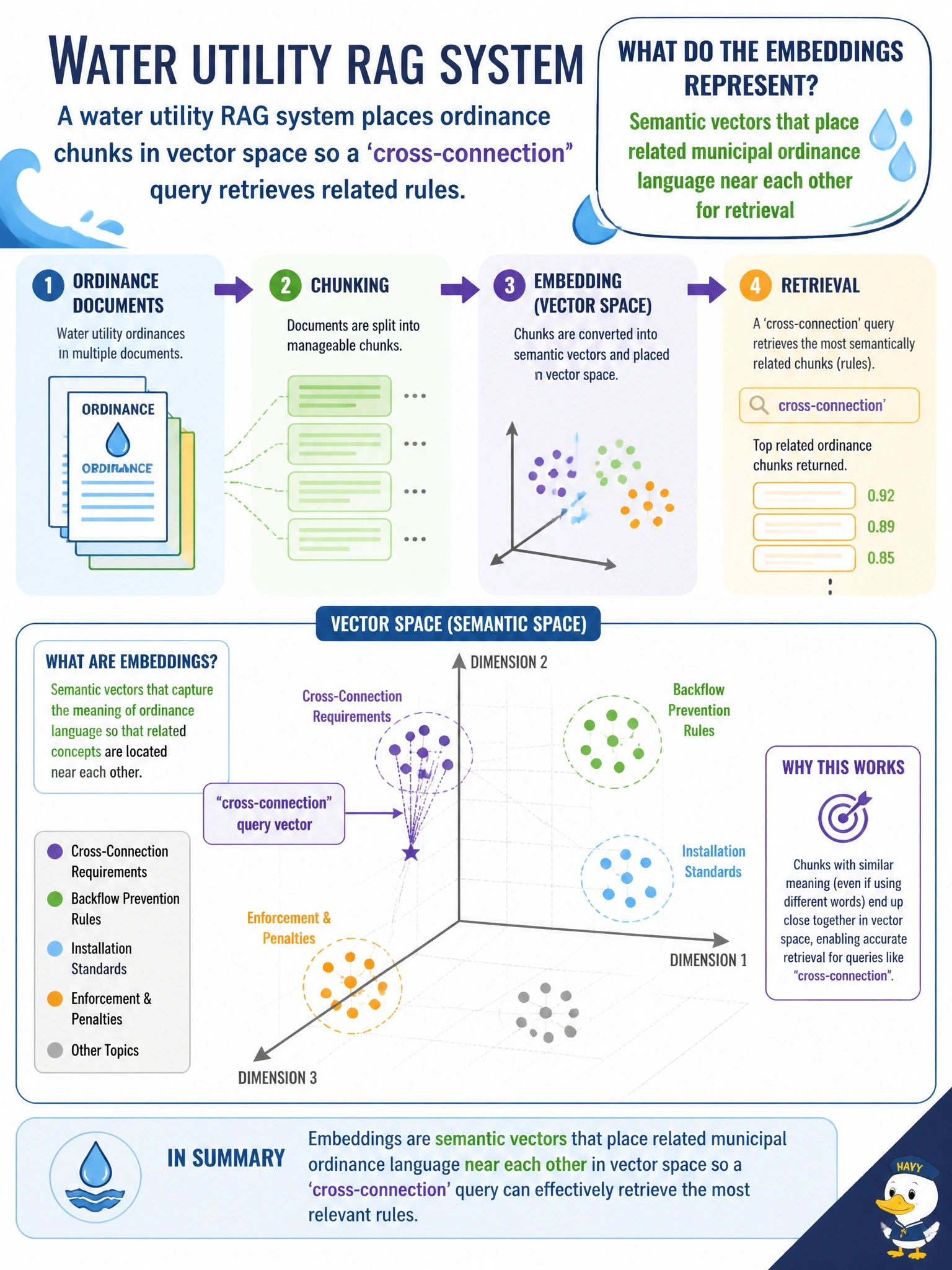
A water utility RAG system places ordinance chunks in vector space so a ‘cross-connection’ query retrieves related rules. What do the embeddings represent?
Select an answer to reveal the explanation.
Short Explanation
Embeddings are meaning coordinates. ‘Cross-connection’ rules that talk about the same idea sit near each other even when the wording differs, which is why RAG can fetch the related ordinance chunks. File size counters and exact-string keys are not that semantic map.
Full Explanation
In a water utility RAG system, ordinance chunks are embedded so a ‘cross-connection’ query can retrieve related rules even when wording differs. Those embeddings are dense semantic vectors: related municipal ordinance language occupies nearby regions of vector space, enabling similarity search for retrieval-augmented generation. That semantic map is what makes paraphrase-tolerant civic retrieval work for operators and residents asking about backflow or cross-connection controls. Byte length of each PDF carries no ordinance meaning and cannot rank legal relevance. Exact string equality keys only hit identical character sequences and miss synonymous cross-connection language spread across code sections. GPU temperature sensors are hardware telemetry, not text semantics, and have no role in ordinance retrieval. Exam caveat: embedding quality depends on chunking strategy, model choice, and metadata filters such as jurisdiction and effective date; proximity is necessary but not sufficient without sound RAG hygiene and citation display. Operational check: run golden queries like ‘cross-connection’ and ‘backflow’, inspect retrieved chunk relevance with utility SMEs, monitor precision and recall as ordinances are updated in the index, and verify answers cite the retrieved section rather than inventing code text.