
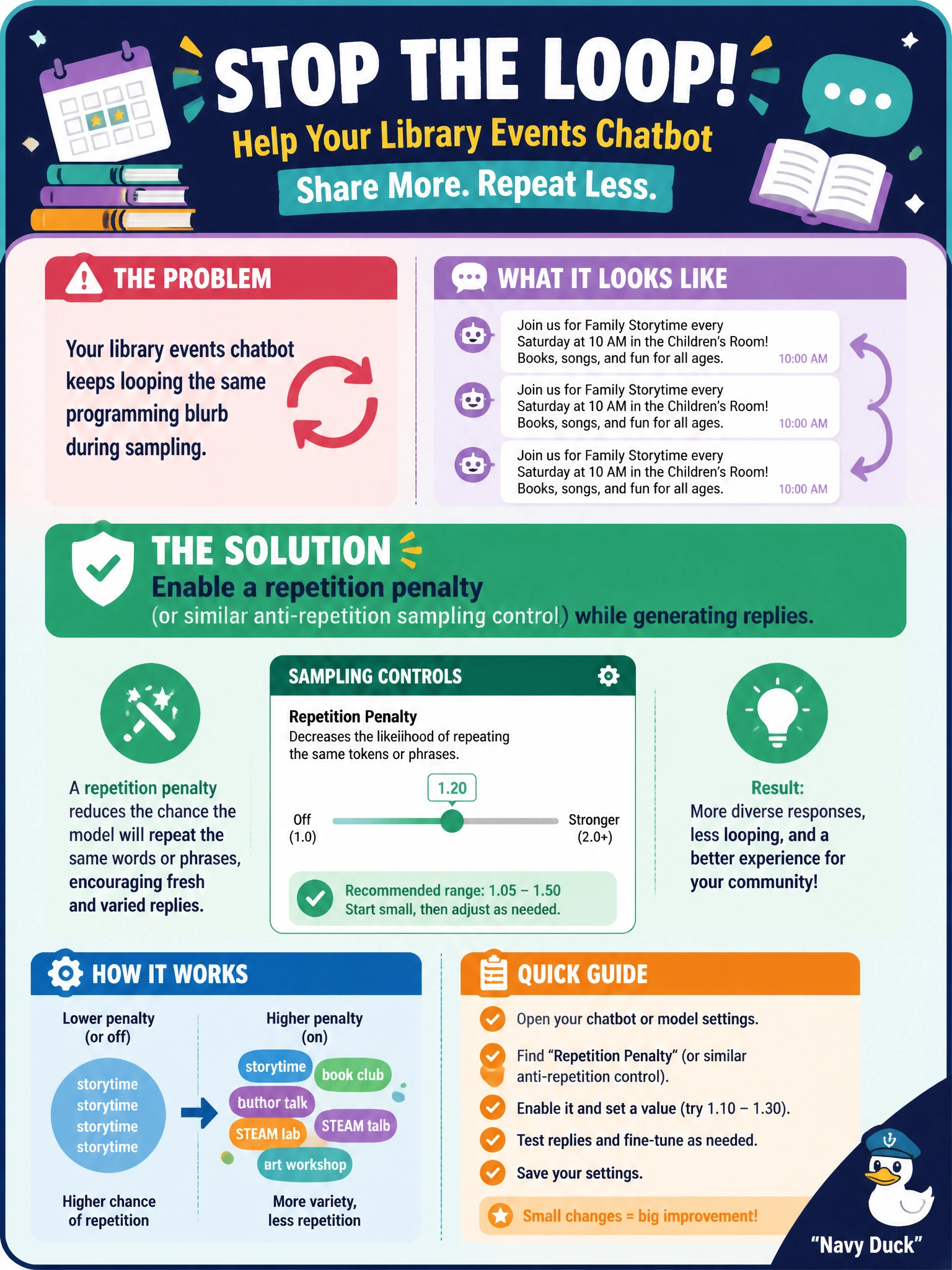
A library events chatbot keeps looping the same programming blurb during sampling. What sampling control should staff apply to reduce that repetition?
Select an answer to reveal the explanation.
Short Explanation
When the bot gets stuck on the same events blurb, a repetition penalty nudges sampling away from tokens it just overused—like telling a announcer not to read the same flyer twice. Turning off tokenization or ripping out the decoder does not fix looping copy.
Full Explanation
When a library events chatbot loops the same programming blurb during sampling, the direct control is an anti-repetition mechanism: a repetition penalty, frequency penalty, or presence penalty that down-weights tokens or phrases already overused in the generated reply (and sometimes in the prompt). That nudges the decoder toward alternative event phrasings instead of recycling the identical calendar blurb residents already saw. Conceptually, repetition controls reshape the sampling distribution after logits are produced so recently emitted tokens become less likely, which is the right lever when the architecture and prompt are otherwise fine but decoding sticks. Disabling tokenization does not stop repetition; it breaks generation because models operate on tokens and cannot emit coherent event copy without a tokenizer. Forcing beam width to one and removing all penalties often worsens sticky phrases under greedy-like behavior without addressing the repetition incentive in the distribution. Replacing the decoder with a pure encoder removes generative capability for event copy entirely, so it cannot solve a chatbot reply loop. Exam caveat: penalties that are too strong can harm required proper nouns such as branch names and program titles; tune gently and whitelist critical civic entities when needed. Operational check: log repeated spans in production replies, A/B test penalty values on events FAQs, verify that required program names still appear while boilerplate loops decline, and confirm staff can disable the penalty for tightly scripted emergency closures.