
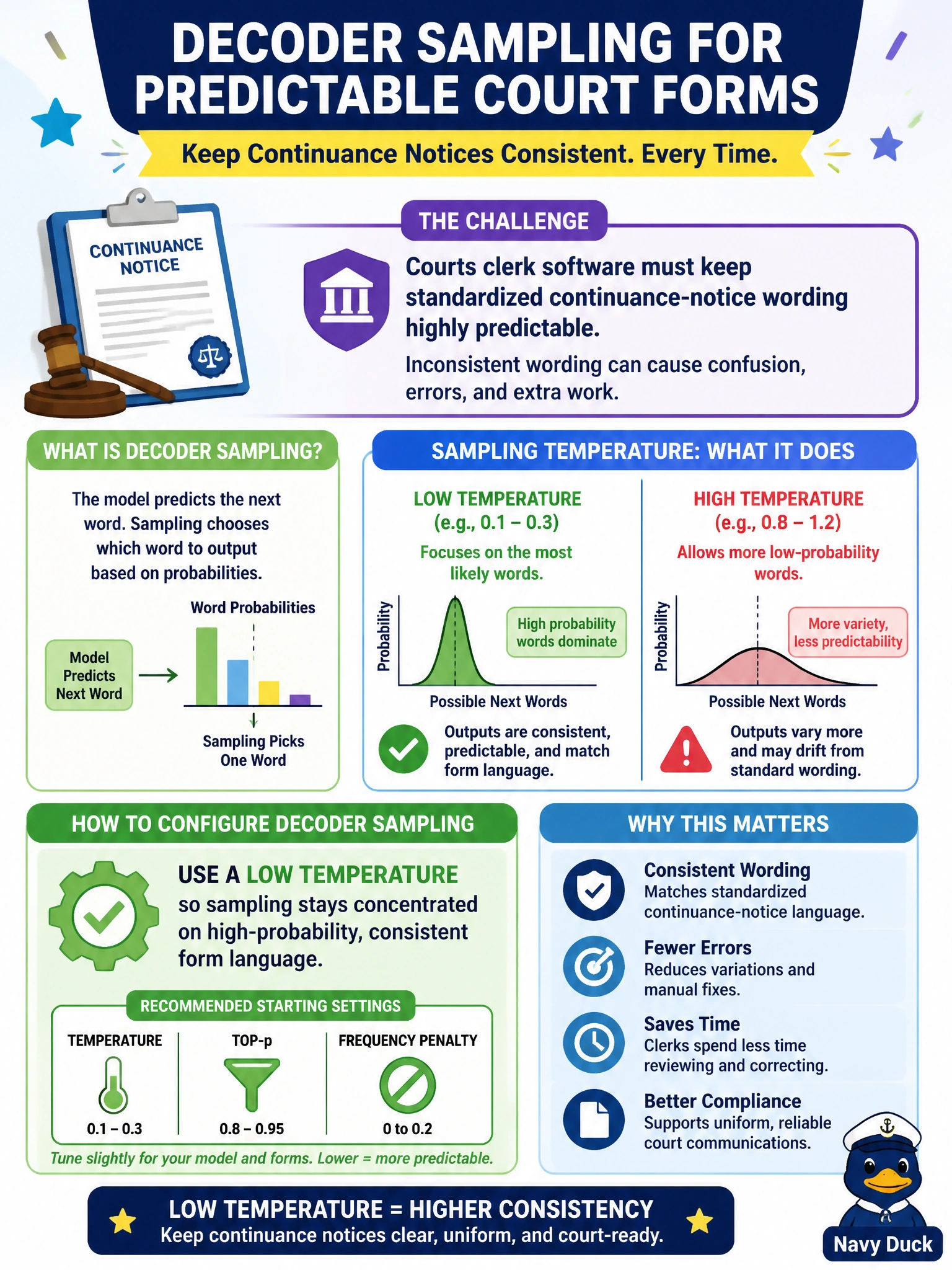
Courts clerk software must keep standardized continuance-notice wording highly predictable. How should decoder sampling be configured?
Select an answer to reveal the explanation.
Short Explanation
Court forms want boring-in-a-good-way consistency. Low temperature keeps the decoder parked on the most likely, standardized continuance phrases instead of creative riffs. High temperature or fishing in the least-likely tokens is the opposite of predictable clerk language.
Full Explanation
Courts clerk software that must keep continuance-notice wording highly predictable should configure decoder sampling for concentration, not novelty. Low temperature sharpens the next-token distribution toward high-probability, standardized form language so notices stay consistent with approved legal phrasing. That predictability is the civic requirement for filings that must match clerk templates and judicial expectations. Maximizing temperature and top-k encourages inventive legal wording, which is undesirable for standardized continuance notices and can introduce risky paraphrases of statutory language. Disabling the language head and emitting random Unicode produces unusable documents that cannot be filed or served. Sampling only the least probable tokens maximizes nonsense rather than compliant court language and directly opposes predictability. Exam caveat: extremely low temperature approaches greedy decoding; combine with templates or constrained decoding when statutes require exact clauses, and remember that temperature alone does not enforce a schema. Operational check: measure edit distance of generated notices against the approved template bank, track rejected filings due to wording drift, lock temperature and related samplers in the clerk application config under change control, and sample-audit notices before statewide rollout.