
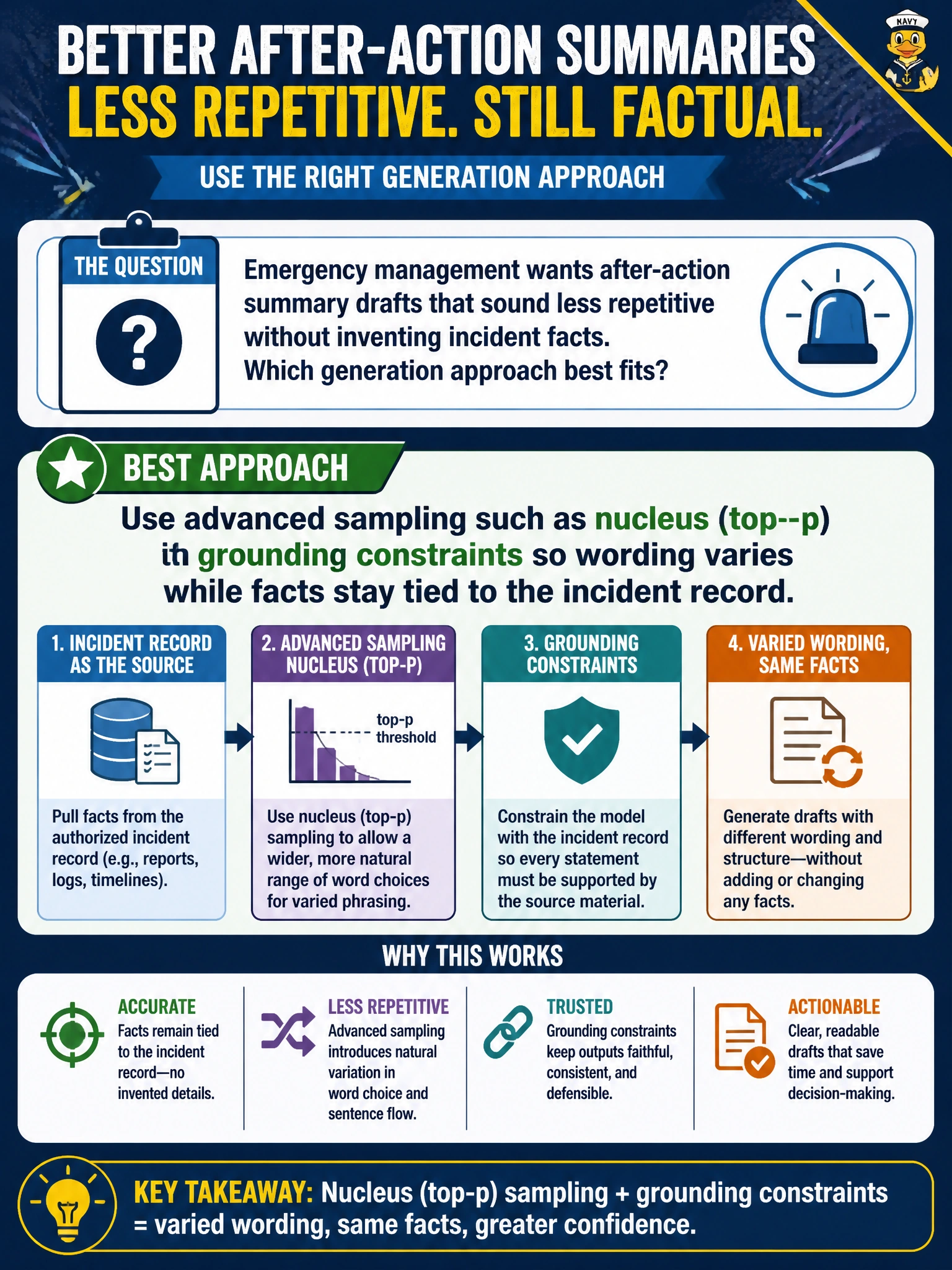
Emergency management wants after-action summary drafts that sound less repetitive without inventing incident facts. Which generation approach best fits?
Select an answer to reveal the explanation.
Short Explanation
You want fresh phrasing, not fan fiction about the incident. Nucleus/top-p style sampling adds variety, while grounding constraints keep the draft glued to the after-action facts. Max temperature with no guardrails, or zero creativity forever, both miss that balance.
Full Explanation
Emergency management drafting after-action summaries needs lexical variety without fabricating incident facts. Advanced sampling such as nucleus (top-p) sampling, optionally with temperature, increases phrasing diversity by drawing from a truncated high-probability mass, while grounding constraints—retrieved incident records, required entities, citation checks, or constrained decoding—keep claims tied to the after-action source of truth. That pairing addresses both “less repetitive” and “without inventing incident facts.” Setting temperature to zero and disabling nucleus permanently maximizes determinism and often increases bland repetition, opposing the variety goal. Shuffling sentences from unrelated city press releases injects off-incident content and breaks factual grounding. Raising temperature to the maximum while removing grounding maximizes hallucination risk in a high-stakes municipal report. Exam caveat: sampling alone never guarantees factuality; grounding and review remain mandatory for emergency after-action drafts. Operational check: measure n-gram repetition and entity fidelity against the incident log, require human review before release, and tune top-p only inside a range that preserves named locations, times, and actions from the record.