
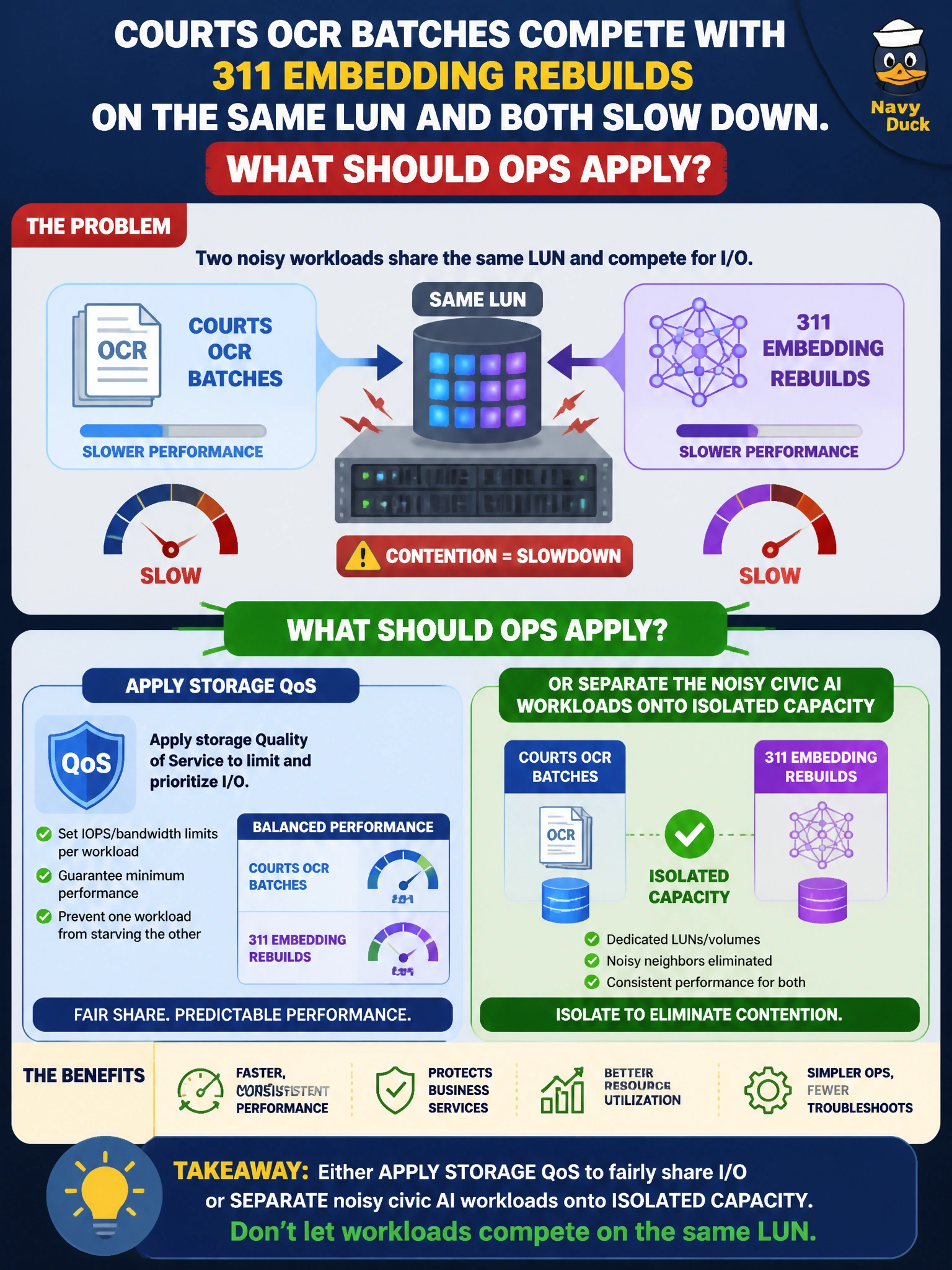
Courts OCR batches compete with 311 embedding rebuilds on the same LUN and both slow down. What should ops apply?
Select an answer to reveal the explanation.
Short Explanation
Two hungry jobs on one LUN need QoS or separate capacity—courts OCR and 311 rebuilds should not shoulder-check each other. Unlimited shared IOPS without controls just prolongs the fight.
Full Explanation
Courts OCR batches competing with 311 embedding rebuilds on the same LUN create noisy-neighbor IO contention that slows both municipal workloads. Applying storage QoS or separating the noisy civic AI workloads onto isolated capacity restores predictable performance without deleting either service. QoS limits or dedicated volumes are the correct storage operations response to shared-LUN contention.
Giving both workloads unlimited IOPS on the shared LUN with no controls prolongs interference and makes SLOs unenforceable. Deleting the courts OCR models so 311 can monopolize the LUN sacrifices a required civic workload instead of isolating capacity. Running both jobs only during peak citizen portal hours stacks AI IO on top of portal traffic and worsens user-facing contention.
Exam caveat: shared-storage contention is solved with QoS or separation—not by deleting one tenant or scheduling both onto peak portal load. Capture per-workload IO metrics before and after QoS for municipal capacity planning. Operational check: measure LUN latency while courts OCR and 311 rebuilds overlap, apply storage QoS or migrate one workload to isolated capacity, rerun the overlap window, and confirm both jobs meet civic latency and throughput targets.