
Library computer-vision datasets on object storage thrash with tiny reads. What improves the access pattern?
Select an answer to reveal the explanation.
Short Explanation
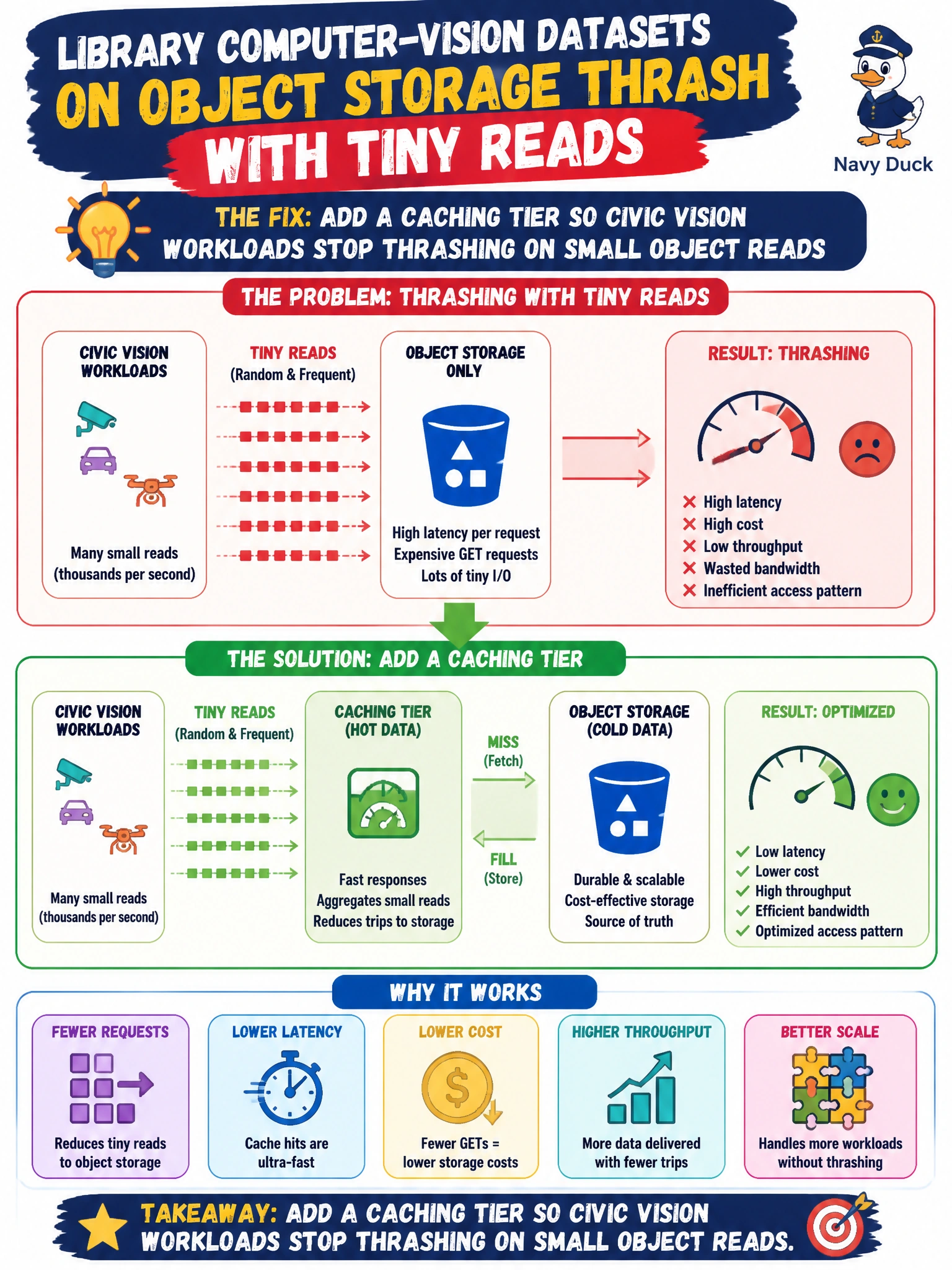
You can ease the tiny-read thrash by adding a caching tier that serves frequently used frames faster. Retrieving every image separately on every epoch, storing frames as single-byte objects, or disabling read-ahead and caching would worsen the access pattern.
Full Explanation
Library computer-vision datasets on object storage can thrash with tiny reads because millions of small GETs overwhelm object APIs and underuse bandwidth. Adding a caching tier so civic vision workloads stop thrashing on small object reads improves the access pattern by coalescing requests and serving hot frames locally or from a faster tier. This addresses the mismatch between small, frequent reads and object storage without requiring a pathological object layout. Retrieving every image separately from object storage on every epoch, with no local reuse, repeatedly downloads the data and multiplies thrash and WAN cost. Storing all frames as millions of single-byte objects maximizes object-API overhead, making the access pattern worse. Disabling read-ahead and caching for vision loaders removes measures that can reduce small-read pressure on municipal object storage. Exam caveat: small-object thrash is primarily an access-pattern and caching problem; the listed choices that remove reuse or increase tiny-object overhead do not solve it. Practical check: measure object GET rate and latency for the library CV loader, add or enable a caching tier in front of object storage, rerun an epoch, and confirm that the small-GET rate falls while sustained throughput for civic vision training rises.