
Transit parallel filesystem shows imbalance across OSTs and ETA training throughput drops. What restores balance?
Select an answer to reveal the explanation.
Short Explanation
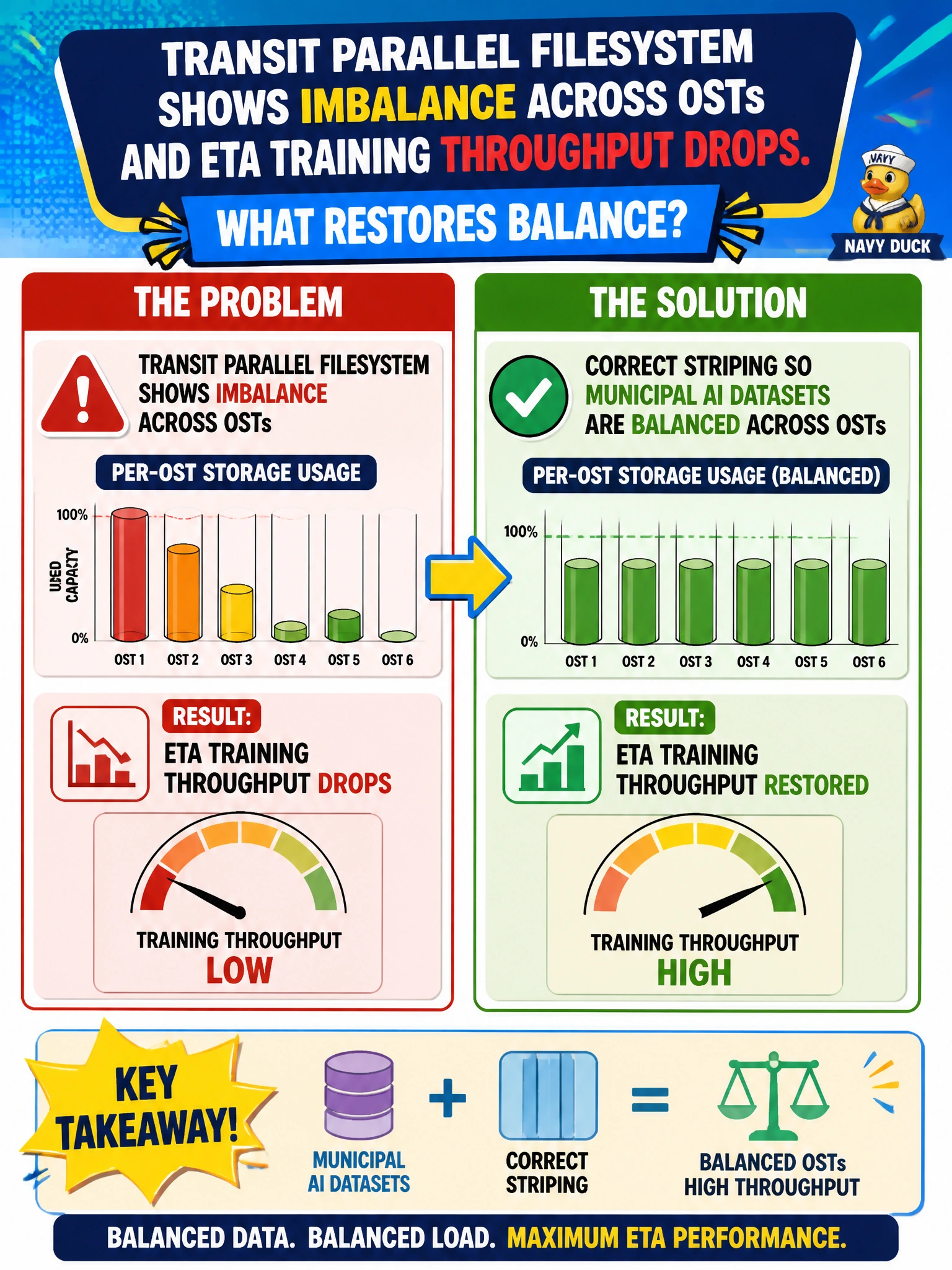
When you see OSTs carrying uneven loads, you can restore throughput by correcting striping so transit datasets are balanced across them. Pinning everything to one overloaded OST would make the hotspot worse.
Full Explanation
Transit parallel filesystems with OST imbalance reduce aggregate bandwidth for AI datasets and can lower ETA training throughput. Correcting striping so municipal AI datasets are balanced across OSTs redistributes the load and restores expected parallel I/O. Imbalance can arise from default striping on large newly ingested datasets or uneven file layouts from civic ETL. Pinning all transit datasets to a single overloaded OST intensifies the hotspot and further harms throughput. Disabling the parallel filesystem and using only local /tmp forever abandons the shared, multi-node dataset access required for transit training at scale. Ignoring OST imbalance because GPUs will catch up overnight misunderstands I/O-bound training: GPUs cannot outrun an imbalanced parallel filesystem. Exam caveat: treat OST imbalance as a striping and layout problem, and correct striping on municipal AI datasets before attributing the slowdown to the model. Practical check: inspect OST space and I/O distribution for the transit training datasets, re-stripe according to civic parallel-filesystem guidance, rerun a representative ETA training read, and confirm that OST metrics are balanced and throughput has recovered.