
Water-utility UCX and NCCL environment variables conflict with Magnum IO guidance after a toolkit bump. What should ops do?
Select an answer to reveal the explanation.
Short Explanation
Toolkit bumps can tangle UCX/NCCL knobs with Magnum IO advice—untangle those env conflicts on the water cluster. Randomizing variables or forcing CPU-only PyTorch is not guidance.
Full Explanation
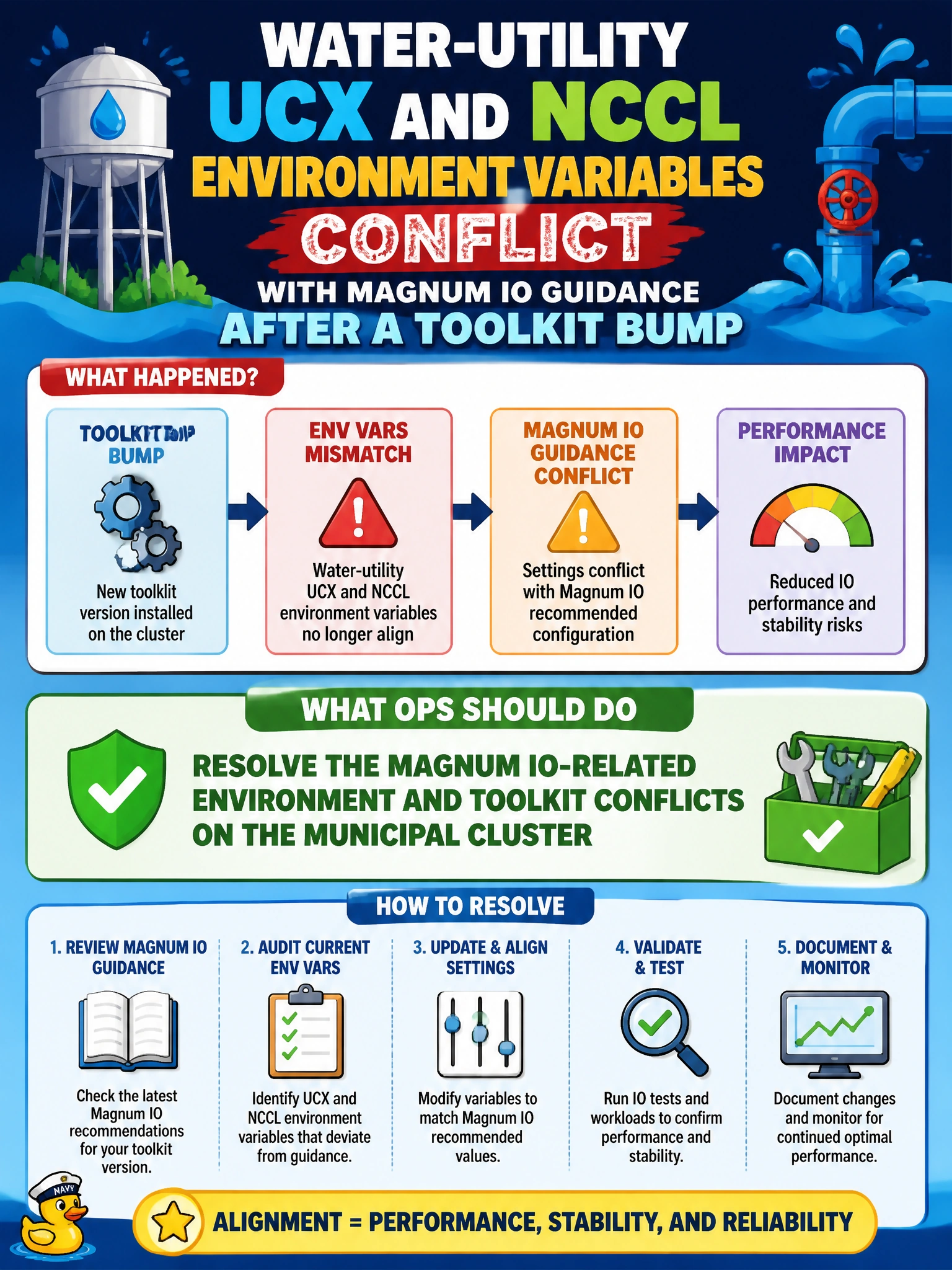
Water-utility clusters often set UCX and NCCL environment variables that must stay consistent with Magnum IO guidance after a toolkit bump. Conflicts—wrong transports, mismatched library paths, or stale variables—produce slow or failing multi-node jobs. Resolving the Magnum IO-related environment and toolkit conflicts on the municipal cluster restores a coherent runtime for UCX/NCCL without abandoning GPU training.
Randomizing all NCCL variables on every reboot makes failures non-reproducible and guarantees drift from Magnum IO-supported settings. Unsetting Magnum IO documentation as irrelevant discards the compatibility guidance needed after toolkit upgrades. Downgrading every civic application to CPU PyTorch builds only avoids GPUs entirely and is not a resolution of Magnum IO environment conflicts.
Exam caveat: after CUDA/toolkit bumps, re-validate UCX/NCCL environment against the Magnum IO guide before chasing application bugs. Prefer deliberate variable cleanup over experimental randomization. Operational check: export the water-utility node environment, diff UCX/NCCL/Magnum IO-related variables against the post-bump civic standard, remove or correct conflicts, run a short NCCL/UCX smoke test on two nodes, and confirm training throughput returns toward baseline.