
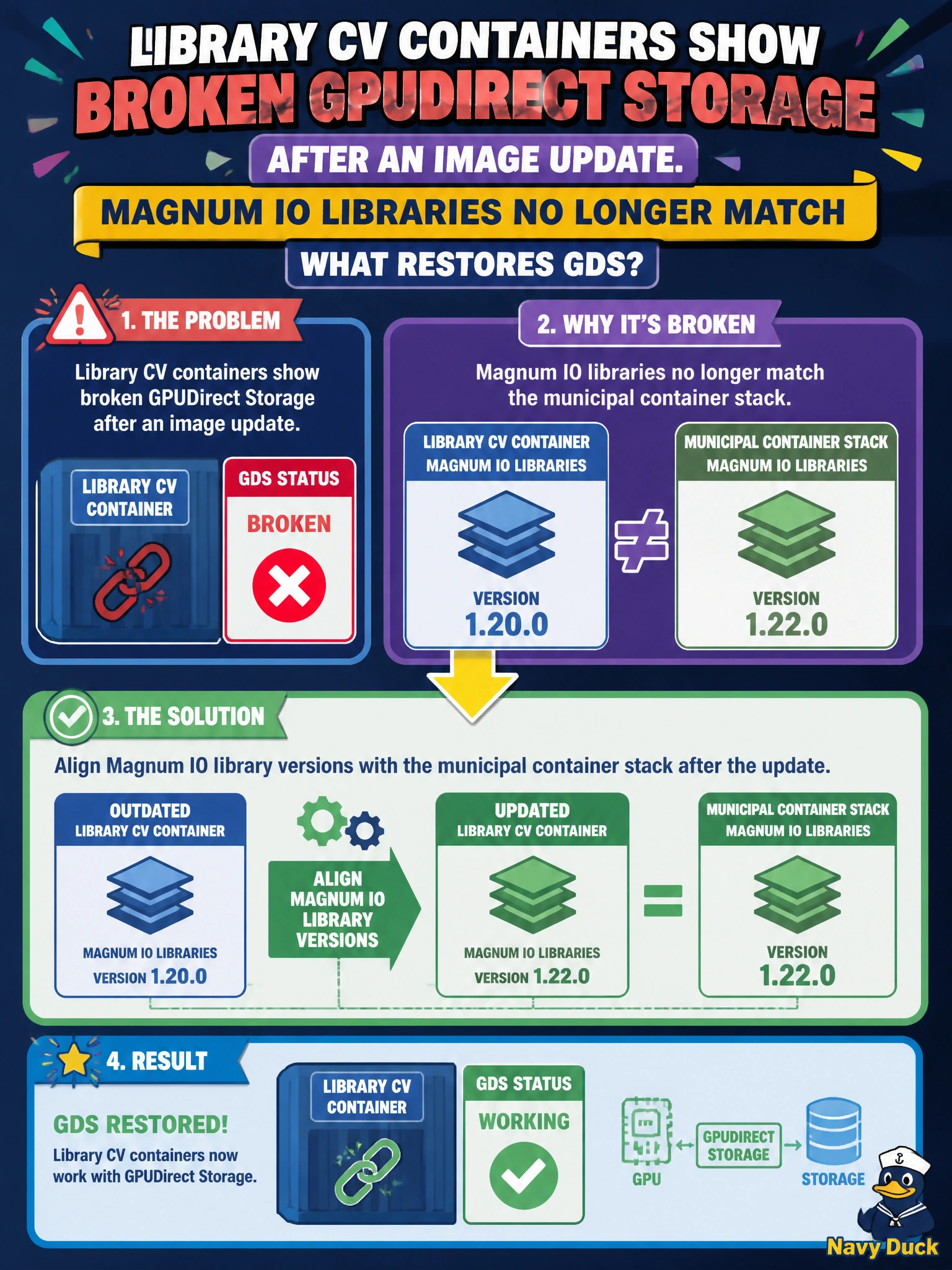
Library CV containers show broken GPUDirect Storage after an image update. Magnum IO libraries no longer match. What restores GDS?
Select an answer to reveal the explanation.
Short Explanation
The new container brought mismatched Magnum IO libraries—line them back up with the civic stack so GDS works for library CV again. Deleting models or forever disabling GDS skips the real fix.
Full Explanation
Library computer-vision containers that lose GPUDirect Storage after an image update usually suffer Magnum IO library skew against the new container stack. Aligning Magnum IO library versions with the municipal container stack after the update restores ABI and feature compatibility so GDS can initialize again. Version alignment is the remediation; abandoning GDS or unrelated consumer drivers does not restore the accelerated path the civic CV pipeline expects.
Pinning an unrelated desktop GPU driver from a consumer laptop introduces an unsupported driver line into the municipal cluster and does not reconcile Magnum IO libraries inside the CV container stack. Deleting the CV models so GDS is no longer required discards library workloads instead of fixing the library mismatch that broke GDS. Disabling GPUDirect permanently and accepting CPU copies may unblock a single job but permanently forfeits Magnum IO acceleration for library vision training and inference IO.
Exam caveat: container image bumps are a common trigger for Magnum IO/GDS library skew—treat “GDS broke after update” as a version-alignment incident before redesigning storage. Operational check: record Magnum IO and container CUDA/GDS library versions before and after the library CV image update, align them to the civic support matrix, restart a pilot container, confirm GDS initializes without fallback, and measure read throughput against the pre-update baseline.