
County storage disables a mount option required for GPUDirect Storage; Magnum IO falls back silently and training slows. What should ops recognize?
Select an answer to reveal the explanation.
Short Explanation
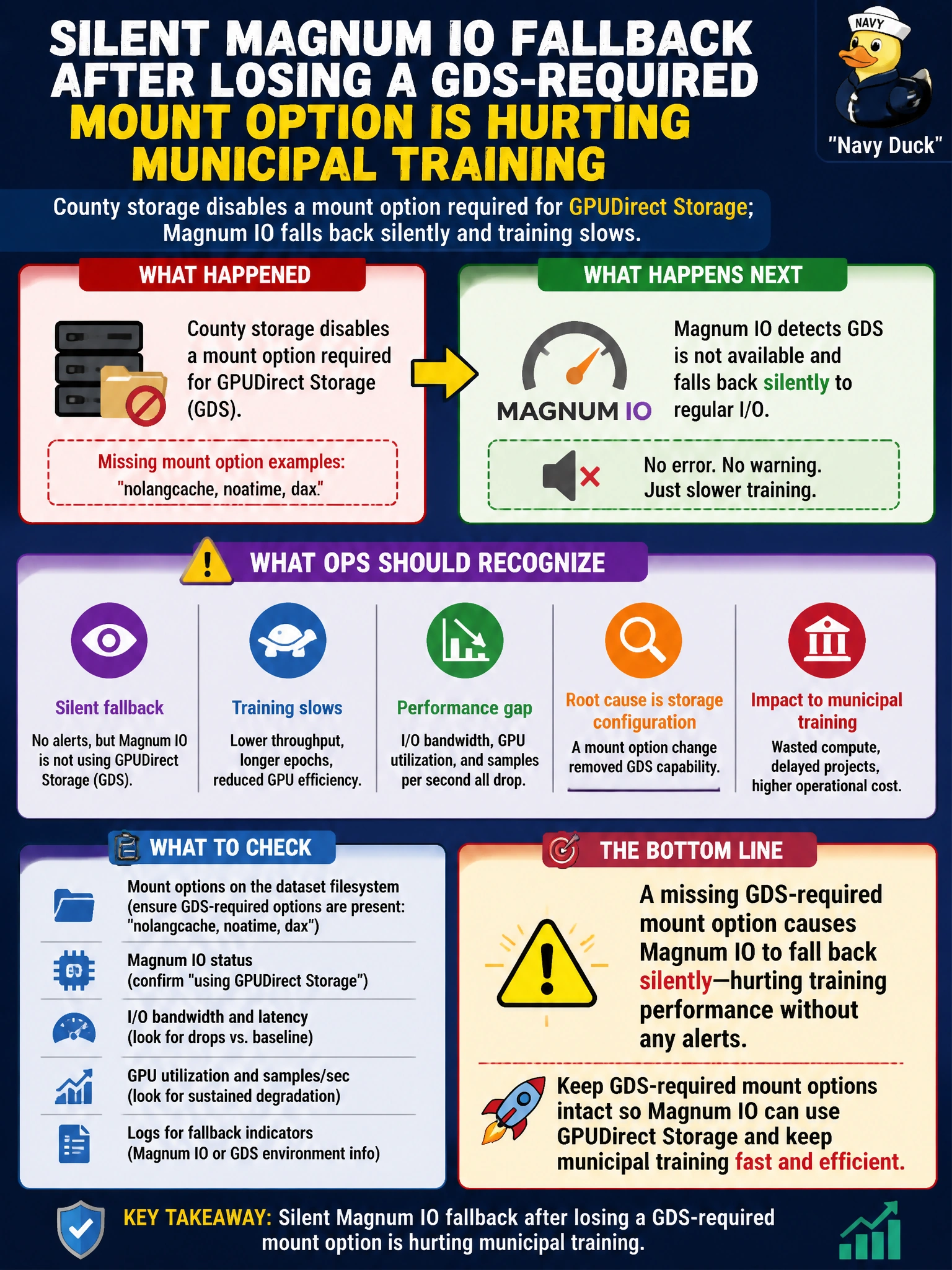
Lose a GDS-required mount option and Magnum IO can quietly walk the slow path—spot that silent fallback when county training crawls. It is not a free speedup, and it is not always an app bug.
Full Explanation
GPUDirect Storage depends on specific storage mount options. When county storage disables a required option, Magnum IO can fall back silently to a slower path and municipal training throughput drops without an obvious hard error. Operators must recognize that silent Magnum IO fallback after losing a GDS-required mount option is hurting training, then restore the mount option or explicitly redesign the IO path—not assume the stack is healthier because it still “works.”
Believing silent fallback always means Magnum IO is faster than before inverts the meaning of fallback: fallback is degradation, not acceleration. Claiming mount options never affect GPUDirect Storage is false; GDS prerequisites commonly include mount and filesystem features that storage teams can change. Blaming training slowdowns solely on application bugs whenever storage mounts change ignores a primary Magnum IO failure mode and wastes developer time.
Exam caveat: silent fallback is a classic Magnum IO/GDS trap—correlate training slowdowns with storage mount change tickets. Prefer explicit GDS health checks over assuming “no error equals full acceleration.” Operational check: compare current county mount options to the GDS-required set, re-enable the missing option in a maintenance window, confirm Magnum IO reports GDS active rather than fallback, and re-run a fixed municipal training job to verify throughput recovery.