
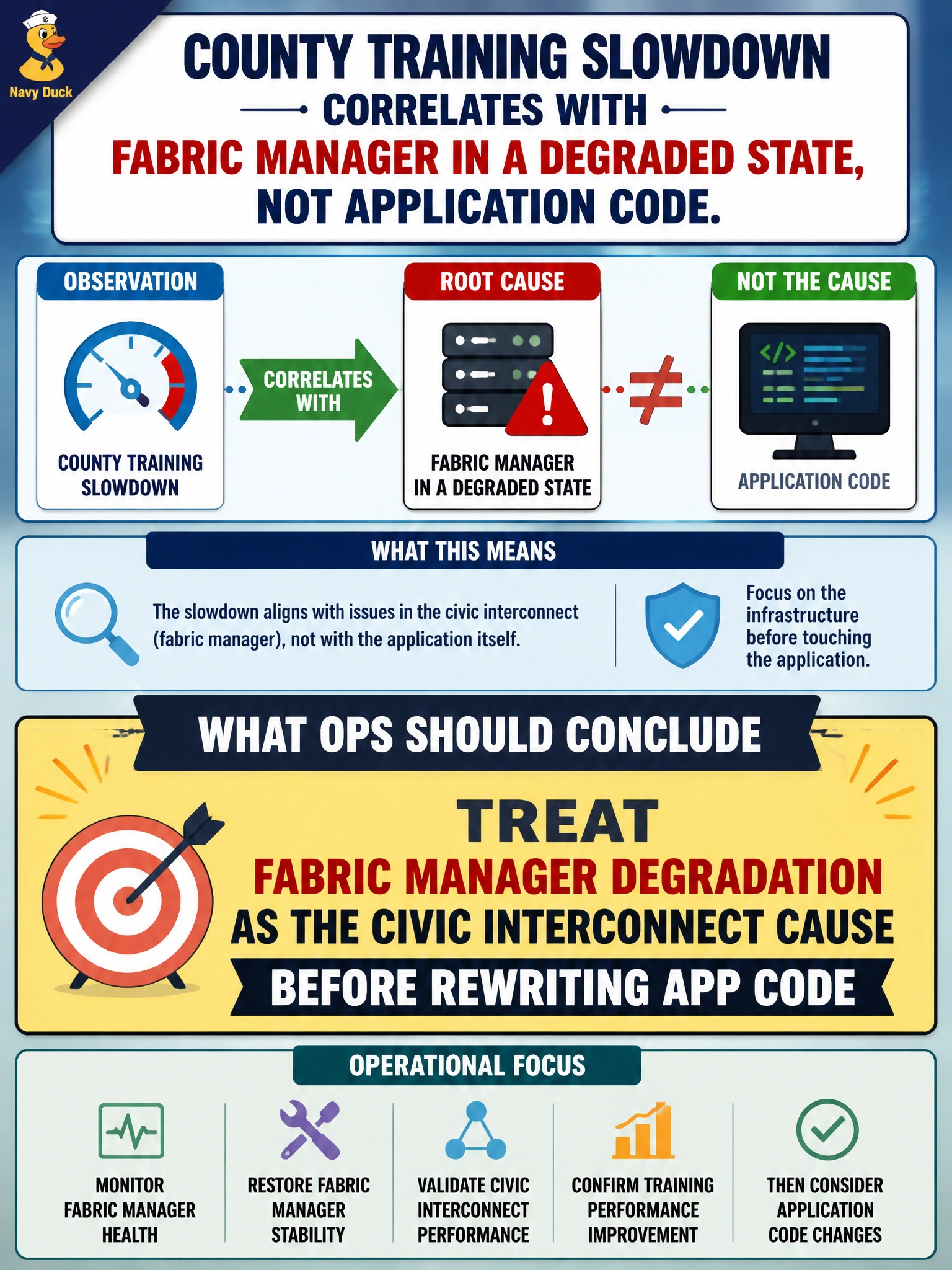
County training slowdown correlates with fabric manager in a degraded state, not application code. What should ops conclude?
Select an answer to reveal the explanation.
Short Explanation
When slowdowns track fabric manager degradation, fix the fabric first—do not rewrite the county app for a sick interconnect. Hiding monitoring just blinds the NOC.
Full Explanation
When county training slowdowns correlate with fabric manager in a degraded state rather than application code, ops should treat fabric manager degradation as the civic interconnect cause before rewriting app code. Degraded fabric reduces effective NVLink/NVSwitch bandwidth or stability, inflating collective times and step latency while the model and hyperparameters remain unchanged. Fixing fabric health restores performance without a costly and misguided application rewrite.
Blaming the application team exclusively and skipping fabric checks fails by concept: it ignores the correlating signal the stem provides and wastes developer cycles. Increasing learning rate to hide interconnect latency fails training science and does not repair bandwidth—it can destabilize convergence. Disabling monitoring so degraded fabric looks healthy fails operations: it removes the evidence path without restoring throughput.
Exam caveat: correlation is not automatic proof, but NCP-AIO expects you to investigate fabric when monitoring points there. Distinguish true application regressions (code/data changes with healthy fabric) from interconnect-induced slowdowns. Partial link-down can look like "the model got slower" after a maintenance window.
Operational check: compare training throughput against fabric manager health timelines, inspect degraded components/links, remediate fabric manager and NVSwitch paths, re-benchmark the same county job hash, and only then open an application defect if slowdowns persist with a fully healthy fabric report.