
Library mistakenly installs fabric manager on non-NVSwitch nodes and creates service noise. What should ops know?
Select an answer to reveal the explanation.
Short Explanation
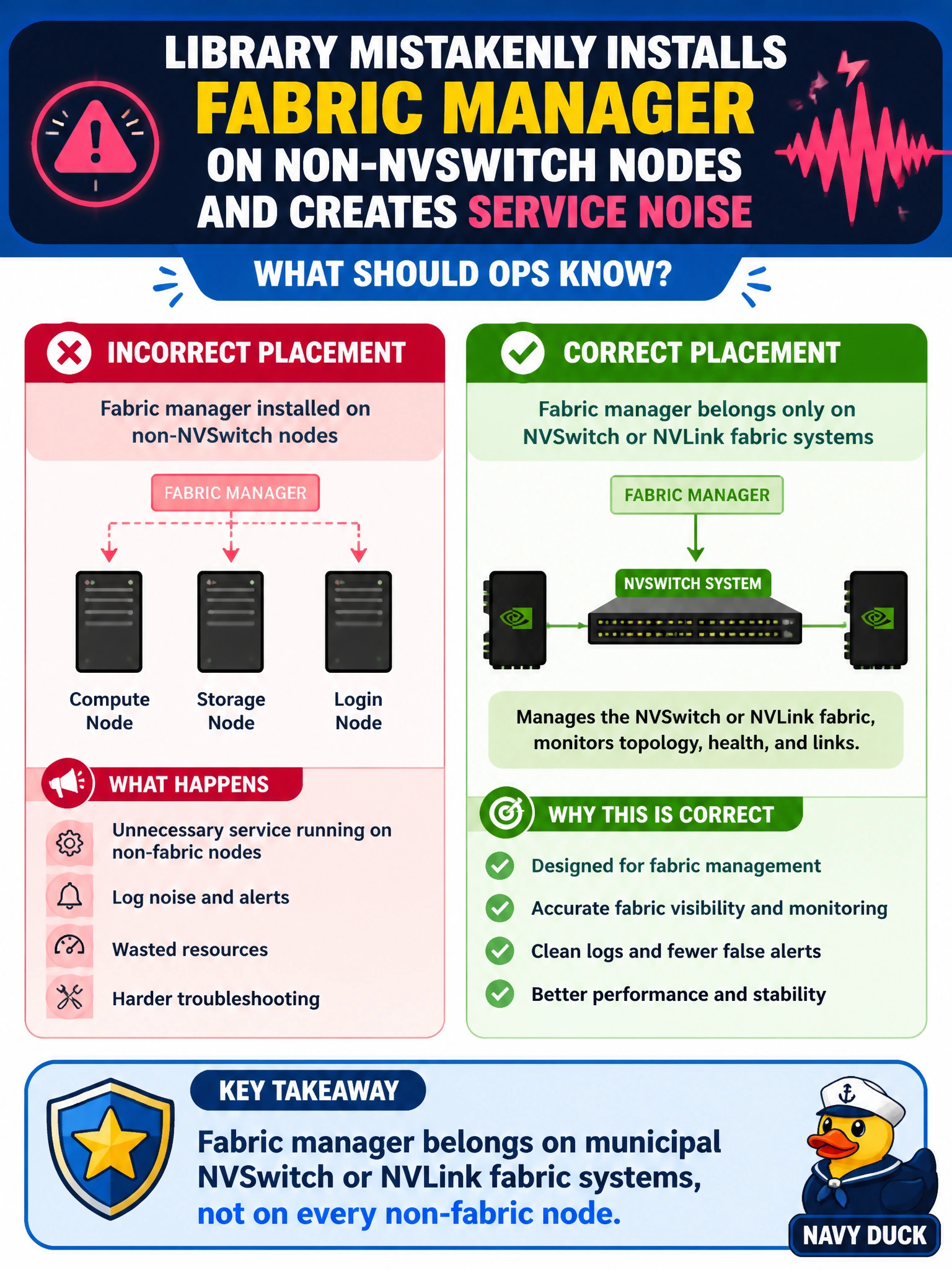
Fabric manager is for NVSwitch/NVLink fabric boxes—not every library PC. Installing it everywhere just fills logs with noise.
Full Explanation
Fabric manager belongs on municipal NVSwitch or NVLink fabric systems, not on every non-fabric node. Installing it on library machines without that topology creates service noise—failed starts, meaningless alerts, and operator fatigue—without enabling any real peer fabric. Correct placement keeps fabric manager where it supervises switches/links and omits it from ordinary single-GPU or non-NVSwitch civic endpoints.
Mandating fabric manager on every civic laptop for GPU presence fails by concept: GPU presence is a driver/toolkit concern; laptops are not NVSwitch racks. Claiming fabric manager replaces nvidia-smi on all CPU-only hosts fails tooling roles—nvidia-smi inventories GPUs; fabric manager manages fabric; CPU-only hosts need neither fabric manager nor GPU inventory lies. Requiring fabric manager on non-NVSwitch nodes before any container starts fails dependency design and blocks unrelated workloads for a service that cannot function there.
Exam caveat: know the product boundary—NVSwitch systems need fabric manager; many municipal GPU nodes do not. Over-installing "because GPUs exist" is a common distractor. Conversely, omitting fabric manager on true NVSwitch dense nodes is equally wrong; match the topology.
Operational check: audit where fabric manager is installed across the library fleet, remove it from non-NVSwitch nodes, silence obsolete alerts, and ensure dense NVSwitch training boxes still have it enabled and monitored. Update the municipal image matrix so roles receive only the services their hardware requires.