
311 Run:ai burst must not starve health training for an entire quarter. What allocation balance fits?
Select an answer to reveal the explanation.
Short Explanation
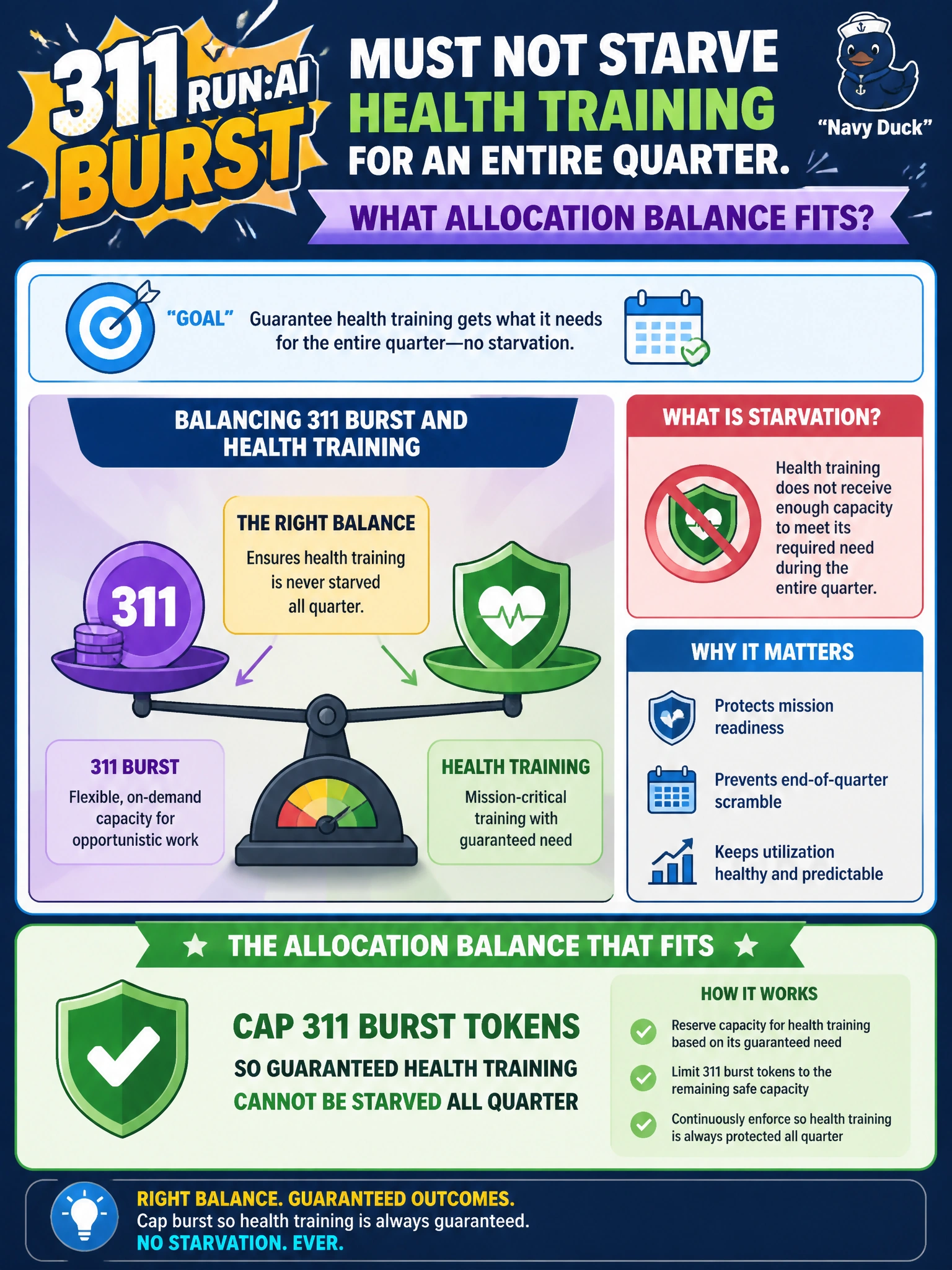
Cap 311 burst so health training keeps a guaranteed lane—storm traffic should not own the freeway all quarter. Unbounded burst and disabling quotas until next fiscal year starve civic partners.
Full Explanation
Capping 311 burst tokens so guaranteed health training cannot be starved all quarter balances burst versus guarantee on Run:ai. Burst lets 311 absorb ticket storms, but unbounded burst can monopolize GPUs and block health training for weeks. Caps and guaranteed allocations preserve health's floor while still allowing 311 limited elasticity.
Allowing unbounded 311 burst that consumes every GPU until health trains never start fails by starvation: burst without a ceiling voids peer guarantees. Removing health project guarantees so only burst traffic matters fails by priority design—guarantees exist specifically for sustained training needs. Disabling Run:ai quotas during ticket storms and restoring them next fiscal year fails by temporal governance: storms are exactly when quotas matter most.
Exam caveat: the right balance depends on policy (how much burst 311 may borrow, and whether health is guaranteed or fairshare-weighted). The exam contrast is capped burst protecting guarantees versus unbounded burst or quota disablement.
Operational check: set 311 burst limits and health guarantees in Run:ai, simulate a ticket-storm burst, confirm 311 can expand only to the cap, and verify health training still obtains GPUs within the quarter rather than remaining pending indefinitely.