
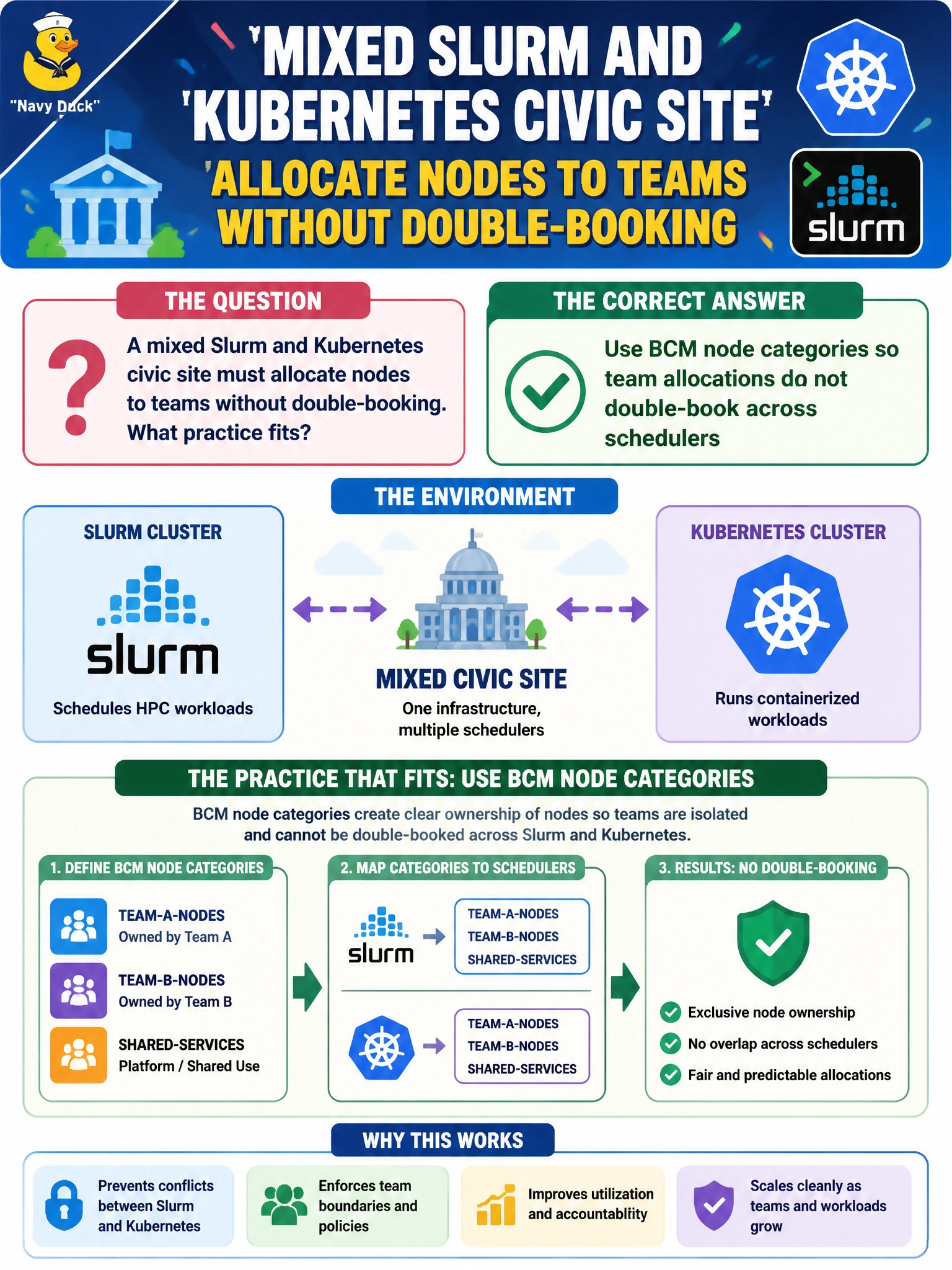
A mixed Slurm and Kubernetes civic site must allocate nodes to teams without double-booking. What practice fits?
Select an answer to reveal the explanation.
Short Explanation
BCM categories are the reserved parking signs—Slurm and K8s teams do not share the same stall. Spreadsheets and dual claims on one node are how double-booking happens.
Full Explanation
Using BCM node categories so team allocations do not double-book across schedulers fits a mixed Slurm and Kubernetes civic site. BCM (Bright Cluster Manager / NVIDIA cluster management) node categories partition hardware into exclusive sets that each scheduler or team may claim. Without category boundaries, Slurm and Kubernetes can both believe they own the same node, producing conflicting drains, unexpected job kills, and capacity double-counting.
Allowing both schedulers to claim the same nodes without category boundaries fails by exclusive ownership: dual control planes on one node is double-booking. Assigning every node to every team simultaneously for maximum apparent capacity fails by fake capacity—apparent sum exceeds real GPUs. Disabling BCM categories and tracking ownership only in an unofficial spreadsheet fails by control-plane integrity: spreadsheets do not prevent scheduler claims.
Exam caveat: categories must be kept in sync with actual scheduler configuration (Slurm partitions, K8s labels/taints, Run:ai node pools). Categories alone do not help if operators manually override and place jobs across boundaries.
Operational check: map team allocations to BCM categories, verify each node appears in only one active scheduler domain, attempt a cross-boundary submit and confirm rejection, and retire spreadsheet-only ownership tracking.