
City NOC suspects ECC errors on a 311 GPU node before escalating a ticket. What first-line check fits?
Select an answer to reveal the explanation.
Short Explanation
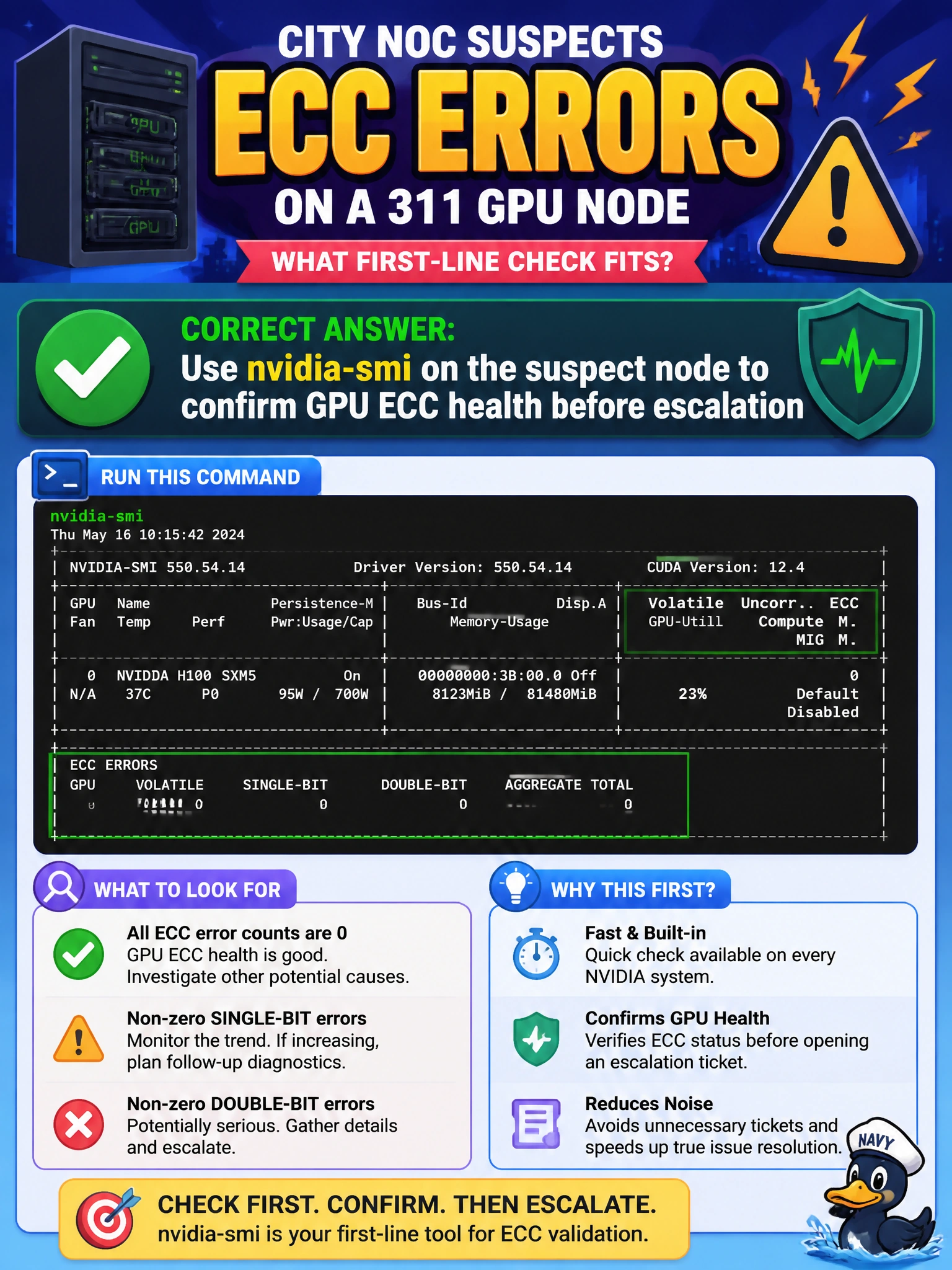
nvidia-smi is the NOC flashlight on a suspect 311 GPU—confirm ECC before the big ticket. Wiping firmware and replacing every switch on a rumor skips evidence.
Full Explanation
Using nvidia-smi on the suspect node to confirm GPU ECC health before escalation is the correct first-line check for a city NOC investigating 311 GPU issues. nvidia-smi exposes ECC error counters, persistence mode, utilization, and related device state on the specific host. Gathering that evidence before opening a large hardware or facilities ticket prevents noisy, unfounded escalations and focuses repair on a verified node.
Wiping entire cluster firmware without GPU evidence fails by change-control and blast-radius concept: firmware mass change is not triage. Replacing every switch in the building based on an ECC rumor fails by fault-domain concept—ECC is a GPU/memory health signal, not automatic proof of campus switching failure. Ignoring hardware health and only restarting 311 application pods fails by layer concept: pod restarts may clear symptoms temporarily while ECC counters continue climbing on bad hardware.
Exam caveat: nvidia-smi is first-line visibility, not the entire diagnostic stack. Persistent ECC growth may still need DCGM, vendor support logs, or RMA—but the exam contrast is evidence on the suspect node versus blind cluster-wide destructive actions.
Operational check: SSH or console to the suspect 311 node, run nvidia-smi (and ECC query options as documented), capture counters in the ticket, correlate with recent jobs, and escalate with node identity and evidence rather than campus-wide firmware or switch replacements.