
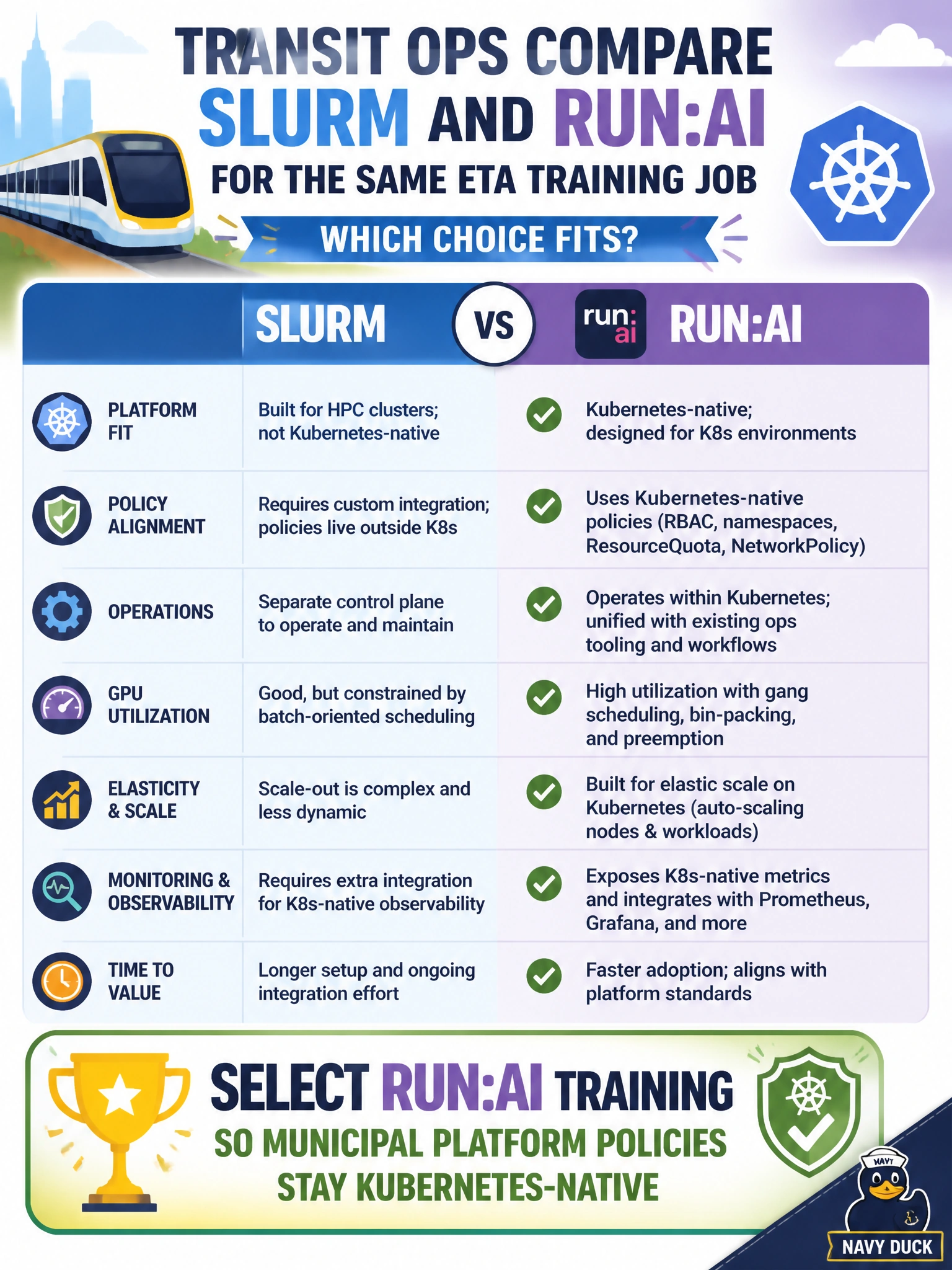
Transit ops compare Slurm and Run:ai for the same ETA training job on a Kubernetes-centric platform. Which choice fits?
Select an answer to reveal the explanation.
Short Explanation
On a K8s-centric transit platform, Run:ai training keeps governance in one policy lane. USB GPUs and nohup on random nodes are how ops nights go long.
Full Explanation
Selecting Run:ai training so municipal platform policies stay Kubernetes-native fits transit ops comparing Slurm and Run:ai for the same ETA job on a Kubernetes-centric platform. When governance, networking, secrets, quotas, and observability already center on Kubernetes, Run:ai training keeps the ETA workload inside that policy plane instead of introducing a parallel non-K8s scheduling island for the same cluster estate.
Always picking Slurm because Kubernetes platforms cannot host any training fails by false dichotomy: Kubernetes-centric stacks routinely host training via operators and platforms such as Run:ai. Training only on USB GPUs unplugged from both schedulers fails by platform integration concept—disconnected devices are not managed municipal capacity. Disabling all schedulers and starting jobs with nohup on random nodes fails by governance and reliability concept: ungoverned processes evade quotas, drain, and audit.
Exam caveat: this item is context-bound to a Kubernetes-centric municipal platform. Elsewhere, Slurm may be the correct primary scheduler; the exam skill is matching the training submit path to the platform's policy center of gravity, not memorizing one forever-winner tool.
Operational check: submit the ETA train through Run:ai into the transit project namespace, verify Kubernetes ResourceQuotas/NetworkPolicies still apply, and confirm the job appears in Run:ai and cluster observability rather than as an unmanaged nohup process.