
A library consortium must train a shared embedding model across two campus GPU sites. What Slurm approach fits?
Select an answer to reveal the explanation.
Short Explanation
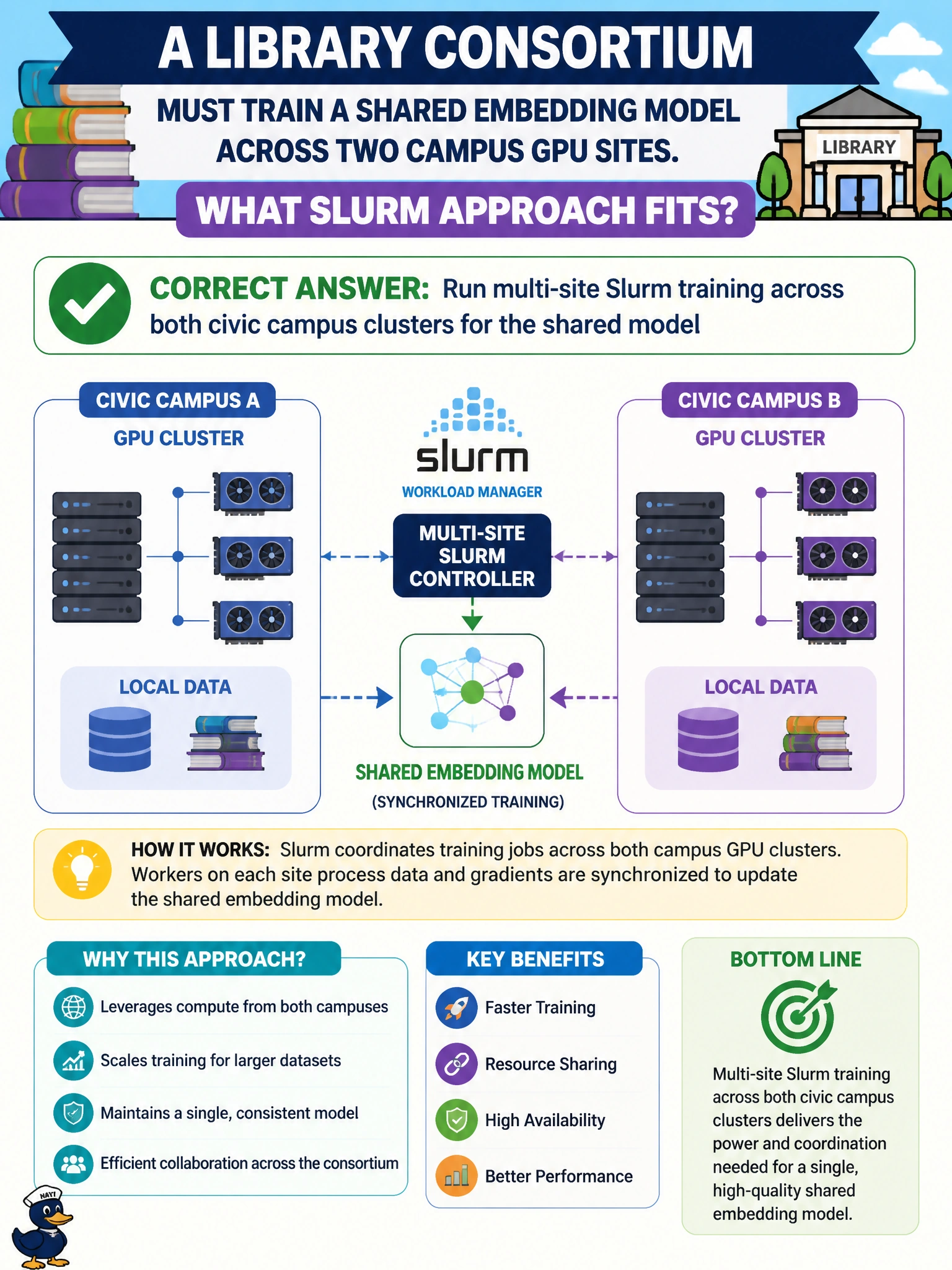
You can use multi-site Slurm to train one shared embedding model across both campus clusters. Training on one branch desktop and emailing weights, requiring each campus to build a separate incompatible model, or carrying GPUs between buildings won’t provide coordinated consortium training.
Full Explanation
Running multi-site Slurm training across both campus GPU sites fits the consortium’s goal: one shared embedding model can use coordinated GPU capacity at both locations as a single training workload. This supports joint training and consistent model development rather than leaving each campus to produce its own result. Training only on one branch desktop and emailing weights fails because a desktop is not the shared cluster workload, and emailing completed weights does not coordinate training across sites. Keeping jobs confined to each campus and requiring separate, incompatible models fails the shared-model objective by splitting the consortium’s work into independent results. Copying GPUs between buildings by hand for every epoch fails as a hardware-logistics approach: moving equipment is not a practical way to provide coordinated compute and interrupts its availability. Exam caveat: multi-site training does not guarantee good performance without attention to inter-site bandwidth, data staging, and security boundaries; a congested link can limit training. Practical check: verify that the consortium job can use GPU resources at both sites, that required data and credentials are available at each, and that measured GPU utilization shows no severe interconnect stalls.