
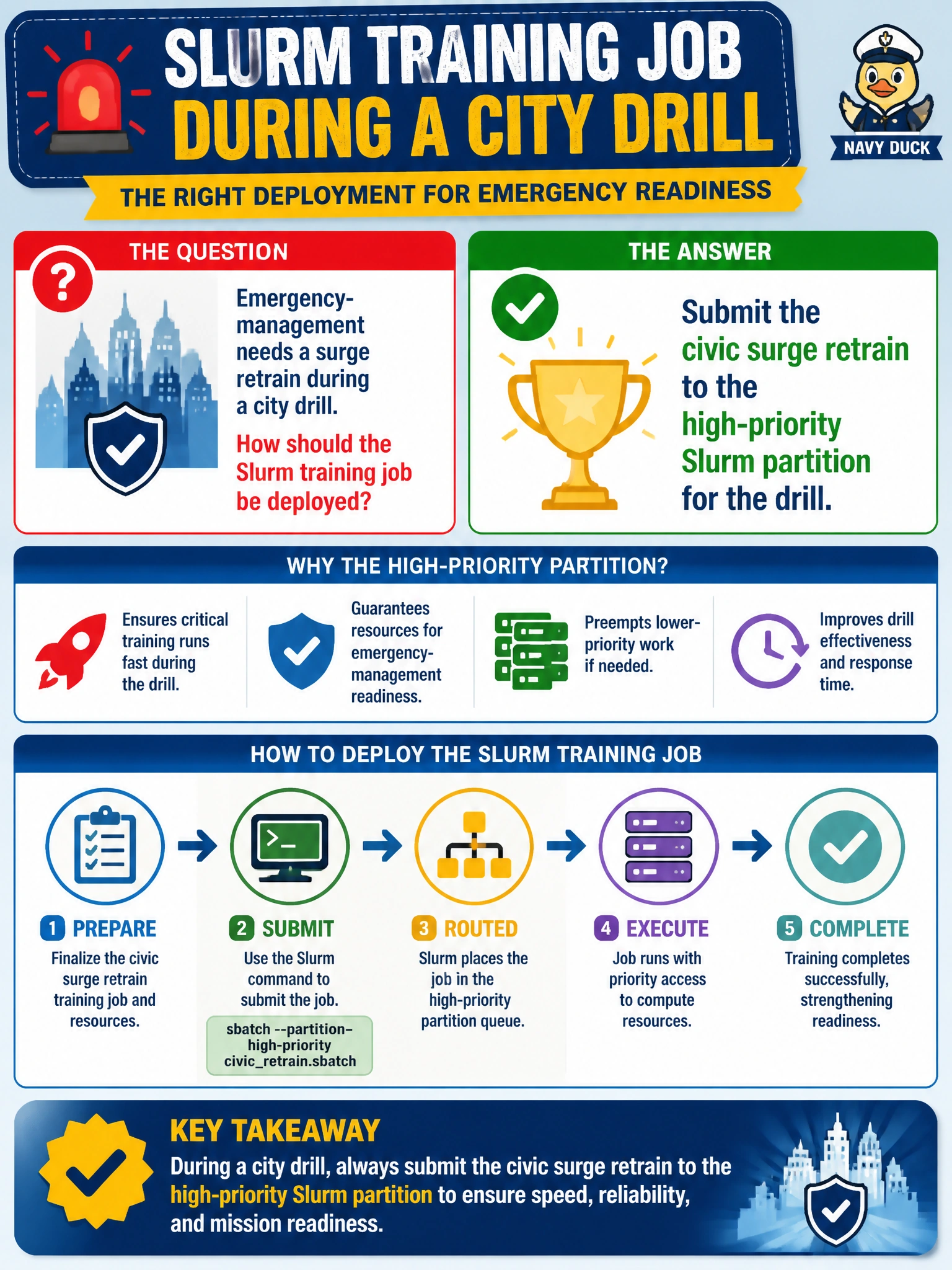
Emergency-management needs a surge retrain during a city drill. How should the Slurm training job be deployed?
Select an answer to reveal the explanation.
Short Explanation
Drill day needs the high-priority Slurm lane—emergency retrains get the expressway, not the volunteer-laptop backroad. Permanent cancel-everything is panic, not ops.
Full Explanation
Submitting the civic surge retrain to the high-priority Slurm partition fits emergency-management drill needs because Slurm priority and partition policy are how municipal clusters express operational urgency. During a city drill, the surge job must schedule ahead of routine batch work so models refresh before exercise injects arrive. A dedicated high-priority partition (or elevated QoS mapped to that partition) gives operators a governed lane without inventing ad-hoc overrides on every node.
Submitting only to the lowest-priority idle queue fails by priority concept: idle backfill is for opportunistic work, not time-bounded emergency readiness. Running the retrain solely on a volunteer laptop disconnected from the cluster fails by platform and reproducibility concept—no shared GPUs, no audit trail, no municipal data controls, and no ability to scale. Canceling every other civic job permanently so one train owns the campus fails by fairness and blast-radius concept: drills need temporary priority, not irreversible eviction of all peer workloads.
Exam caveat: high-priority submission does not mean unlimited preemption forever or deleting other departments' accounts. Exam items often contrast temporary surge priority with permanent exclusive capture; pick the scheduler control that elevates the drill job within policy, not chaos.
Operational check: verify the emergency partition or QoS accepts the job, confirm pending→running transition during the drill window, and ensure post-drill priority or reservations revert so routine civic training returns to normal fairshare.