
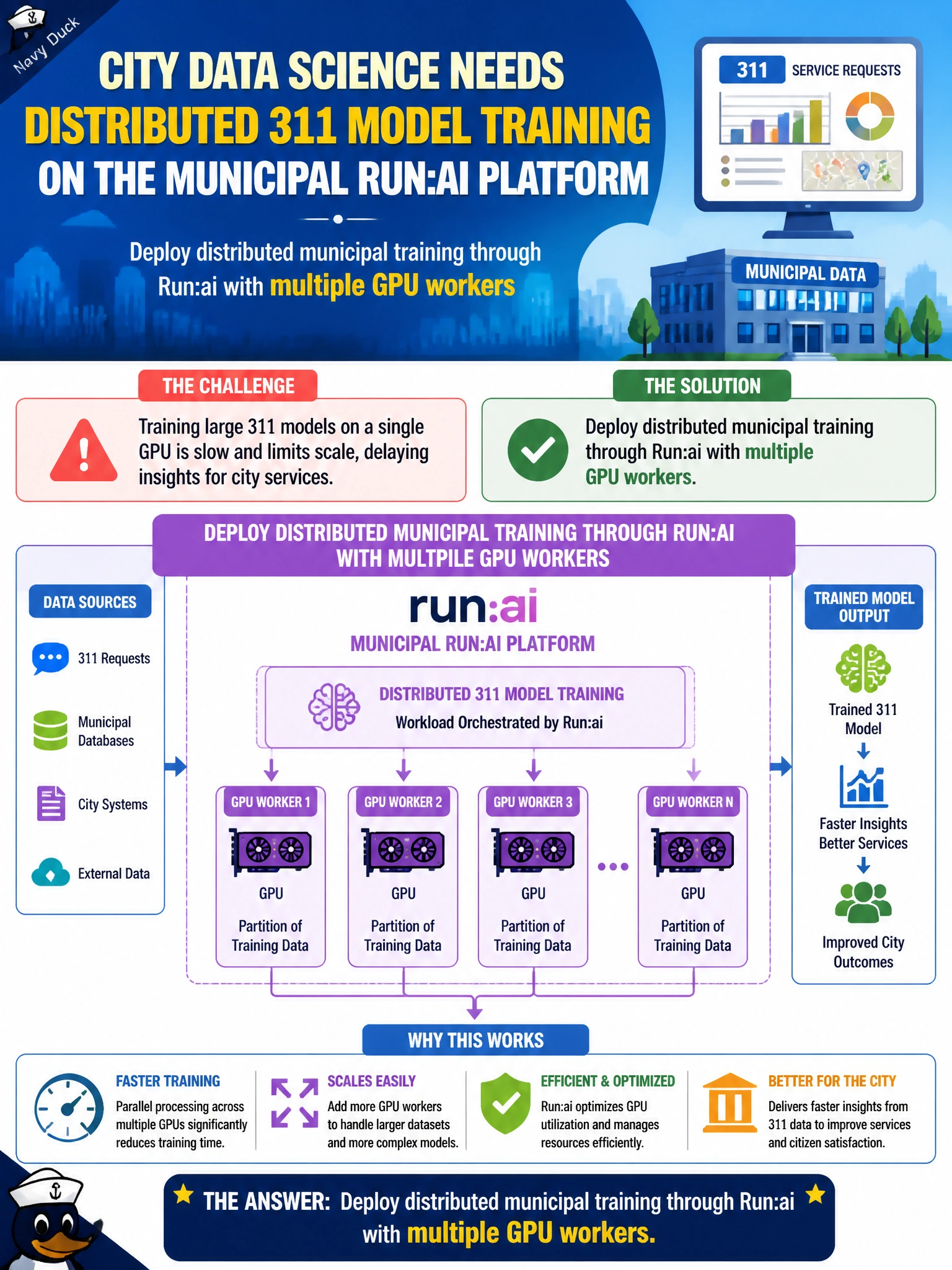
City data science needs distributed 311 model training on the municipal Run:ai platform. How should the workload be deployed?
Select an answer to reveal the explanation.
Short Explanation
Distributed 311 trains need Run:ai with multiple GPU workers—many hands on the ticket pile. Solo CPU loops and bypassing project quotas dump civic governance.
Full Explanation
Deploying distributed municipal training through Run:ai with multiple GPU workers is the right pattern for city data science 311 model training because Run:ai exists to schedule, quota, and orchestrate multi-GPU workloads on the shared civic platform. Distributed training needs multiple workers (or a multi-GPU job shape) under a project so gradients and data parallelism scale while remaining visible to operators and constrained by project policy.
Training only with a single CPU process and ignoring GPU workers fails by accelerator concept: CPU-only loops do not use the municipal GPU investment and will not meet distributed training throughput goals. Ungoverned docker run commands that bypass Run:ai project quotas fail by governance concept—sidecar or host docker escapes defeat fair share, audit, and quota enforcement. Hard-coding every worker to the same overloaded GPU and disabling distribution fails by parallelism concept: collapsing workers onto one device recreates contention and removes the benefit of distributed training.
Exam caveat: "distributed through Run:ai" means submitting a governed multi-worker training workload, not that every toy notebook must be multi-node. Small experiments may still use fewer GPUs, but the scenario asks how to deploy distributed 311 training on the municipal Run:ai platform—so the platform path with multiple GPU workers is required.
Operational check: submit under the correct Run:ai project, confirm the job requests multiple GPUs/workers within quota, watch workers become Running together, and verify training logs show distributed initialization rather than a lone CPU process or host docker bypass.