
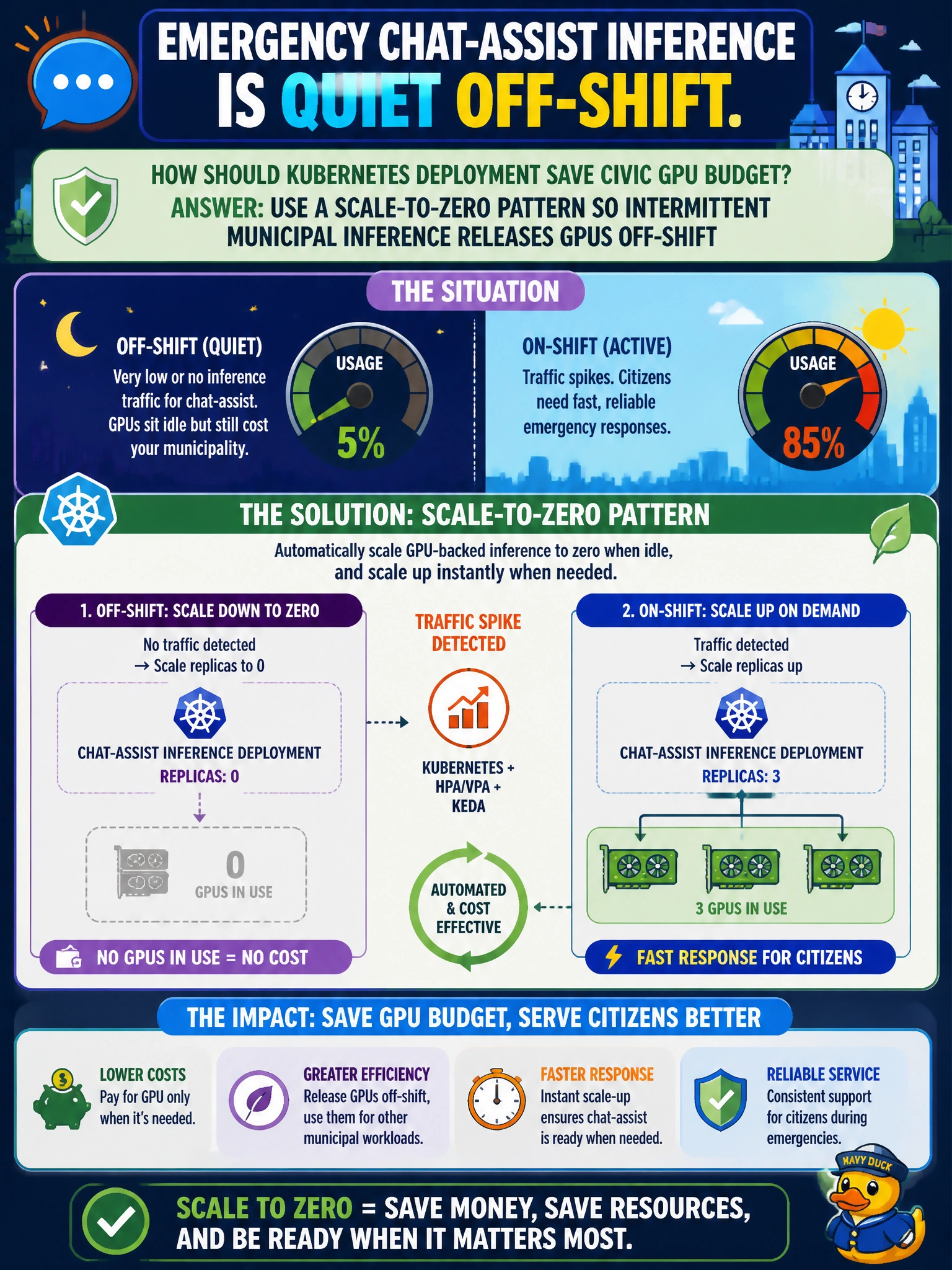
Emergency chat-assist inference is quiet off-shift. How should Kubernetes deployment save civic GPU budget?
Select an answer to reveal the explanation.
Short Explanation
When your night desk is quiet, scale chat-assist to zero and free the GPUs—like turning off unused lobby lights. Scale-to-zero helps you avoid burning civic budget on peak replicas or idle GPUs when the queue is empty.
Full Explanation
Use a scale-to-zero pattern for emergency chat-assist inference that is quiet off-shift, so intermittent municipal demand releases GPUs when the queue is empty. Knative, KEDA, or an equivalent autoscaler can reduce Deployment replicas to zero after idle, then cold-start on the next request or keep a minimal warm pool if the SLO requires it. This converts idle GPU burn into budget other civic workloads can use. Keeping maximum replicas running 24/7 with an empty queue wastes capacity; buying additional idle GPUs exclusively for off-shift decoration spends capital on unused silicon; disabling autoscaling and freezing replica counts at peak levels locks in high cost with no elasticity. Exam caveat: pure scale-to-zero adds cold-start latency from image pull, model load, and GPU attach. For true emergencies, define a warm-pool minimum during declared incidents or use predictive schedule-based floors for known busy windows. Ensure PDB and disruption settings do not fight scale-to-zero, and monitor the first-request path. Practical check: idle the service past the scale-down threshold and confirm GPU resources are freed for other namespaces; send a probe request, measure time-to-first-token against the civic SLO, and document when operators should raise minReplicas during incidents.