
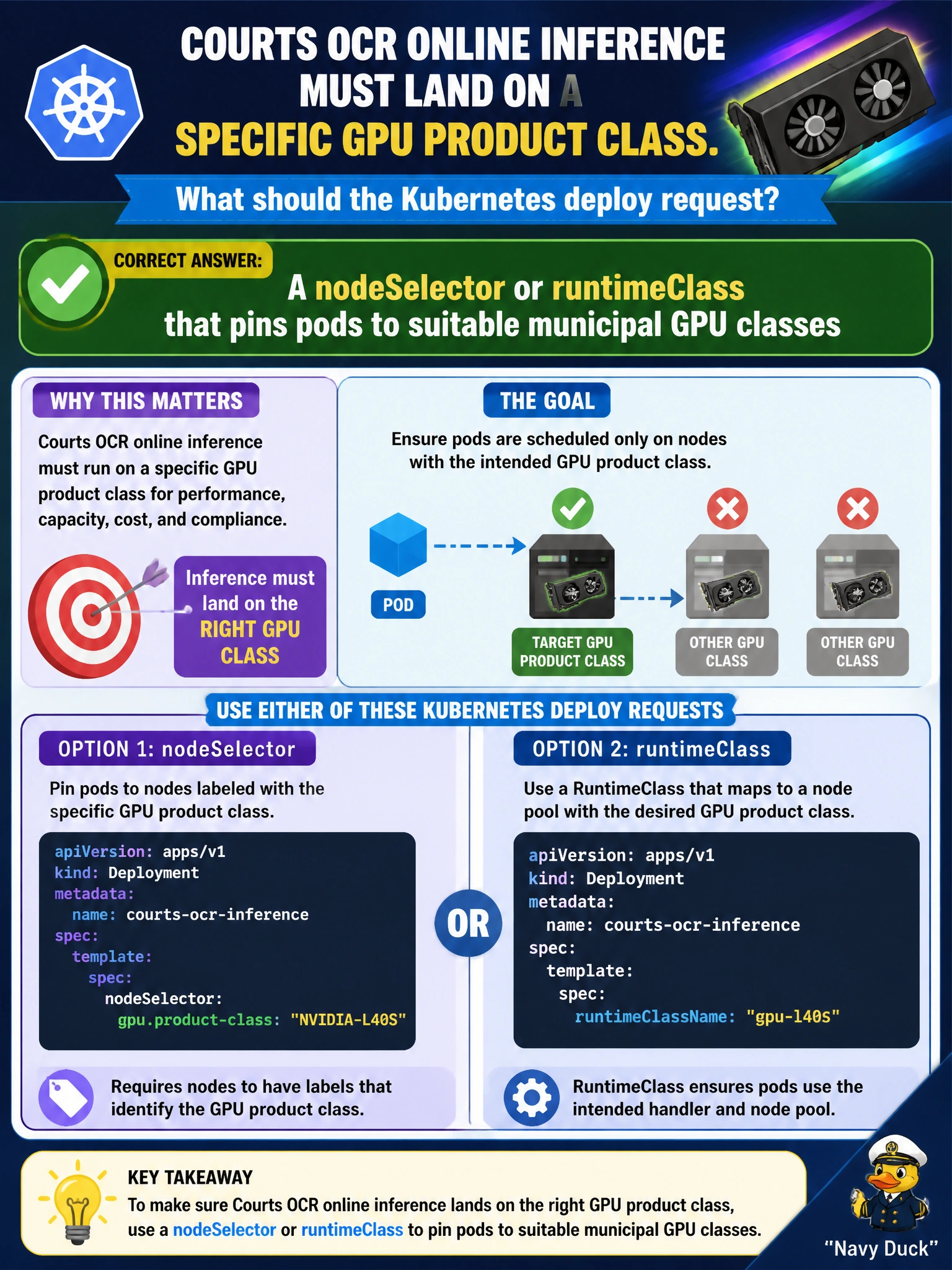
Courts OCR online inference must land on a specific GPU product class. What should the Kubernetes deploy request?
Select an answer to reveal the explanation.
Short Explanation
Pin OCR pods to the right GPU class with nodeSelector or runtimeClass—like sending evidence scans to the imaging lab, not the mailroom. CPU printer nodes and unconstrained community hosts will not meet courts latency needs.
Full Explanation
Courts OCR online inference must request placement onto a suitable municipal GPU product class via nodeSelector, nodeAffinity, or an appropriate RuntimeClass (and matching GPU resource requests). Those controls bind pods only to nodes labeled for the required accelerator SKU/driver stack so evidence scanning lands on hardware that meets throughput and driver compatibility—not on random CPU print servers.
Scheduling onto any CPU node labeled for printers and scanners only ignores accelerator needs and will fail OCR SLAs or fail admission if GPUs are required. Random community nodes with no accelerator constraints invite pending pods or silent CPU fallback. Privileged hostNetwork pods with no GPU resource requests increase blast radius and still do not reserve a GPU through the device plugin.
Exam caveat: nodeSelector is simple but rigid; affinity/anti-affinity and taints/tolerations often scale better across pools. RuntimeClass may select a container runtime/handler for GPU (e.g., NVIDIA) but still needs resource requests for scheduling. Privileged mode is not a substitute for proper device plugin allocation.
Operational check: label GPU classes clearly, deploy OCR with the matching selector/RuntimeClass and nvidia.com/gpu (or MIG) request, and confirm kubectl get pod -o wide lands on the intended nodes with devices allocated. Reject privilege escalation in admission policy for this workload.