
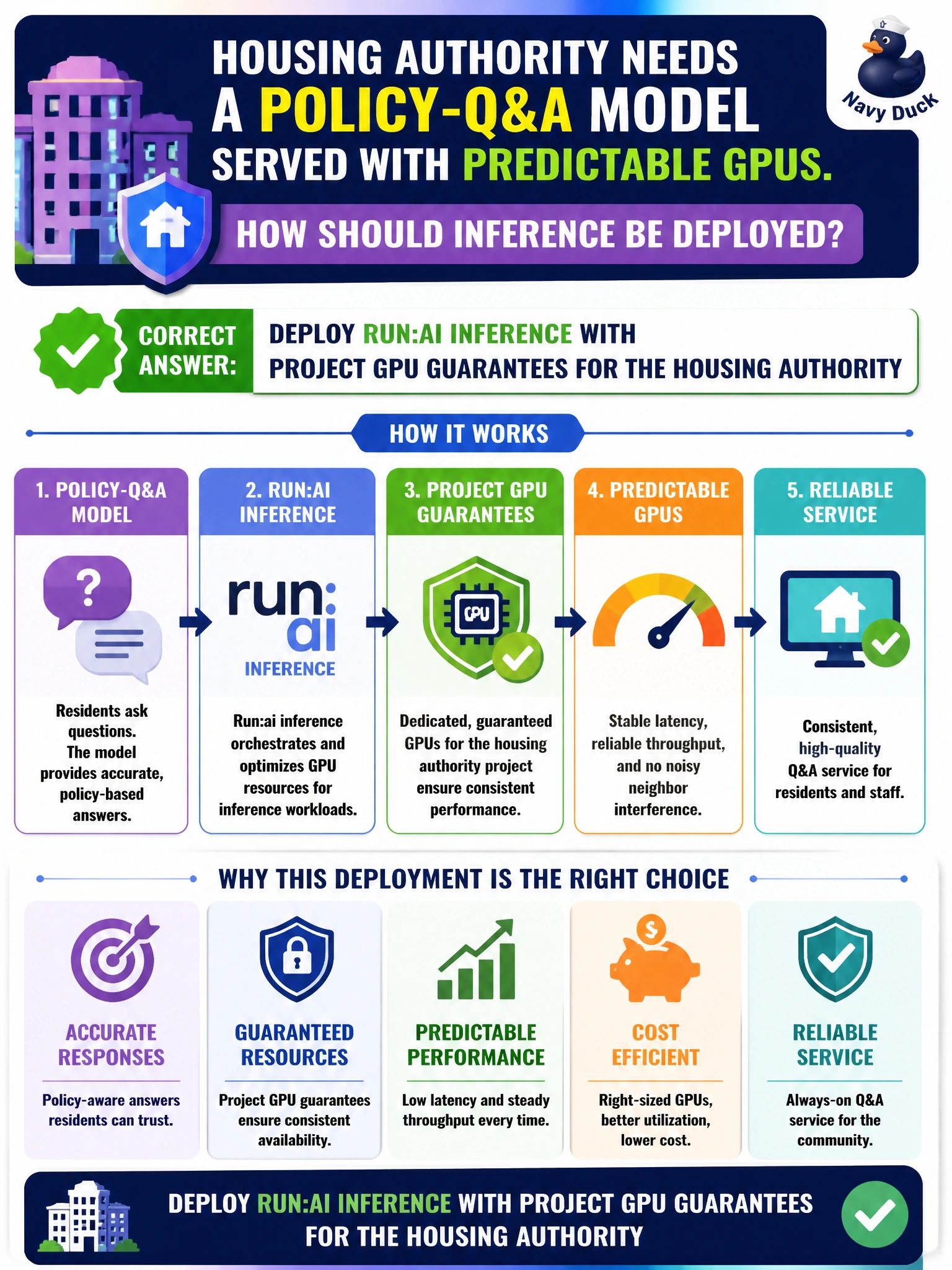
Housing authority needs a policy-Q&A model served with predictable GPUs. How should inference be deployed?
Select an answer to reveal the explanation.
Short Explanation
Run:ai project GPU guarantees are reserved seats for housing Q&A—capacity you can count on. Intern laptops and quota-free scrapes are not how civic serving stays predictable.
Full Explanation
Deploy Run:ai inference with project GPU guarantees so the housing authority's policy-Q&A model gets predictable accelerator capacity. Run:ai projects bind workloads to quotas/guarantees/fairshare; guarantees reserve GPUs the housing project can count on even when the shared municipal cluster is busy. That is how serving stays responsive for caseworkers instead of competing ad hoc for leftover devices.
Running the model only on an unpaid intern laptop outside the cluster voids HA, auditability, patching, and GPU guarantees. Submitting inference as best-effort CPU Jobs with no project binding neither uses accelerators nor participates in Run:ai governance. Bypassing Run:ai to scrape GPUs from other departments without quotas breaks chargeback and starves peers.
Exam caveat: a guarantee is not infinite—size it to measured QPS and model footprint, and distinguish guarantee vs. burst quota. Inference still needs readiness probes, autoscaling policy, and network controls; Run:ai schedules capacity but does not replace application SLOs. Align project membership with least-privilege IdP groups.
Operational check: submit the housing inference workload under the correct project, verify scheduled GPUs match the guarantee under contention from another project, and review the Run:ai dashboard for preempted/pending jobs. Confirm latency holds during a simulated neighbor spike.