
School-district teaching labs keep crashing production district models. What architecture control helps?
Select an answer to reveal the explanation.
Short Explanation
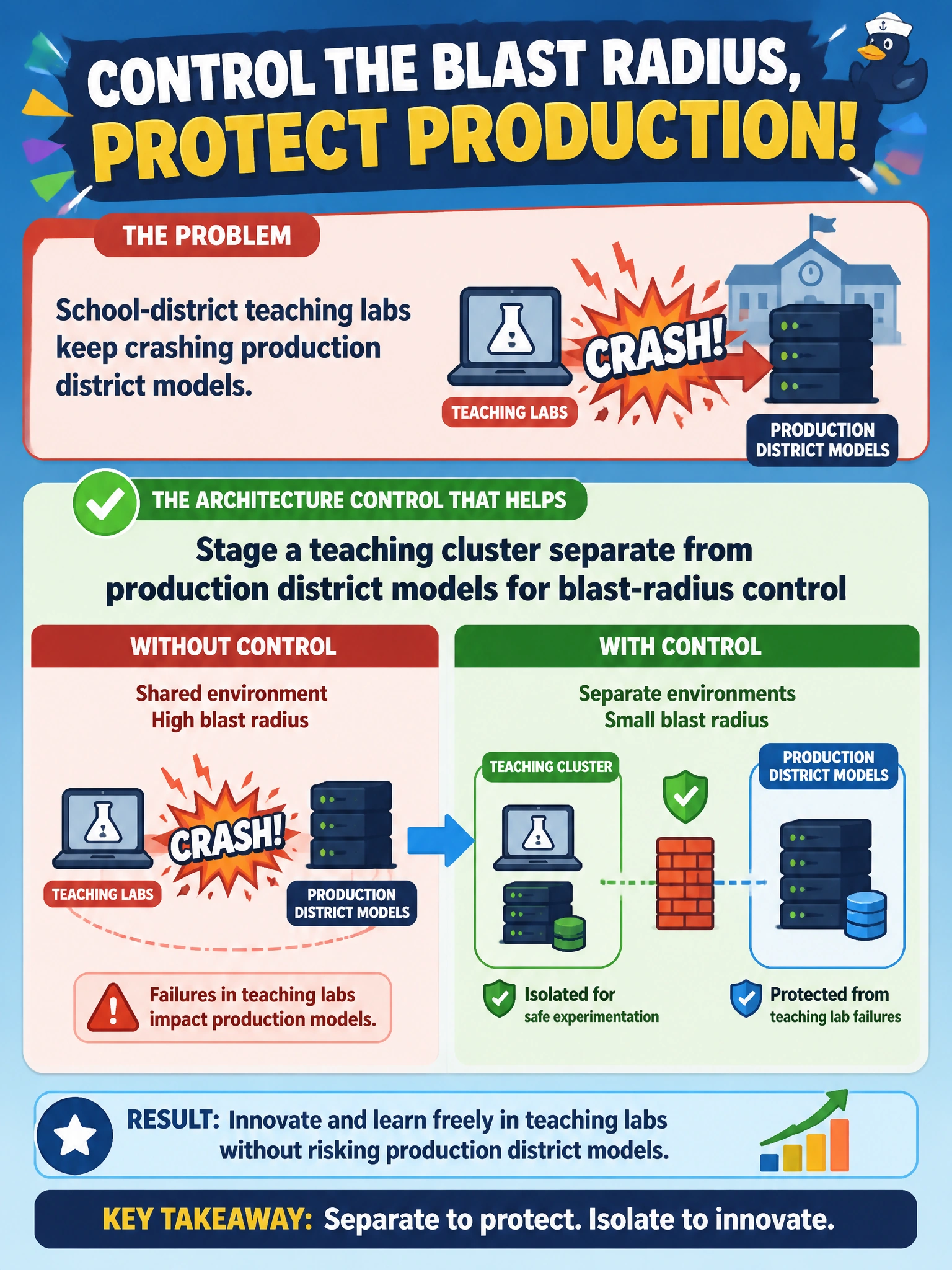
Keep the teaching sandbox away from production district models—smaller blast radius when labs go sideways. Merging pools or handing students prod admin is how outages spread. Hiding monitoring makes it worse.
Full Explanation
School-district teaching labs are noisy, experimental, and frequently misconfigured; production district models need protection. Staging a teaching cluster (or hard-separated pool) apart from production district models limits blast radius so student crashes, bad kernels, or runaway jobs cannot take down civic production inference/training. Separation is the architectural control. Merging teaching and production onto one unprotected GPU pool lets lab faults become district outages. Giving students admin rights on production district model nodes maximizes privilege abuse and accidental damage. Disabling all monitoring so crashes are harder to notice removes detection without reducing failure likelihood. Exam caveat: 'separate' can be distinct clusters or strongly isolated namespaces/node pools with separate credentials—token sharing between teaching and production re-creates the merged blast radius. Operational check: attempt a destructive teaching-lab action and confirm production district model endpoints and node pools remain untouched; verify students lack prod admin roles and monitoring still alerts on both environments. Teaching clusters should use separate registries, secrets, and network policies so a malicious or broken student container cannot reach production district model endpoints even if someone mis-tags a GPU pool. Blast-radius control is incomplete without credential and registry separation alongside compute separation for school-district AI.