
Courts OCR GPU row lost power in a prior UPS event. What architecture improvement fits?
Select an answer to reveal the explanation.
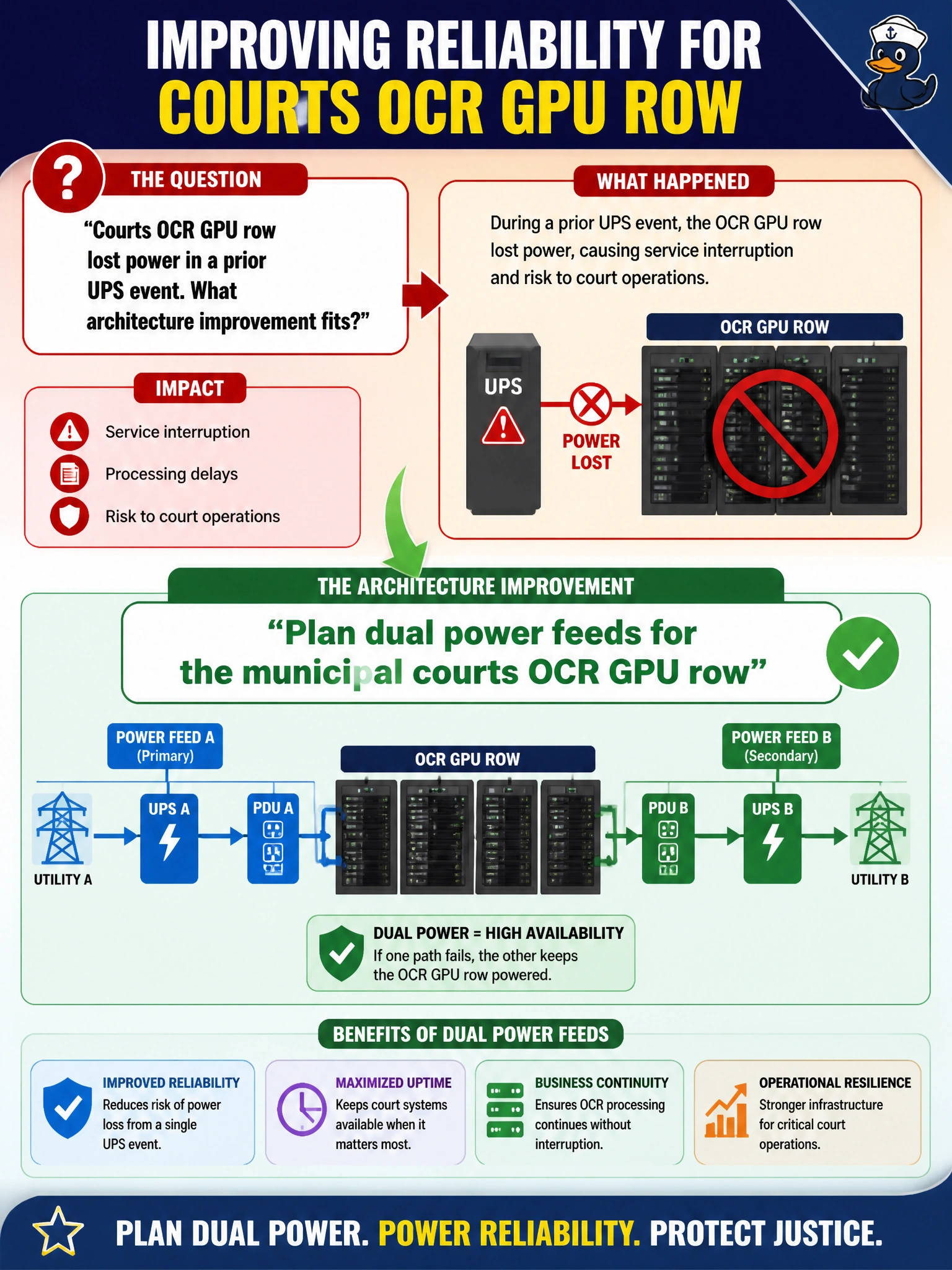
Short Explanation
You can protect the municipal courts OCR GPU row with dual power feeds after its prior UPS-related outage. A single feed leaves you exposed to a repeat, while battery-only desk UPSes and storm-forecast shutdowns do not improve facility power architecture.
Full Explanation
After the municipal courts OCR GPU row lost power in a prior UPS event, you should plan dual A/B power feeds so a single PDU, UPS, or feed failure does not darken OCR capacity again. Redundant power paths are the facility-level improvement that matches the incident history. Relying on a single power feed with no redundancy repeats the known failure mode. Moving OCR GPUs onto battery-only desk UPSes under benches lacks the runtime, monitoring, and data-center grounding needed for sustained court workloads. Disabling OCR overnight whenever storms are forecast is an operational workaround that drops service rather than fixing power architecture. Exam caveat: dual feeds require dual-corded gear or an ATS design and balanced loads; two cords plugged into the same UPS still share a failure domain. Practical check: validate that the A and B feeds land on independent UPS/PDU paths for the courts OCR row, test failover where safe, and confirm OCR nodes stay up through a simulated single-feed loss window. Courts OCR rows often have tight case-processing SLAs, so after a UPS event, also confirm generator transfer, rack ATS behavior, and monitoring that pages facilities when a feed drops—not only when nodes disappear from the scheduler. Dual feeds and observable power telemetry turn a prior outage into a hardened municipal design rather than tribal knowledge.