
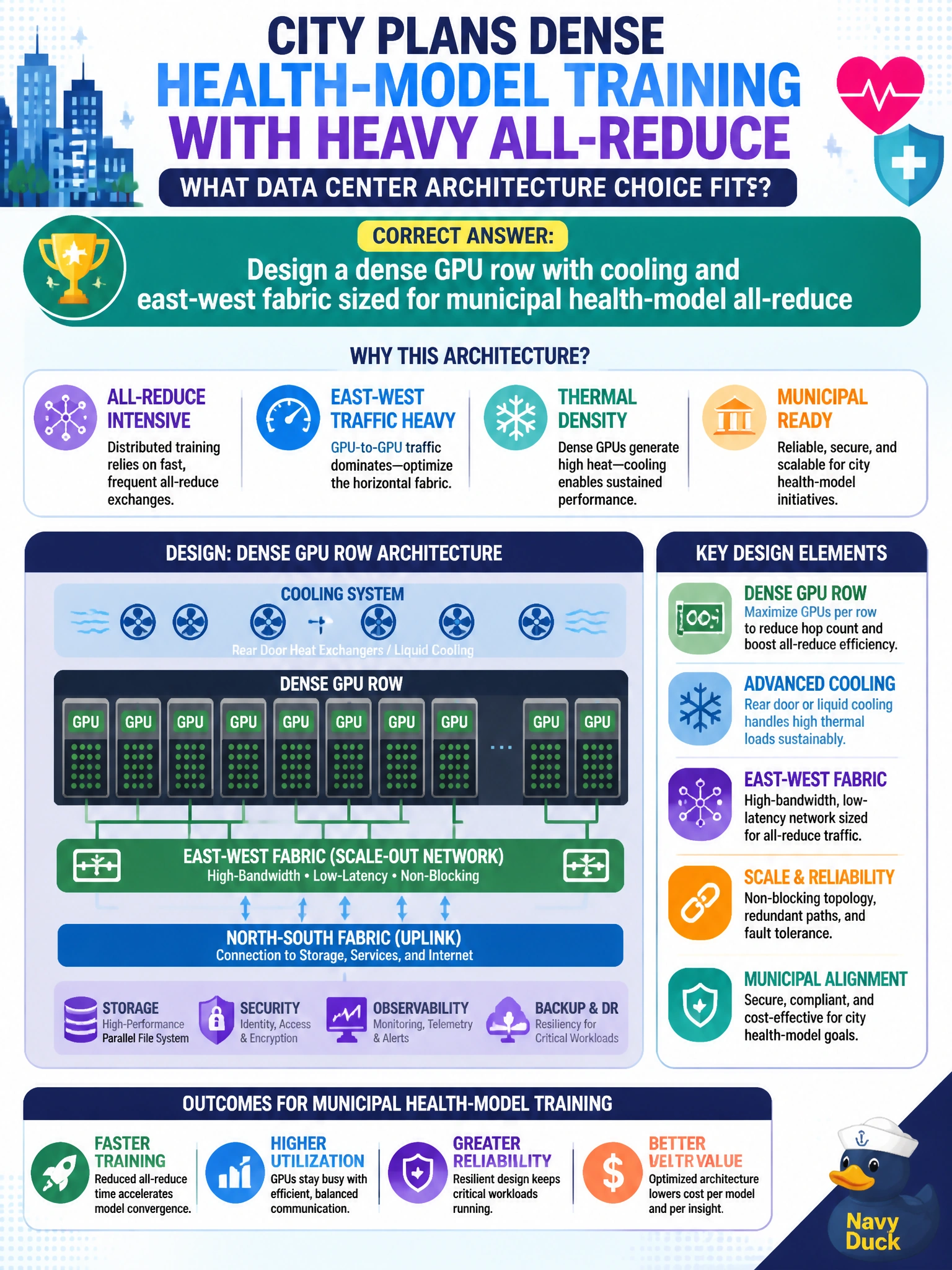
City plans dense health-model training with heavy all-reduce. What data center architecture choice fits?
Select an answer to reveal the explanation.
Short Explanation
Dense health training wants a proper GPU row—cooling and a fat east-west fabric, not GPUs stuffed in random closets. Conference-room Wi-Fi laptops and starving interconnect are how all-reduce crawls.
Full Explanation
Dense municipal health-model training with heavy all-reduce needs a data-center row designed for GPU density: adequate power and cooling (often liquid-assisted), and an east-west fabric (IB/RoCE/NVLink domains as appropriate) sized so gradients and collectives do not stall. Architecture that places GPUs together with fabric and thermal headroom is what makes civic health training finish in useful time windows. Scattering single GPUs across distant closet racks with no fabric plan maximizes hop count and variance, so all-reduce becomes the bottleneck. Hosting training solely on Wi-Fi laptops in conference rooms cannot deliver cluster-scale bandwidth, security, or cooling. Removing liquid cooling and under-sizing interconnect to cut costs first saves CapEx while guaranteeing thermal throttling and slow collectives—false economy for dense health workloads. Exam caveat: 'dense row' does not mean ignoring failure domains; still plan redundant power/cooling and avoid a single ToR as a silent SPOF for the entire health training pod. Operational check: validate rack PDU and cooling capacity against the planned GPU TDP, measure east-west bandwidth/latency between training nodes, and run a short all-reduce microbenchmark before committing the full municipal health job.