
311 inference wants many smaller nodes; overnight training wants dense NVLink domains. What should architecture reflect?
Select an answer to reveal the explanation.
Short Explanation
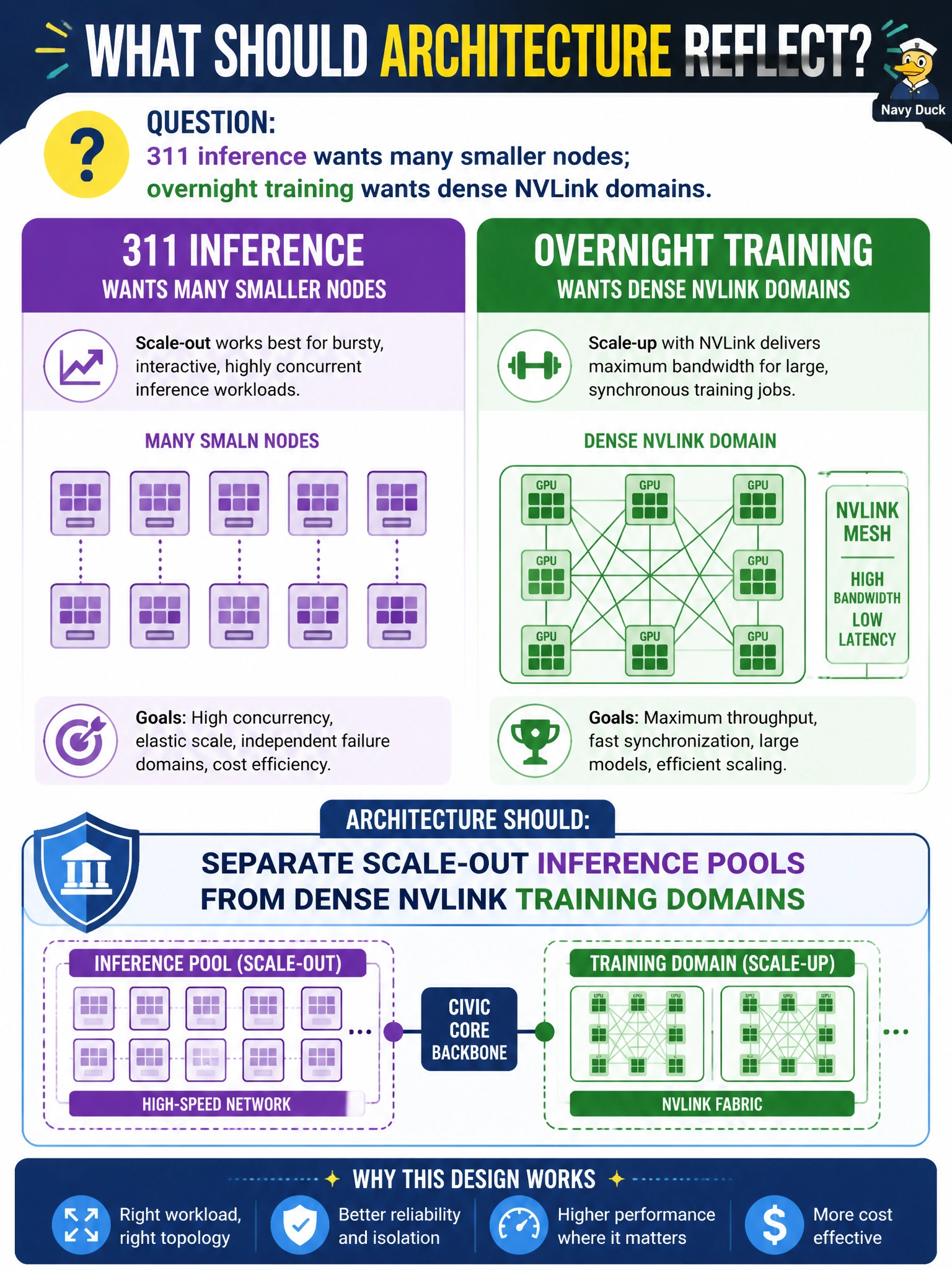
You match the hardware to the job: scale-out nodes suit 311 inference, while dense NVLink domains suit overnight training. A single host configuration, consumer desktops, or CPU-only training misses those workload needs.
Full Explanation
311 inference typically benefits from many smaller scale-out nodes for concurrency and isolation, while overnight training benefits from dense NVLink domains for fast multi-GPU collectives. Separating scale-out inference pools from dense training domains lets each workload use hardware suited to its communication pattern rather than forcing one compromised configuration across civic services. Standardizing every municipal workload on one host configuration can waste NVLink capacity on chatty, smaller inference workloads or leave training starved when it is spread across weakly coupled boxes. Consumer desktops lack the data-center networking, management, and reliability needed for these civic roles. Disabling GPUs for 311 and training only on CPUs overnight gives up accelerator value and will usually miss latency and throughput service-level objectives. Exam caveat: separate pools can be logical pools within one cluster or distinct rows; the key is placement policy, not unmanaged shadow IT. Practical check: tag or pool nodes by dense NVLink versus scale-out capability, submit a 311 inference deployment and an overnight training job, and verify that each lands in the matching domain with the expected GPU topology.