
Public-health PHI training must not share Slurm QoS with open research. What should civic admins configure?
Select an answer to reveal the explanation.
Short Explanation
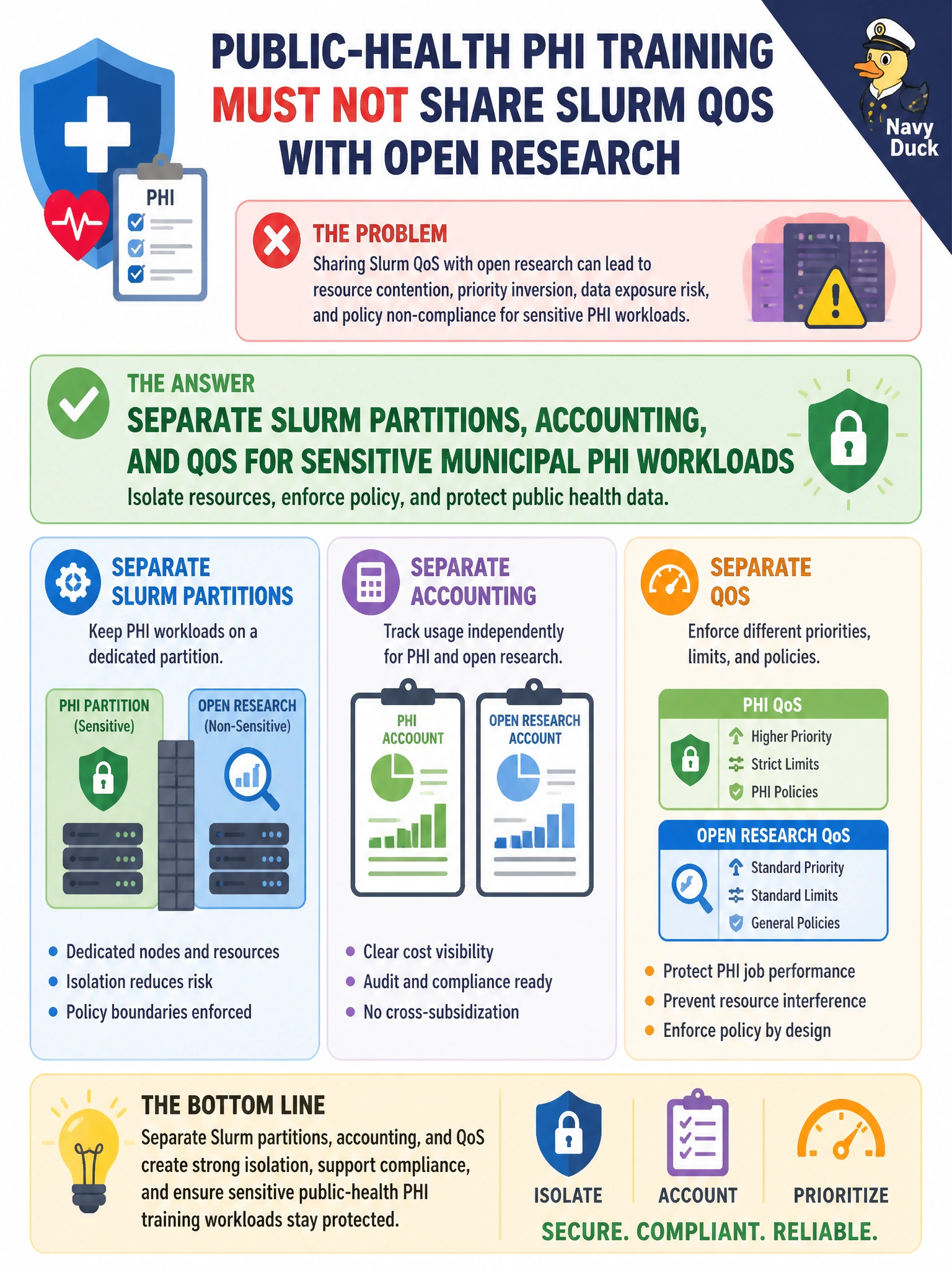
You should give sensitive municipal PHI workloads separate Slurm partitions, accounting, and QoS, so their scheduling and usage stay distinct from open research. That separation is a safer fit than one shared partition and QoS, root-run PHI jobs on login nodes, or PHI datasets in every student’s home directory.
Full Explanation
Separate Slurm partitions, accounting, and QoS for sensitive municipal PHI workloads keep public-health training from sharing scheduling policy with open research. Distinct partitions and QoS can isolate fair-share, priority, and node eligibility, while accounting attributes and audits sensitive usage. Think of PHI as a locked clinic wing: it may be in the same building, but it needs different access rules. One shared partition and QoS with standard access controls fails by concept because it leaves PHI and open research in the same scheduling domain; ordinary access controls do not provide the requested separation of scheduling policy and accounting. Disabling Slurm and running PHI jobs as root on login nodes fails because root execution bypasses scheduling controls, concentrates credentials, and is an unsafe pattern for sensitive data. Putting PHI datasets on every student’s home directory fails because it grants overly broad access and home directories are not an appropriate PHI platform. Exam caveat: separate partitions, accounting, and QoS are central to Slurm multi-tenancy, but QoS alone may not suffice; dataset placement and access controls still matter. Open research can remain on the cluster without sharing the PHI scheduling and data domain. Practical check: restrict the PHI partition to PHI accounts, place datasets on access-controlled storage, submit PHI and open-research test jobs to verify separation, and review accounting records for correct attribution.