
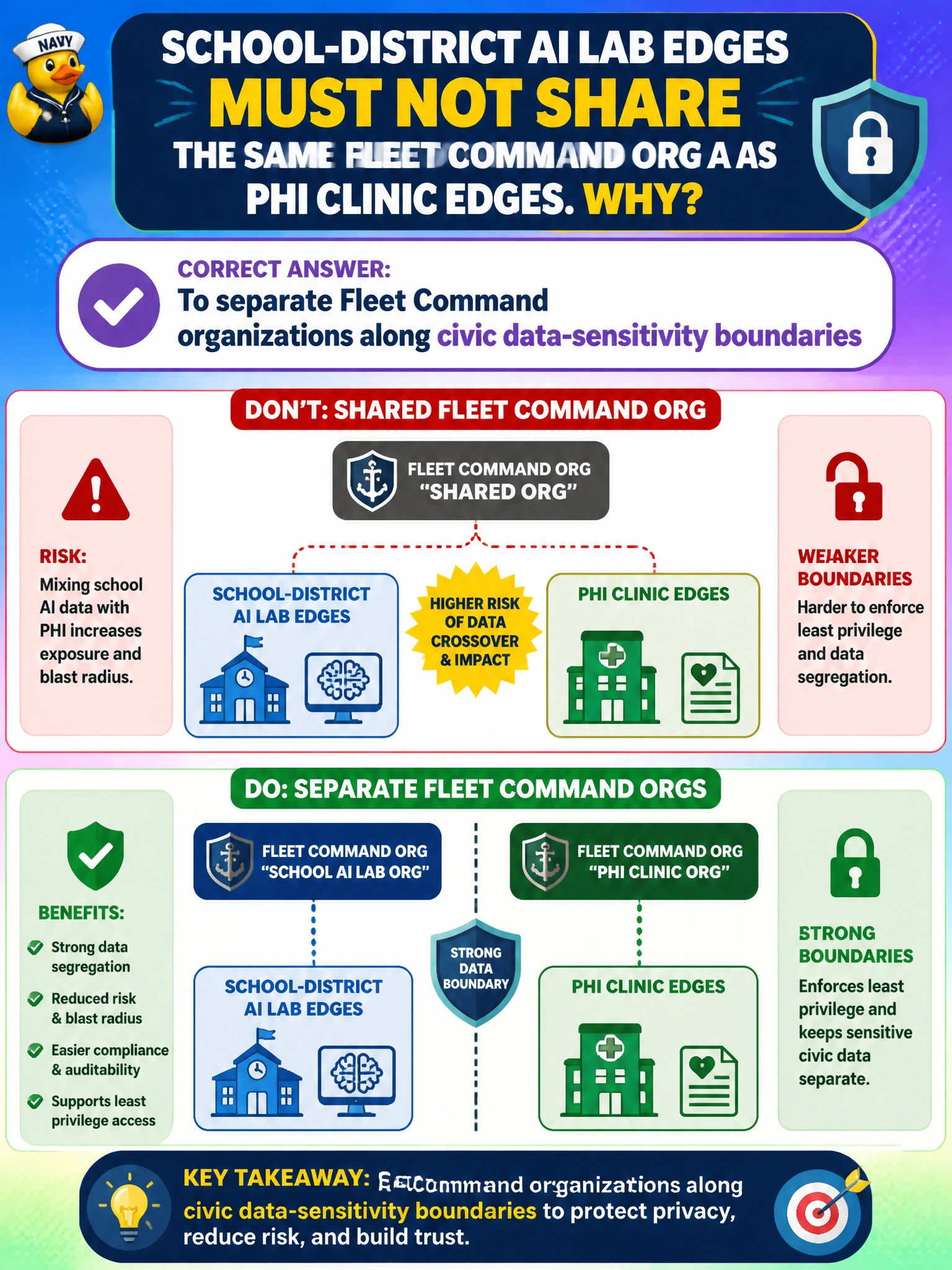
School-district AI lab edges must not share the same Fleet Command org as PHI clinic edges. Why?
Select an answer to reveal the explanation.
Short Explanation
Keep school labs and PHI clinics in different Fleet Command orgs—different keys for different data. Identical orgs are not a GPU requirement. Students should not administer clinic PHI fleets.
Full Explanation
Separating Fleet Command organizations along civic data-sensitivity boundaries keeps school-district AI lab edges from sharing the same org as PHI clinic edges. Distinct orgs enforce administrative and often policy separation so student-lab operators are not implicitly positioned to administer PHI-capable clinic devices, and clinic update rings do not collide with classroom fleets. Sensitivity boundaries are organizational controls, not GPU physics.
Because GPUs cannot run unless orgs are identical fails by concept—GPU execution does not require identical Fleet Command orgs. Because Fleet Command requires one org for the entire county always fails because multi-org separation is a legitimate tenancy pattern for mixed-sensitivity estates. Because students must administer clinic PHI devices directly fails because students should not administer PHI fleets; that reverses least-privilege and privacy expectations.
Exam caveat: org-separation questions map to data sensitivity and administrative blast radius. Candidates may think “one county means one org”; the exam cares about PHI versus non-PHI boundaries. Org separation complements—not replaces—encryption, network segmentation, and HIPAA/process controls on clinic edges.
Operational check: place school-lab edges and PHI clinic edges in separate Fleet Command organizations, verify admin role assignments do not cross sensitivity lines, confirm update packages and secrets are org-scoped, and audit that a school operator cannot list or update clinic devices.