
Courts OCR farm needs durable datasets, fast scratch, and a model registry. What storage layout should civic ops follow?
Select an answer to reveal the explanation.
Short Explanation
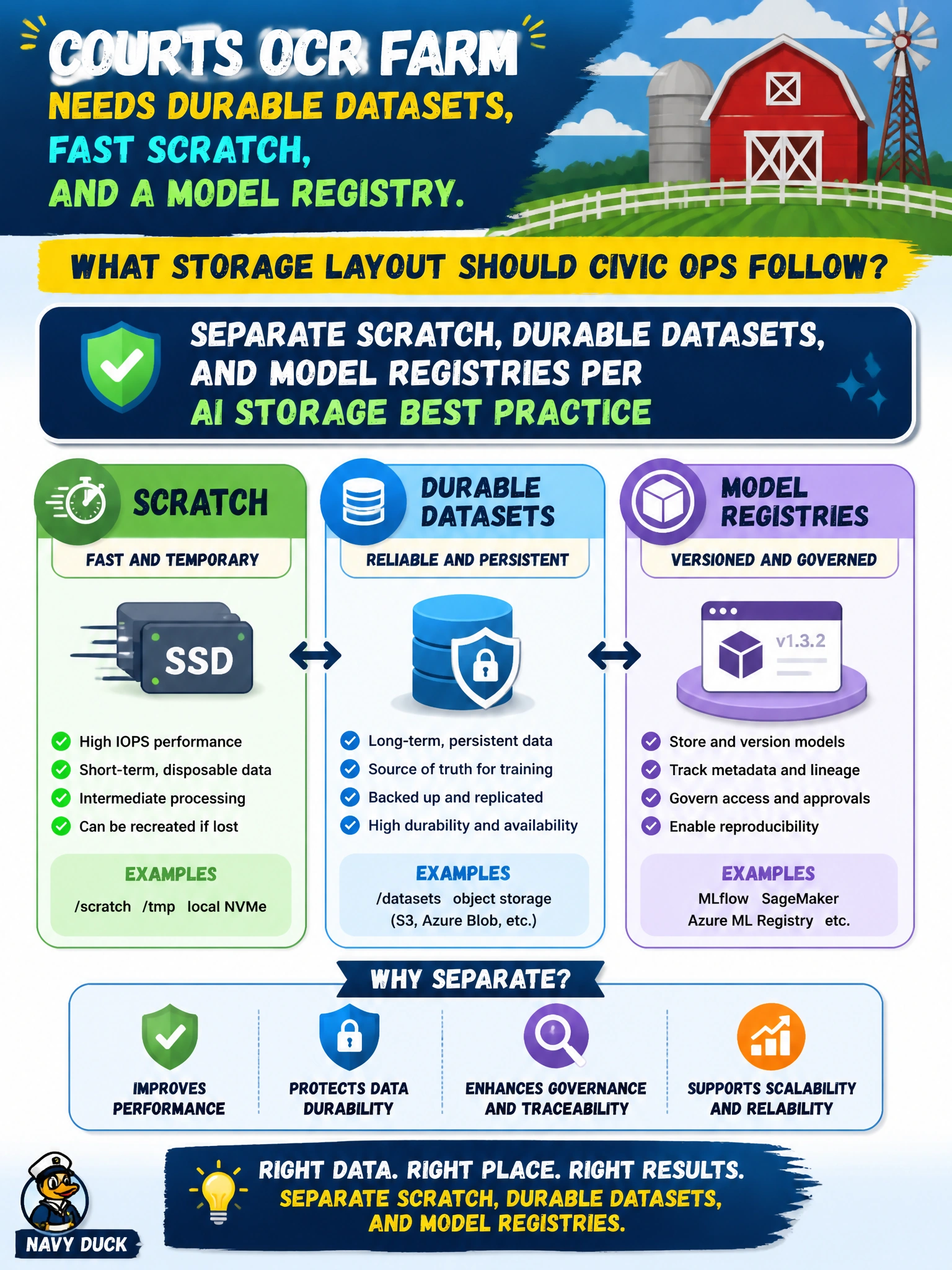
Keep scratch, datasets, and model registries in their own lanes—like evidence lockers vs temp desks. Mixing everything in one folder invites accidents. RAM-only durables and email inboxes are not registries.
Full Explanation
Separating scratch, durable datasets, and model registries follows AI storage best practice for a courts OCR farm that needs all three roles. Scratch absorbs ephemeral training/inference intermediates and can be wiped; durable datasets hold evidence-grade or production OCR corpora with backup and retention; model registries store versioned artifacts with promotion controls. Isolation prevents a full scratch partition from deleting registry tags or mixing volatile junk with records the clerk of court must retain.
One shared folder mixing scratch, datasets, and registries without isolation fails by concept because mixed namespaces invite accidental deletion, quota fights, and unclear retention—exactly what court workloads cannot afford. Only volatile RAM disks for every durable court record fail because RAM disks are not durable storage for records that must survive reboot and audit. Email attachments as the sole model artifact store fail because mailboxes are not model registries: they lack versioning discipline, GPU-pipeline integration, and scale.
Exam caveat: layout questions test separation of concerns more than brand of filesystem. Candidates may invent a single “AI share” and miss lifecycle differences. Registry separation also supports promotion (dev → staging → prod) without exposing courts production models to scratch-cleanup jobs.
Operational check: define three municipal storage classes with distinct mount points and quotas, apply scratch auto-cleanup safely away from dataset and registry paths, verify OCR jobs write intermediates only to scratch and publish models only through the registry API/path, and test that a scratch wipe leaves durable corpora and registered models intact.