
Water-utility training starves reading large sensor corpora over plain NFS. What storage path should civic design consider?
Select an answer to reveal the explanation.
Short Explanation
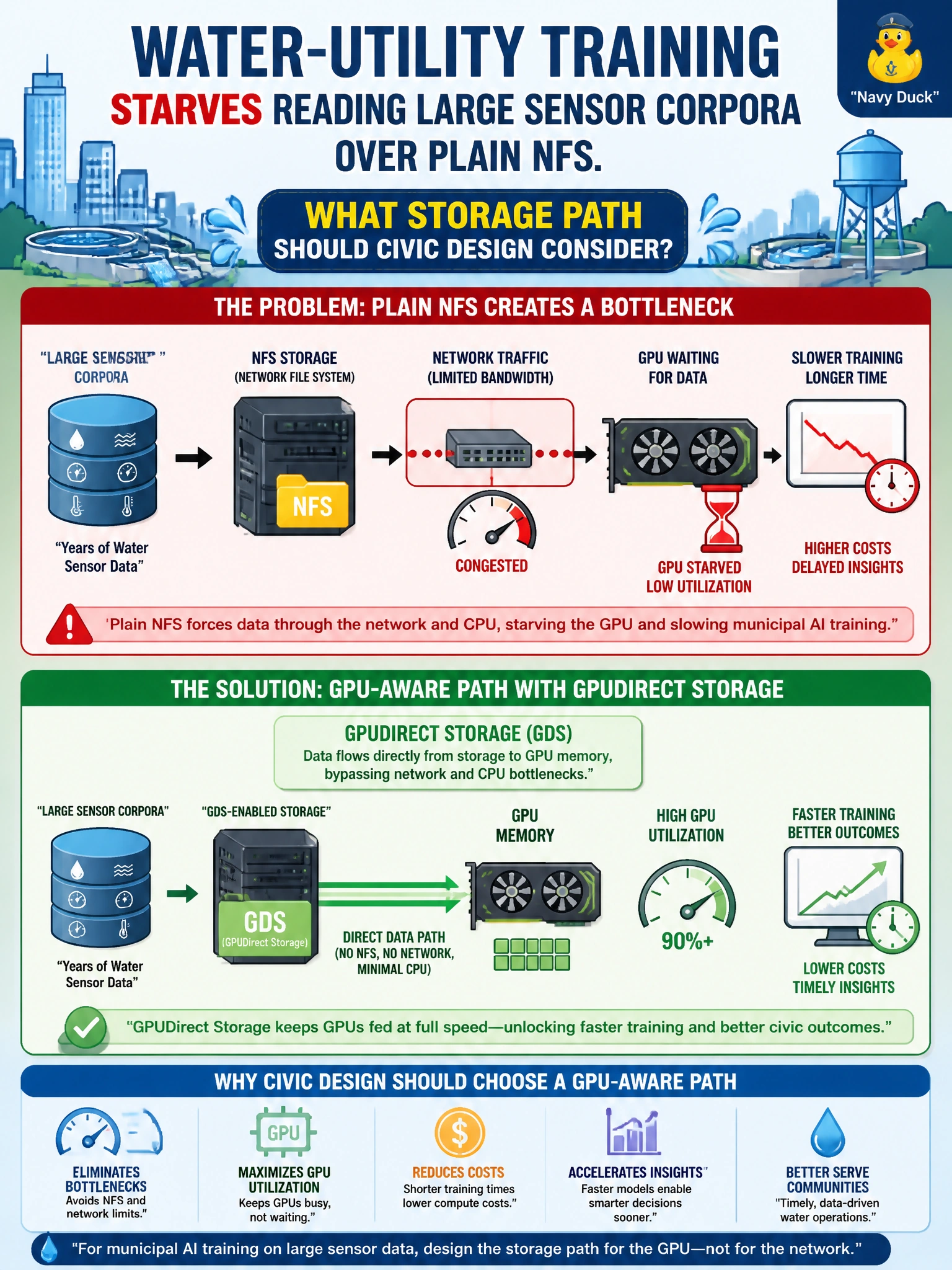
When plain NFS leaves GPUs waiting on large sensor reads, you can consider GPUDirect Storage to ease the bottleneck. A single spreadsheet, engineer laptops, or manually transcribed local files won’t provide a workable path for large-scale training.
Full Explanation
A GPU-aware path such as GPUDirect Storage fits water-utility training that starves while reading large sensor corpora over plain NFS. It reduces CPU-mediated copies and lets GPU nodes feed training pipelines from storage with less bottlenecking when corpora are large and their access patterns challenge naive NFS mounts. You should consider this path when profiling shows GPUs idle behind storage waits rather than compute. Disabling GPUs and training on a single spreadsheet fails because it abandons the sensor scale and accelerator investment that motivated the workload. Storing all corpora only on engineer laptops fails because laptops are not shared, durable, or suitable for concurrent training, and they conflict with municipal data-control expectations. Replacing NFS with manual transcription of sensor records into local files fails because hand re-entry cannot feed multi-GPU training and creates absurd operational risk. Exam caveat: storage-performance questions point to improving the data path, not abandoning GPUs; NFS may still serve other data classes, while GPUDirect Storage requires compatible NICs, drivers, and filesystem support, so the feature name alone does not guarantee faster I/O. Practical check: profile GPU utilization versus I/O wait on the current NFS path, verify platform support, compare performance with GPUDirect Storage enabled, and adopt it only after documenting checkpoint correctness and throughput gains.