
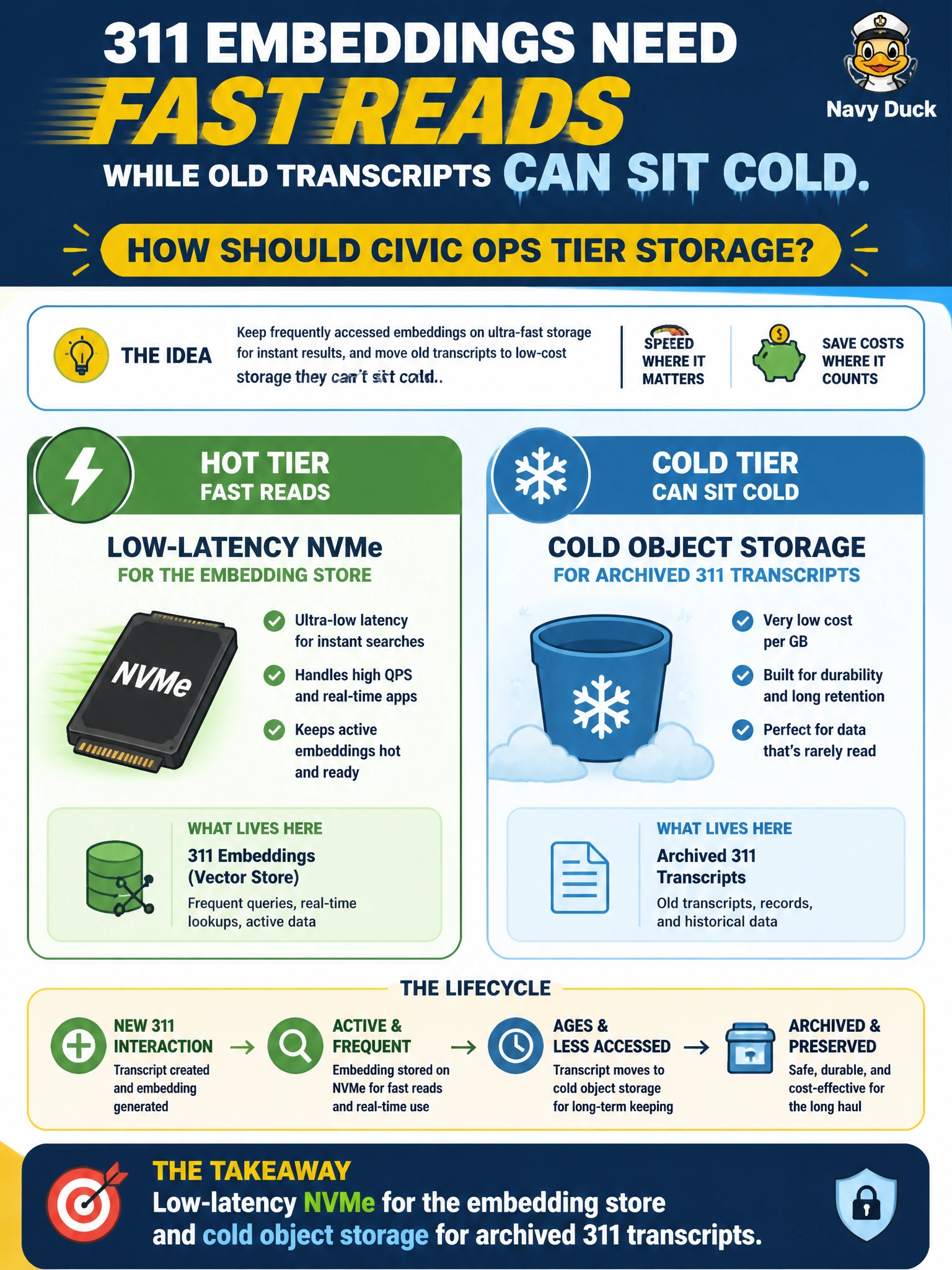
311 embeddings need fast reads while old transcripts can sit cold. How should civic ops tier storage?
Select an answer to reveal the explanation.
Short Explanation
Hot embeddings on NVMe, cold transcripts on object—like keeping 311 dispatch radios charged and old paper in the basement. One USB stick or tape for the live index will crawl. Deleting embeddings nightly breaks the service.
Full Explanation
Low-latency NVMe for the embedding store and cold object storage for archived 311 transcripts implements classic hot/cold tiering for civic NLP. Live embeddings need fast random and sequential reads to keep 311 retrieval and inference responsive; aged transcripts are infrequently accessed and belong on cheaper object storage with lifecycle policy. The municipal pattern mirrors dispatch radios kept charged versus paper archives in the basement—performance where citizens wait, economy where history sleeps.
One slow USB drive for both live embeddings and archives fails by concept because a single slow device cannot meet embedding latency and creates a trivial single point of failure for both hot and cold data. Only tape for the live embedding index fails because tape latency and sequential access patterns are hostile to online embedding lookup. Deleting embeddings nightly to save space fails because it destroys the serving index the 311 feature depends on and forces expensive rebuilds.
Exam caveat: tiering questions reward matching access pattern to media class. “Cheapest media everywhere” and “delete to save space” are recurring wrong instincts. Embedding stores may still need snapshots/replicas for availability; NVMe speed does not waive durability for citizen-facing 311 services.
Operational check: place the active embedding index on NVMe (or equivalent low-latency tier), configure lifecycle rules moving aged 311 transcripts to object storage, benchmark p95 embedding read latency under expected query load, and confirm restore/rebuild procedures exist before cutting over production 311 retrieval.