
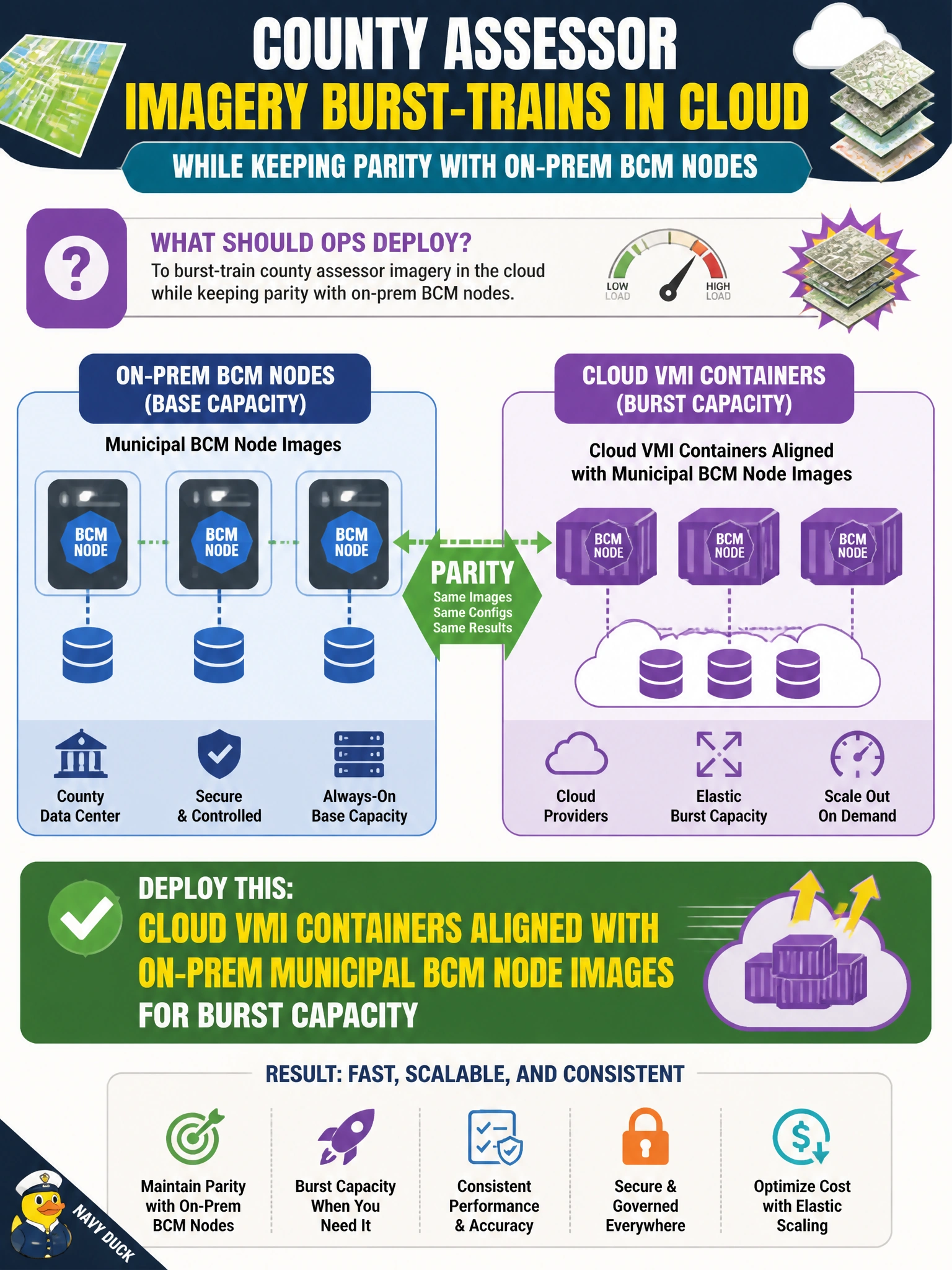
County assessor imagery burst-trains in cloud while keeping parity with on-prem BCM nodes. What should ops deploy?
Select an answer to reveal the explanation.
Short Explanation
Burst assessor training needs cloud VMI images that twin the on-prem BCM stack—same recipe, more ovens. Desktop ISOs and empty shells will not run GPU training. Shipping disks overnight is not elastic capacity.
Full Explanation
Cloud VMI containers aligned with on-prem municipal BCM node images give the county assessor a burst path that preserves stack parity—same NVIDIA AI software recipe, more capacity when imagery training spikes. Alignment means drivers, CUDA userspace, and framework containers track the on-prem BCM baseline so models and scripts do not need a second unsupported build for cloud. Civic hybrid design treats cloud as elastic ovens running the same municipal recipe, not a second incompatible kitchen.
Unrelated consumer desktop ISOs uploaded as cloud VMs fail by concept because desktop ISOs lack the NVIDIA AI ops stack, GPU driver discipline, and cluster-oriented tooling BCM nodes expect. Only empty cloud shells with no NVIDIA AI software stack fail because empty VMs provide compute shells without the container/runtime layer required for GPU training. On-prem disks shipped overnight instead of any cloud path fail because physical shipment is not elastic burst capacity and cannot absorb sudden assessor imagery peaks.
Exam caveat: hybrid burst questions emphasize parity via official or aligned VMI/container paths, not “any cloud VM.” Cloud without stack alignment creates two operational truths and doubles failure modes. Burst capacity still requires data staging, secrets, and network controls appropriate for municipal imagery—parity of compute stack does not waive data-handling policy.
Operational check: compare cloud VMI (or container) driver/CUDA/framework versions to the on-prem BCM node image matrix, run the same assessor training smoke job in both places, confirm checkpoint and dependency behavior match, and document the approved VMI/tag pair before enabling production burst for imagery jobs.