
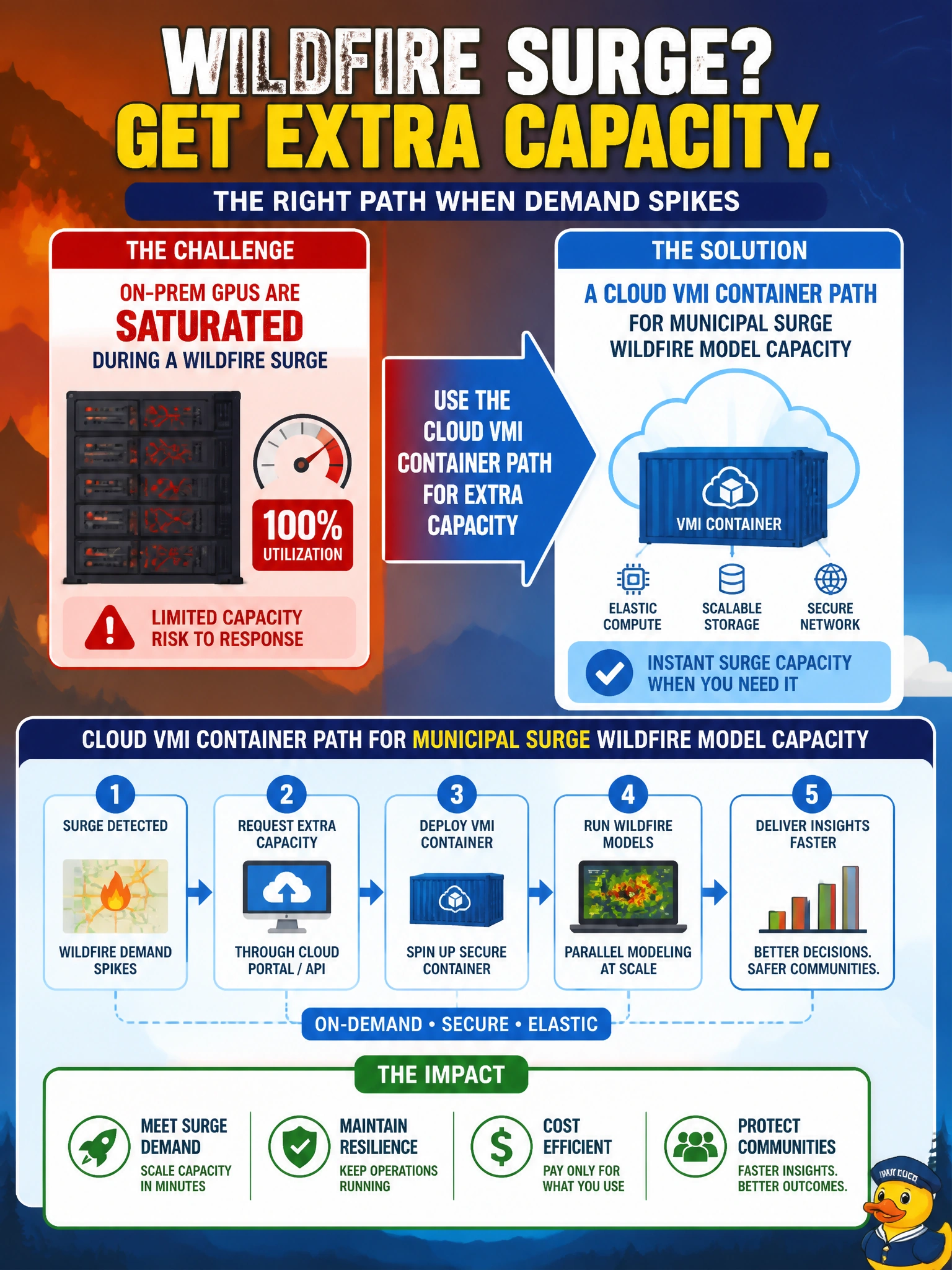
On-prem GPUs are saturated during a wildfire surge. What should emergency management use for extra capacity?
Select an answer to reveal the explanation.
Short Explanation
When on-prem is full in a wildfire surge, cloud VMI is the overflow lane—not waiting until next year's budget. Desk laptops are not a training fabric. Turning off BCM during an emergency is the wrong move.
Full Explanation
A cloud VMI container path for municipal surge wildfire model capacity is the operational overflow when on-prem GPUs are saturated during an emergency. Emergency management needs additional trained or inferred capacity without waiting for capital refresh; VMI-based cloud hosts that carry the municipal NVIDIA stack let surge jobs run with known tooling while BCM continues managing the on-prem fabric. Continuity under wildfire load is about elastic, supportable capacity—not heroics on unmanaged devices.
Canceling all models and waiting for hardware refresh next fiscal year fails by concept because fiscal wait times are incompatible with surge timelines; emergencies do not pause for budget cycles. Local laptops under desks as the primary training fabric fail because laptops lack cluster scheduling, shared datasets, power/cooling for sustained GPU training, and municipal control-plane visibility. Disabling BCM so nodes cannot be monitored during the surge fails because removing monitoring and management during peak risk blinds the NOC exactly when capacity and health matter most.
Exam caveat: surge capacity items test hybrid elasticity with an operable stack (VMI path), not improvisation. Disabling management tooling is a common wrong answer dressed as “reduce overhead.” Cloud surge still must respect data residency and model-governance rules for emergency workloads; capacity alone is not carte blanche.
Operational check: pre-stage an approved wildfire-capable cloud VMI/tag, validate network and dataset staging from the municipal side, run a timed surge drill that overflows a fraction of jobs to cloud while BCM monitoring remains on for on-prem nodes, and record RTO/capacity gained before declaring the path ready for live emergency use.