
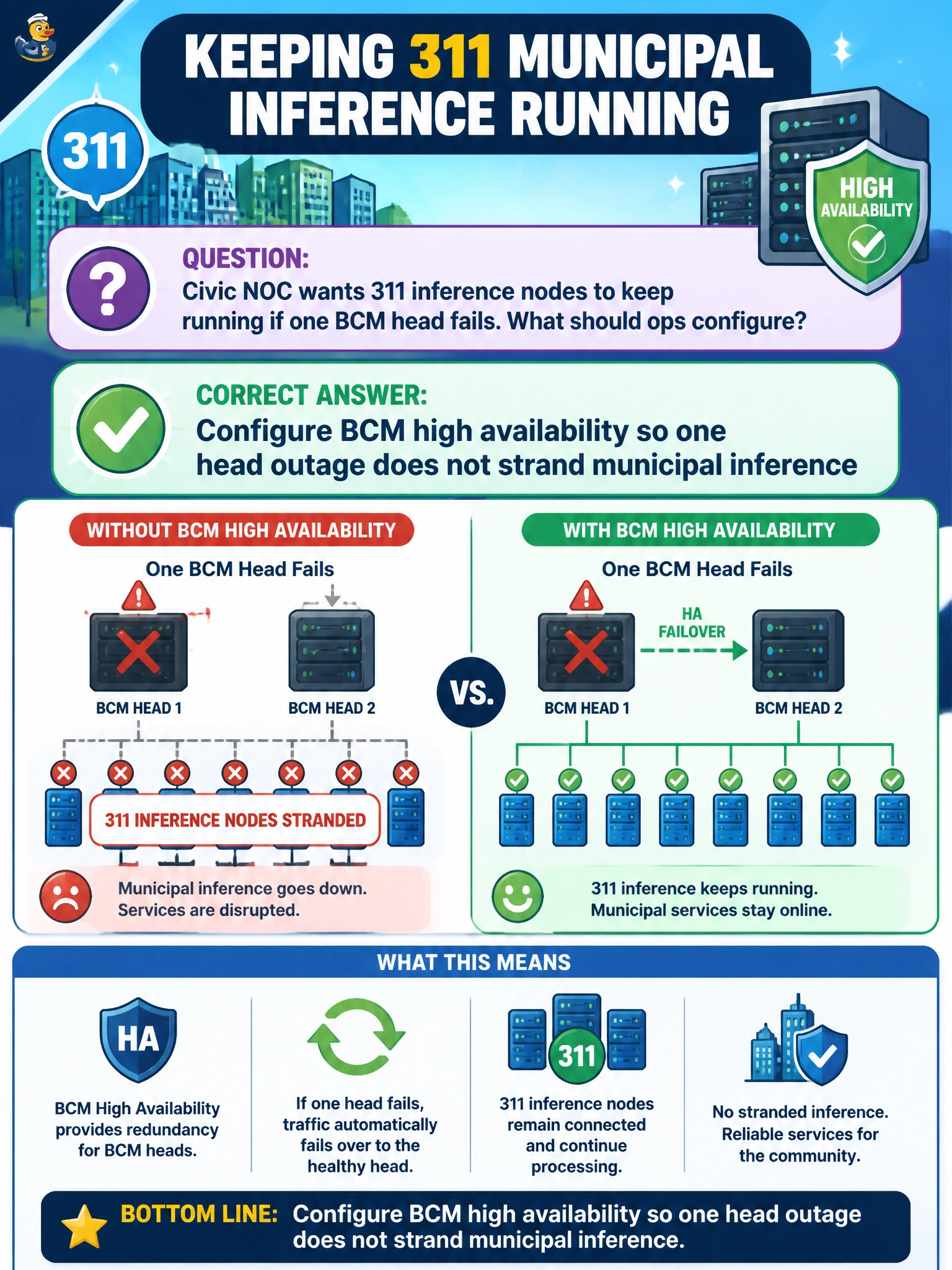
Civic NOC wants 311 inference nodes to keep running if one BCM head fails. What should ops configure?
Select an answer to reveal the explanation.
Short Explanation
Think of BCM high availability like dual fire stations: if one head goes dark, the other keeps your city’s 311 inference running. Manual node tracking and disabled monitoring leave you without continuity, while putting every GPU in one unmanaged workstation creates a single point of failure.
Full Explanation
Configure BCM high availability to keep municipal cluster management continuous when a head fails, so 311 inference is not stranded. The surviving head retains control-plane duties such as scheduling visibility, node management, imaging hooks, and monitoring. For an always-on city service, this is the cluster-management equivalent of dual fire stations: one head outage should not halt orchestration across the GPU fleet. Removing BCM management and tracking node assignments manually fails because it eliminates the live control plane and makes inventory, provisioning, health checks, and workload admission unsustainable. Disabling monitoring so outages go unnoticed is the opposite of continuity; a civic NOC needs to detect and respond to head or worker failures. Moving every GPU into one unmanaged workstation abandons cluster scheduling and pooled capacity, creating a single point of failure that cannot support multi-node inference at city scale. Exam caveat: BCM HA protects the management plane; it does not fix insufficient GPU capacity or misconfigured inference services. Do not confuse keeping the manager available with making GPUs available. Practical check: during a maintenance window, fail over or fence one head, confirm the surviving head still shows the 311 node inventory and accepts management actions, verify monitoring alerts on the failed head, and ensure inference workers remain reachable before returning the primary to service.