
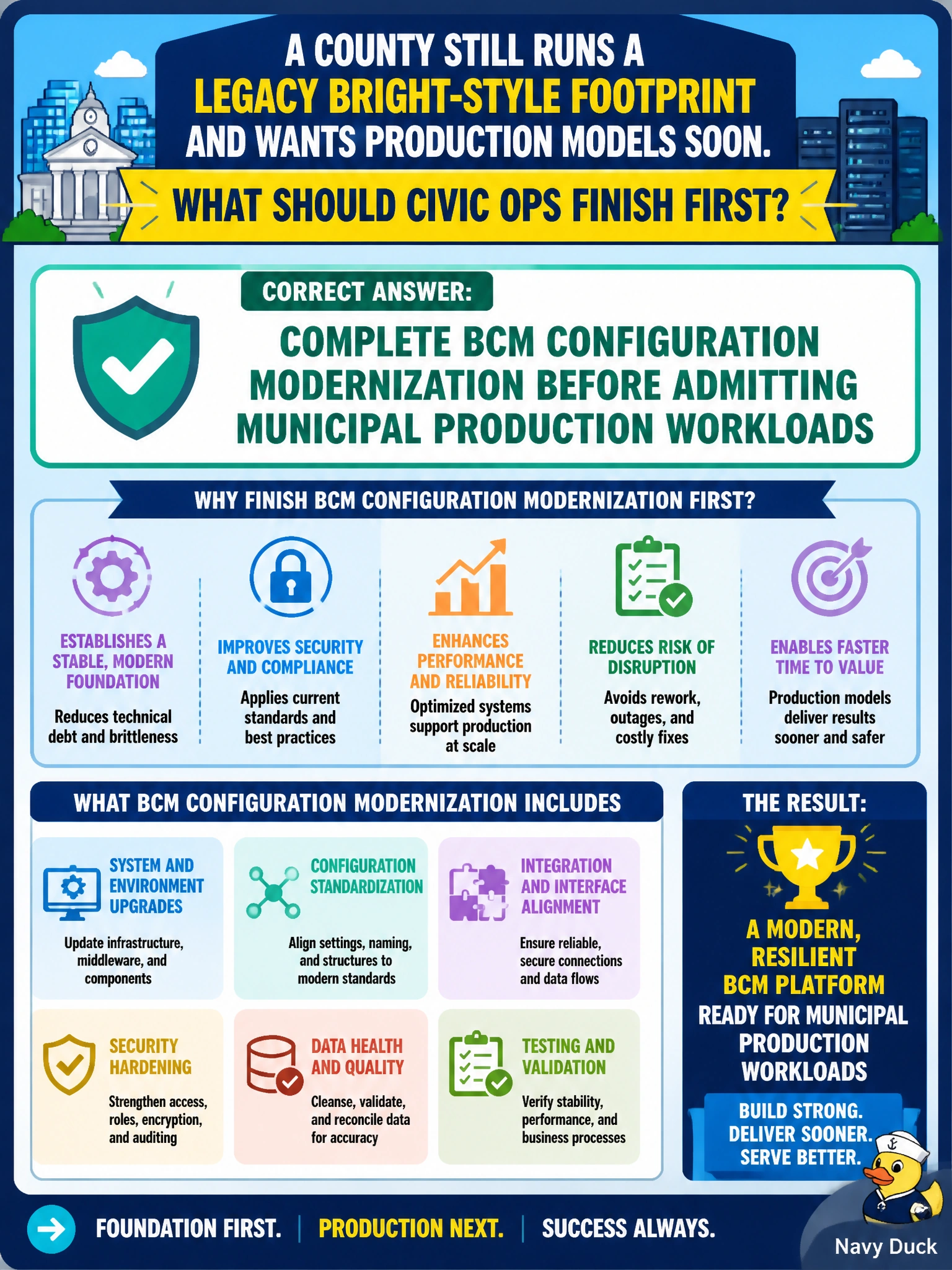
A county still runs a legacy Bright-style footprint and wants production models soon. What should civic ops finish first?
Select an answer to reveal the explanation.
Short Explanation
Modernize BCM first—like updating the city's SCADA before flipping new pumps into prod. Shipping models on a half-migrated Bright-style footprint is asking for surprise outages. CPUs and tribal knowledge are not a migration plan.
Full Explanation
Completing BCM configuration modernization before admitting municipal production workloads establishes a supported, operable cluster-management baseline for a county still carrying a legacy Bright-style footprint. Modernization aligns imaging, networking, authentication, monitoring, and workload-manager integration with current BCM practice so production models land on a coherent ops surface rather than a half-migrated control plane. Civic ops treat this like updating SCADA before energizing new pumps: configuration debt becomes production incident risk the moment live models depend on the cluster.
Admitting production models on the unmodernized legacy footprint immediately fails by concept because it prioritizes model launch over operational readiness. Legacy gaps in configuration, documentation, and integration tend to surface as unexplained node states, broken image paths, or inconsistent job admission once traffic is real. Replacing all GPUs with CPUs to avoid cluster management fails because it abandons the accelerator requirement that justified the municipal AI investment and does not solve migration sequencing. Skipping configuration and relying on undocumented tribal knowledge fails because tribal knowledge is not a reproducible runbook, cannot survive staff turnover, and cannot be audited for county production standards.
Exam caveat: migration and modernization questions emphasize finishing the management-plane cutover before production admission. Speed-to-model is a distractor when the stem already signals legacy footprint risk. BCM modernization is not optional cosmetics; it is the gate that makes subsequent NGC, Slurm, Kubernetes, and monitoring steps trustworthy.
Operational check: before the first county production model is scheduled, walk a modernization checklist—BCM version and HA posture, node image baselines, network and identity integration, monitoring endpoints, and a non-production job that successfully lands on modernized nodes—then record sign-off that the legacy Bright-style path is no longer the admission path for production.