
Transit keeps overnight training on Slurm while Kubernetes serves daytime inference. What Domain 1 stance fits under BCM ops?
Select an answer to reveal the explanation.
Short Explanation
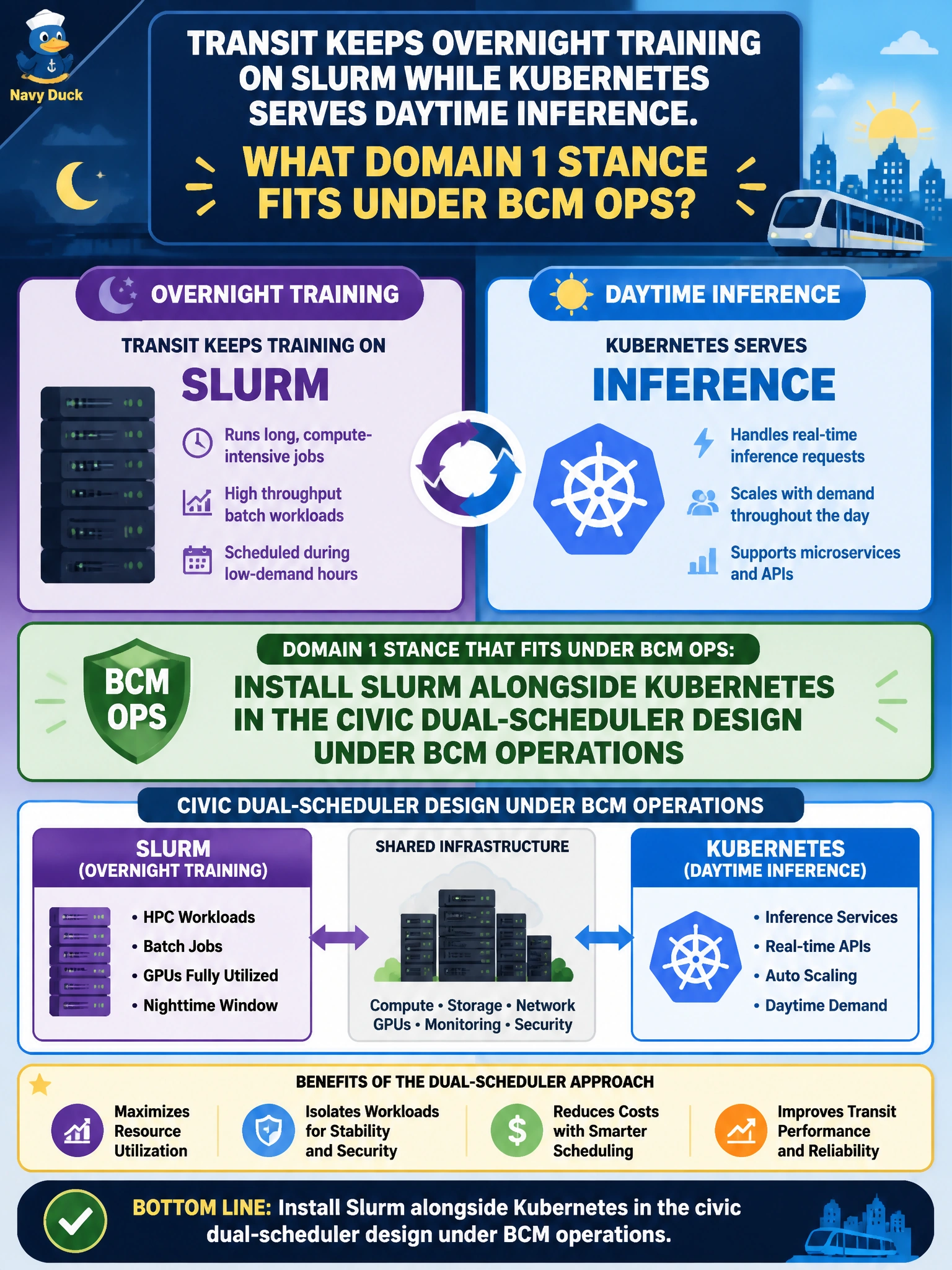
Daytime K8s inference and overnight Slurm training can share one civic roof—install both under BCM ops. You do not have to delete one to keep the other. Manual SSH starts are not a dual-scheduler strategy.
Full Explanation
Transit platforms that keep overnight training on Slurm while Kubernetes serves daytime inference should install Slurm alongside Kubernetes in a civic dual-scheduler design under BCM operations. Both schedulers can coexist; BCM is the operational umbrella for municipal AI cluster management. Dual-scheduler is an intentional Domain 1 stance—not a contradiction—when day and night workload shapes differ. Inference Services and batch fine-tuning simply use the tool that fits each window.
Deleting Kubernetes because Slurm cannot coexist in any municipal design is false and removes the daytime inference platform citizens rely on. Deleting Slurm because Kubernetes alone always covers overnight multi-node training needs ignores common batch-training practice and the stated overnight requirement. Banning both schedulers and relying on manual SSH job starts forfeits queueing, fair share, accounting, and recovery controls.
Exam caveat: Kubernetes and Slurm may both be installed under BCM for civic day/night workload splits—do not assume mutual exclusion. Operational check: ensure both Kubernetes and Slurm are installed/managed under BCM, place daytime inference on K8s and overnight training on Slurm, and verify neither deletion nor SSH-only workflows are required for the dual design.