
Emergency-management designs need DOCA on DPU-Arm for storage and network services without changing host GPU MIG layouts. What distinction should architects keep?
Select an answer to reveal the explanation.
Short Explanation
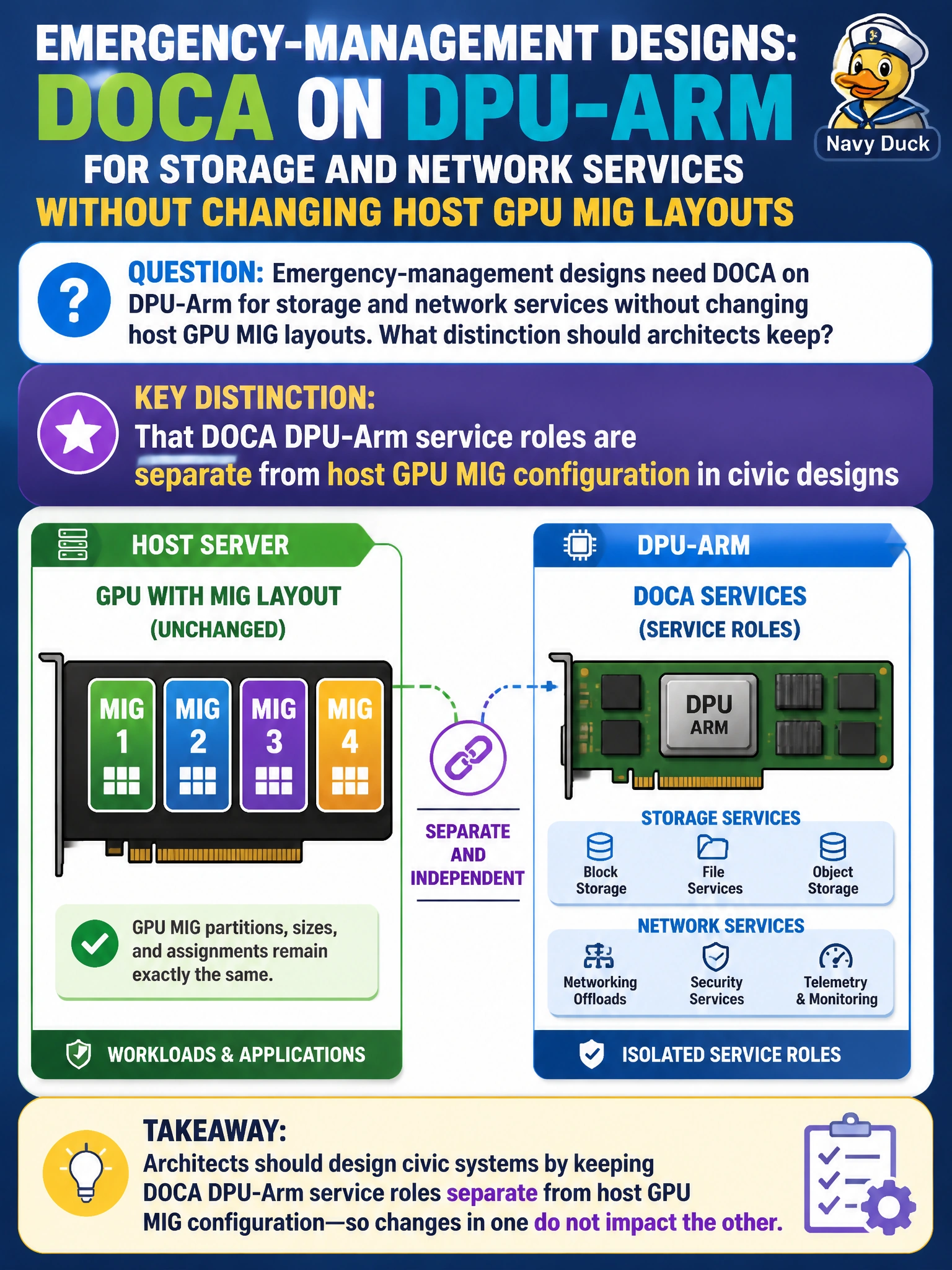
DOCA on the DPU-Arm is the storage/network helper; MIG lives on the host GPUs—keep those jobs separate. You do not have to kill GPUs or reshuffle MIG every time a DOCA service starts. Treating DPUs and GPUs as one device class mixes two different toolbelts.
Full Explanation
Emergency-management designs can run DOCA on DPU-Arm for storage and network services without retuning host GPU MIG layouts because those roles are separate. Architects should keep DOCA DPU-Arm service roles distinct from host GPU MIG configuration in civic designs. Changing MIG is not a required side effect of starting DOCA services on the DPU. Keeping change windows separate reduces risk when emergency GPU partitions must stay stable during fabric offload work.
Claiming DOCA on DPU-Arm always requires disabling every host GPU is false and would needlessly stop emergency GPU workloads that MIG is protecting. Asserting that MIG must be reconfigured whenever any DOCA service starts couples unrelated change domains and expands blast radius. Treating BlueField DPUs and host GPUs as the same device class in BCM blurs inventory, monitoring, and change windows for municipal responders.
Exam caveat: DPU-Arm DOCA services and host GPU MIG are independent configuration planes—do not conflate device classes or change windows. Operational check: deploy or adjust DOCA services on DPU-Arm while leaving host MIG profiles unchanged, verify emergency-management GPU jobs still see the same MIG layout, and confirm BCM shows DPU and GPU as distinct device roles.