
County edge depot sites must match downtown Kubernetes control-plane versions. What install approach should civic ops use?
Select an answer to reveal the explanation.
Short Explanation
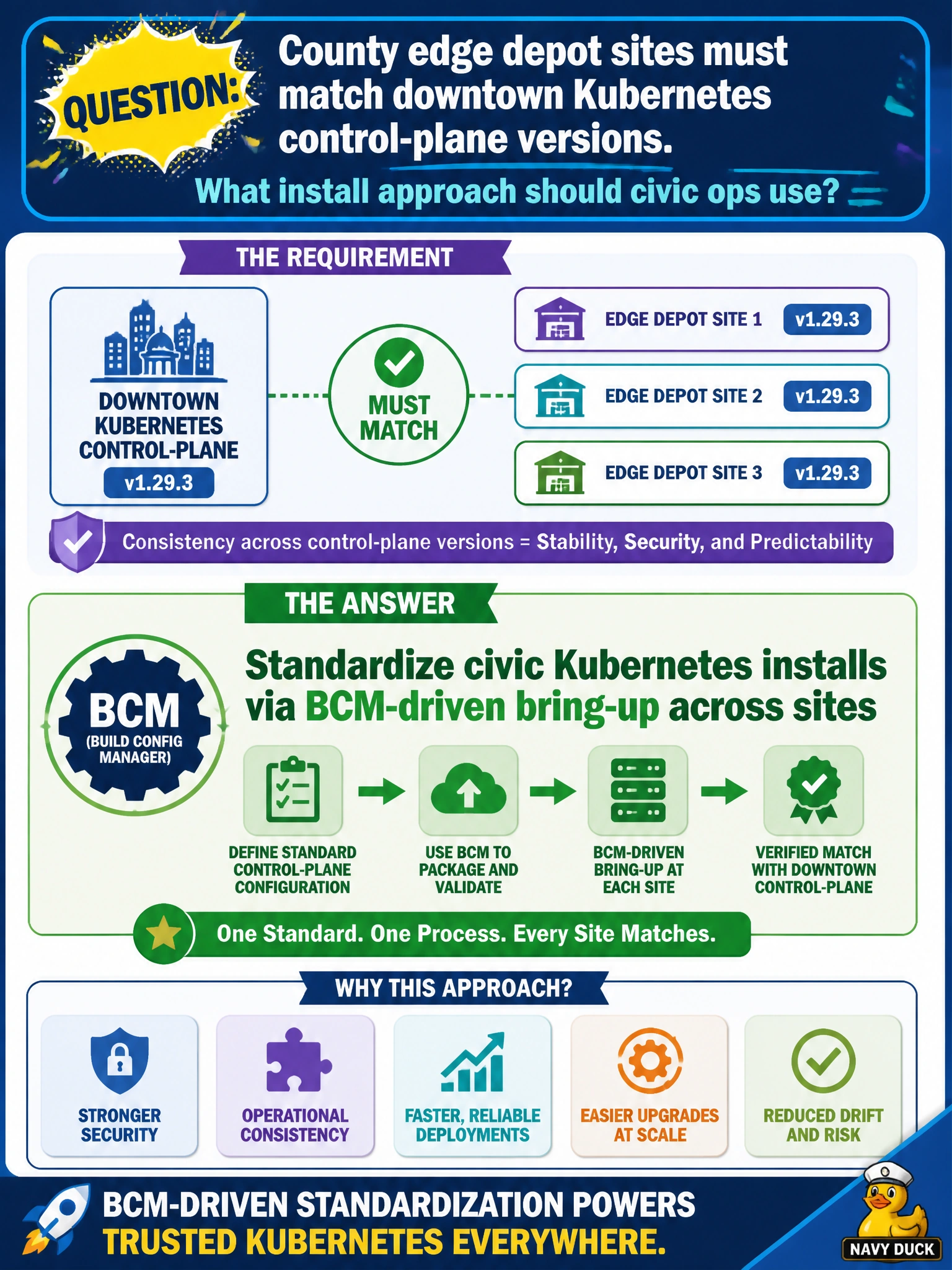
Depots and downtown need the same K8s story—BCM-driven bring-up keeps versions aligned across the county. Letting every site freestyle versions is how edge drift starts. Freezing forever or switching to non-GPU Windows stacks misses the civic AI goal.
Full Explanation
County edge depot sites that must match downtown Kubernetes control-plane versions should standardize installs via BCM-driven bring-up across sites. BCM provides a repeatable civic install path that reduces version drift between downtown and depot Kubernetes stacks and keeps NVIDIA GPU operations coherent. Standardization is the install approach—not per-site invention—especially when edge depots feed the same municipal AI platform. Matched versions simplify support, upgrades, and policy enforcement across the county.
Allowing each depot to invent its own Kubernetes version without BCM guarantees drift and supportability pain when downtown changes. Never upgrading or installing at edge sites so versions drift forever fails the matching requirement by neglect and leaves depots stranded on stale stacks. Running only Windows Hyper-V clusters at depots with no NVIDIA GPU stack abandons the municipal AI platform model these depots are meant to extend.
Exam caveat: multi-site civic Kubernetes consistency is achieved through BCM-standardized bring-up, not ad-hoc depot versioning. Operational check: perform BCM-driven Kubernetes install/upgrade at a depot to the downtown-approved version, compare control-plane versions, verify GPU stack compatibility, and document the depot as aligned before admitting edge workloads.