
After a BCM Kubernetes install, what should civic ops verify before exposing the first public-health inference Service?
Select an answer to reveal the explanation.
Short Explanation
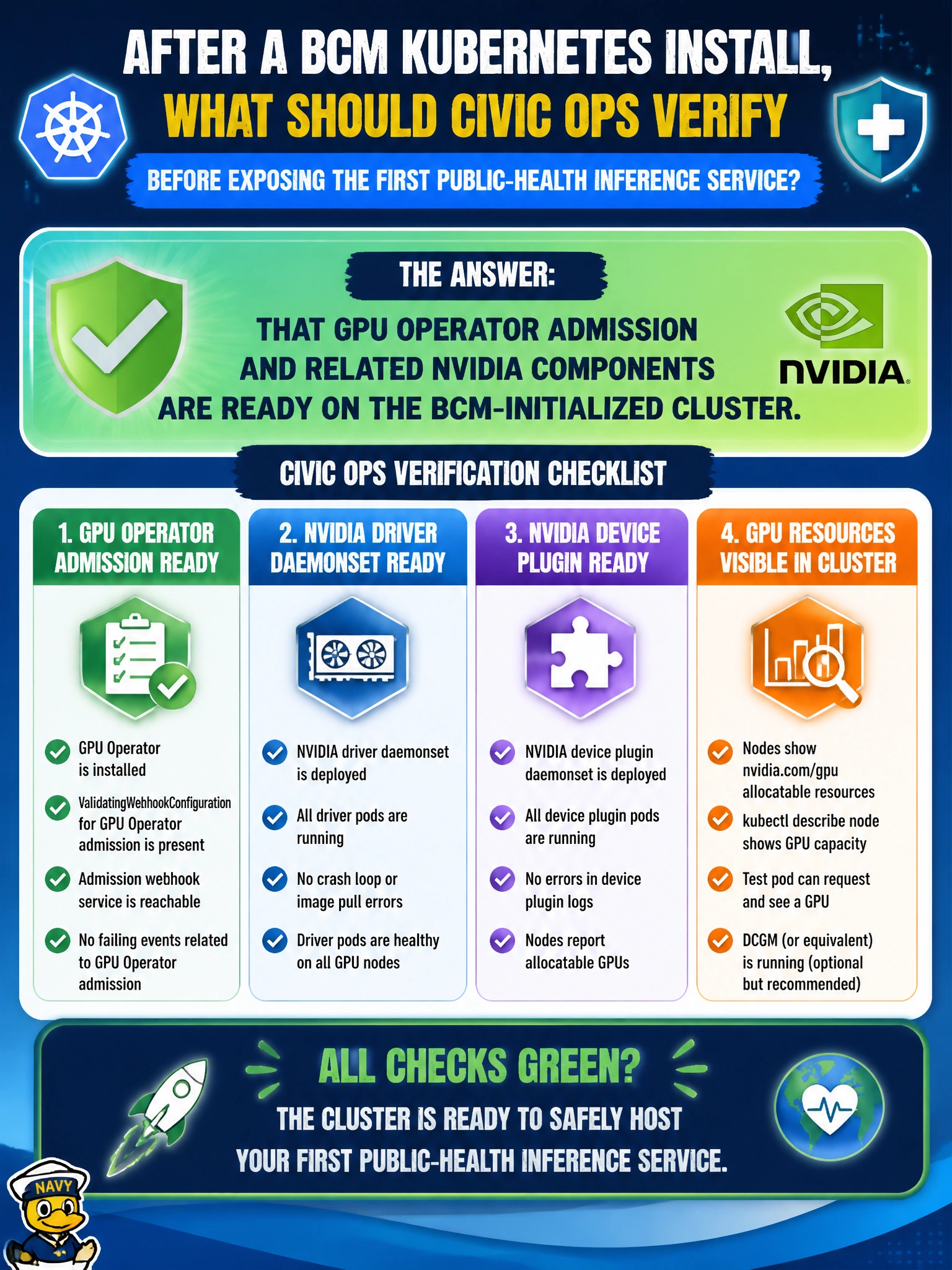
Before the first public-health Service goes live, confirm GPU Operator and NVIDIA bits actually admitted after the BCM K8s install. Gaming-only drivers, ripping Kubernetes out, or killing CNI will not get inference pods scheduled. Readiness beats hoping the cluster is fine.
Full Explanation
After a BCM Kubernetes install, civic ops must verify GPU Operator admission and related NVIDIA components before exposing the first public-health inference Service. Without those components, pods cannot reliably consume GPUs even if the API server is up. Readiness of the NVIDIA software stack on the BCM-initialized cluster is the gate before municipal Services go live. Shipping a Service that cannot schedule GPUs creates a false readiness signal for public-health consumers.
Checking that every node has consumer gaming GPUs only and no data-center drivers is the wrong success criterion for a civic inference platform and would fail enterprise driver/Operator expectations. Uninstalling Kubernetes so Services cannot schedule actively prevents the intended deployment. Disabling CNI networking permanently for security theater breaks pod networking required by inference Services and is not a substitute for verifying GPU Operator health.
Exam caveat: Kubernetes up is not the same as GPU-ready; GPU Operator/NVIDIA components must be verified post BCM install before civic inference exposure. Operational check: confirm GPU Operator and related device plugins/drivers are admitted and healthy on the BCM cluster, schedule a GPU test pod for public-health inference, then expose the Service only after GPU scheduling succeeds.