
After a 311 outage, auditors ask for after-action records. How should civic ops preserve the story in BCM?
Select an answer to reveal the explanation.
Short Explanation
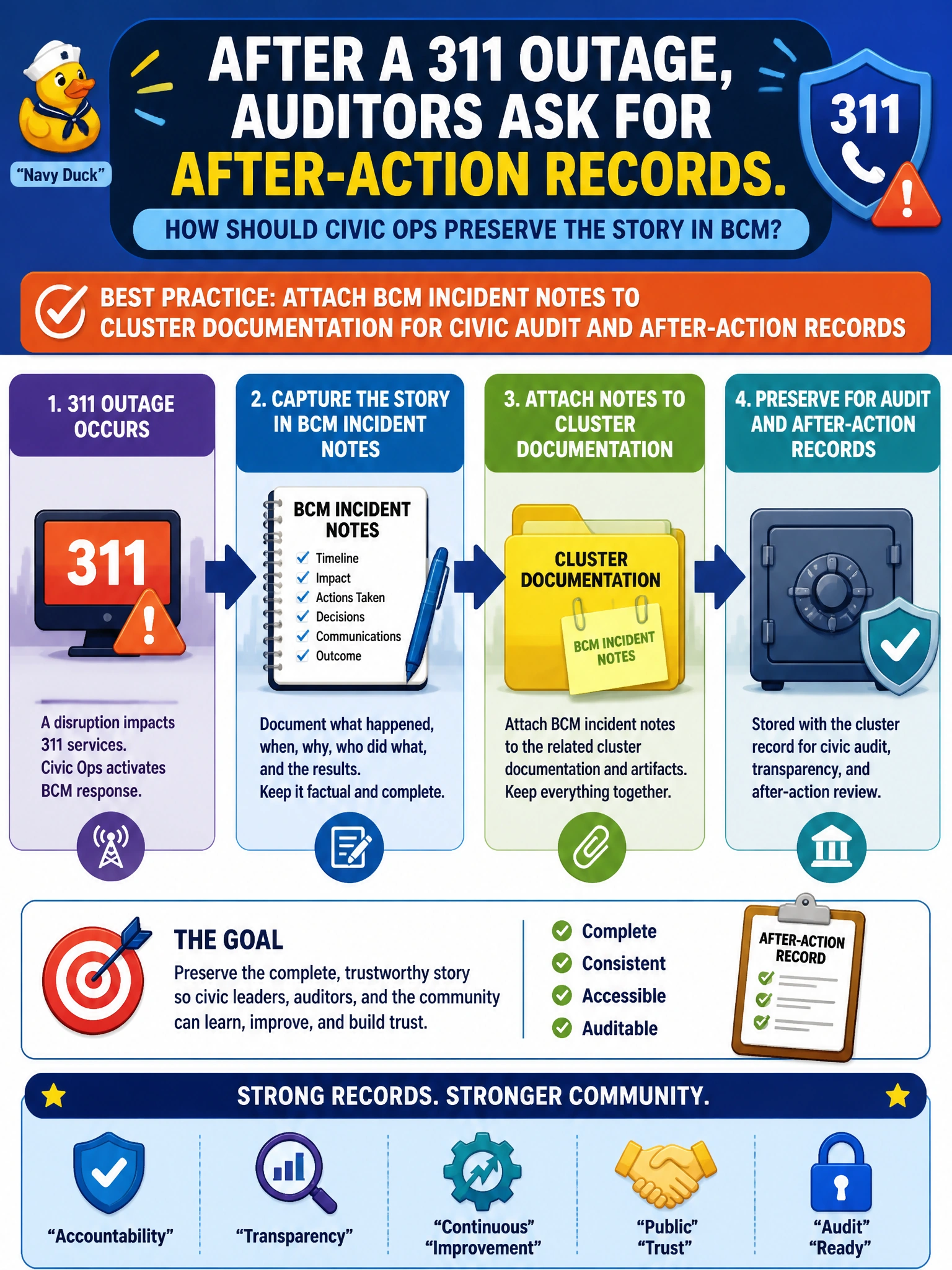
Auditors want the 311 outage story tied to the cluster—put incident notes into BCM documentation. Wiping logs or parking facts on sticky pads will not satisfy an audit. Social posts are not an official after-action file.
Full Explanation
After a 311 outage, auditors expect durable after-action records tied to the cluster. Attaching BCM incident notes to cluster documentation preserves timeline, actions, owners, and linkage to municipal systems of record. That practice supports civic audit, continuity, and learning without relying on ephemeral channels. BCM-linked notes keep the technical story next to the same platform that observed the failure.
Deleting all BCM logs immediately to reduce disk usage destroys evidence needed for after-action review and may violate retention expectations for a public-facing 311 service. Keeping notes only on paper sticky pads with no cluster linkage creates orphaned records that cannot be correlated with BCM events or node identifiers. Relying solely on social media posts as the official incident record is inappropriate for municipal audit trails and lacks authoritative cluster context.
Exam caveat: incident memory for civic AI platforms belongs in BCM-linked documentation/notes—not in deleted logs or informal social posts. Operational check: after the 311 event, create BCM incident notes with timeline and remediation, attach or link them to cluster documentation, confirm auditors can retrieve the package, and verify log retention still meets policy without a panic wipe.