
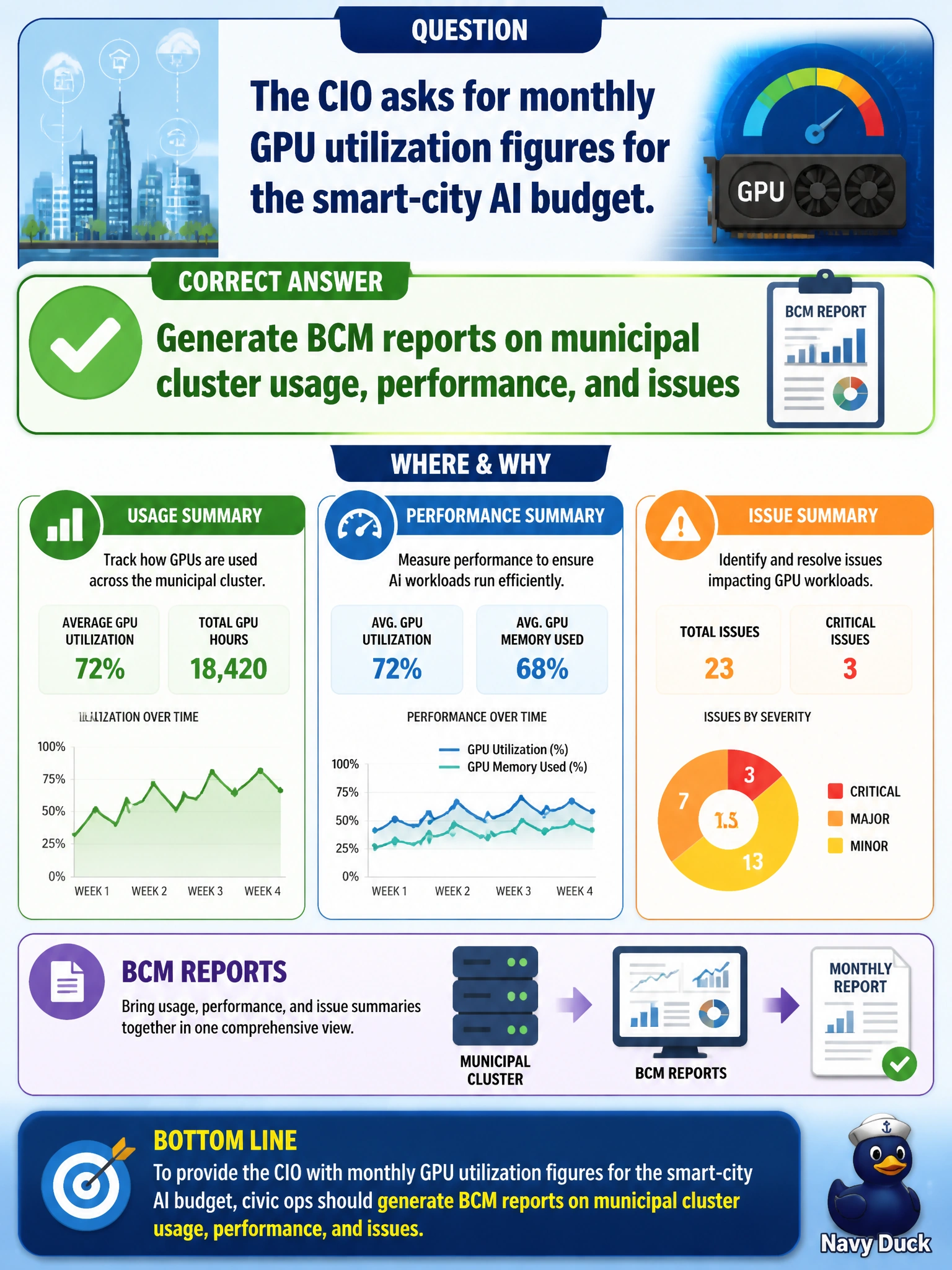
The CIO asks for monthly GPU utilization figures for the smart-city AI budget. Where should civic ops generate usage, performance, and issue summaries?
Select an answer to reveal the explanation.
Short Explanation
Budget season wants numbers, not hallway lore—BCM reports roll up usage, performance, and issues for the smart-city AI spend. One idle-node screenshot is not a month of fleet truth. Saying clusters cannot report metrics is simply wrong.
Full Explanation
When the CIO asks for monthly GPU utilization for the smart-city AI budget, civic ops should generate usage, performance, and issue summaries from BCM reporting—not from anecdotes. BCM aggregates cluster-level metrics and operational issues suitable for municipal budget and capacity conversations. That reporting path is the Domain 1-aligned source of truth for shared GPU estates and after-the-fact reconciliation of outages versus idle waste. Executive questions about AI spend should map to BCM outputs, not hallway folklore.
Estimating utilization from hallway conversations only is not auditable and will not survive budget scrutiny or year-over-year comparison. Exporting random nvidia-smi screenshots from one idle node misrepresents fleet utilization and ignores multi-node civic workload patterns and time ranges. Refusing reporting because AI clusters cannot produce usage metrics is false—BCM exists partly to produce those operational summaries for municipal stakeholders.
Exam caveat: executive GPU utilization asks map to BCM reports, not single-node CLI snapshots or informal estimates. Operational check: generate the BCM usage/performance/issues report for the municipal cluster covering the month, sanity-check totals against known outages, archive the artifact with the budget packet, and deliver the CIO package from that BCM output rather than ad-hoc screenshots.