
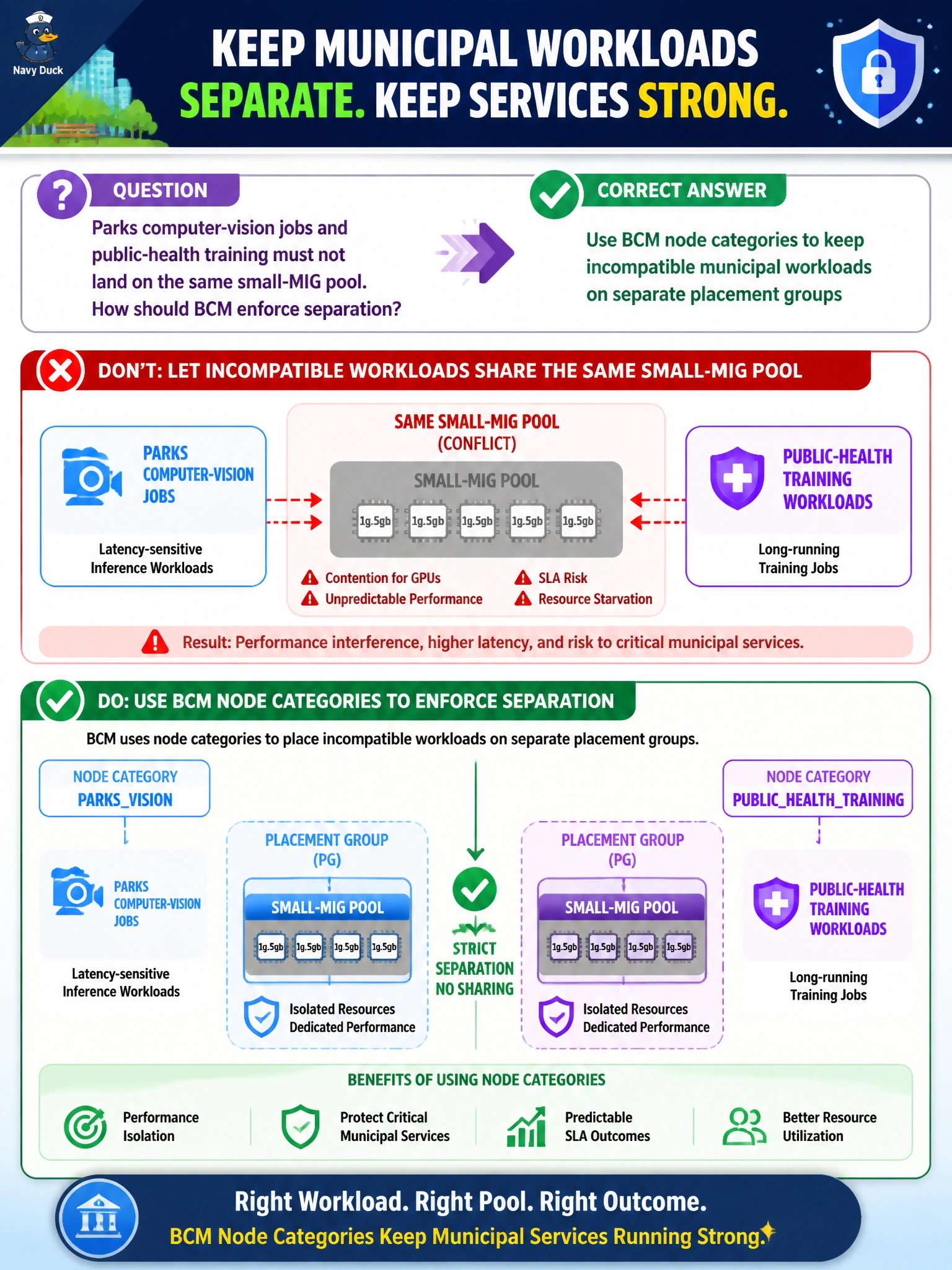
Parks computer-vision jobs and public-health training must not land on the same small-MIG pool. How should BCM enforce separation?
Select an answer to reveal the explanation.
Short Explanation
Incompatible parks CV and public-health training on a tiny MIG pool is a collision waiting to happen—BCM categories keep them on separate placement groups. Sticky notes and shared accounts will not enforce that. Deleting the pool just stops everyone’s work.
Full Explanation
Parks computer-vision and public-health training must not share an unsuitable small-MIG pool. BCM node categories create enforceable placement groups so incompatible municipal workloads stay on pools that match their resource profiles. Policy-backed categories beat informal reminders when both teams share a constrained GPU estate. Small MIG slices that are fine for one profile can starve or destabilize another; categories keep those profiles from colliding on the wrong pool.
Relying on users to remember which pool is forbidden lacks auditability and will fail under deadline pressure when someone submits to the wrong target. Merging both teams into one shared account erases tenancy boundaries and makes collisions more likely, not less, because identity no longer encodes placement intent. Deleting the MIG pool so neither workload can run removes capacity instead of directing each workload to an appropriate category and leaves both civic programs blocked.
Exam caveat: separation of incompatible civic workloads is a placement/policy problem solved with BCM categories—not by deleting pools or trusting memory. Operational check: define distinct categories/placement groups for parks CV and public-health training, exclude the small-MIG pool from the incompatible combination, submit test jobs from each team, and confirm neither lands on the forbidden MIG set while both still have a valid placement target.