
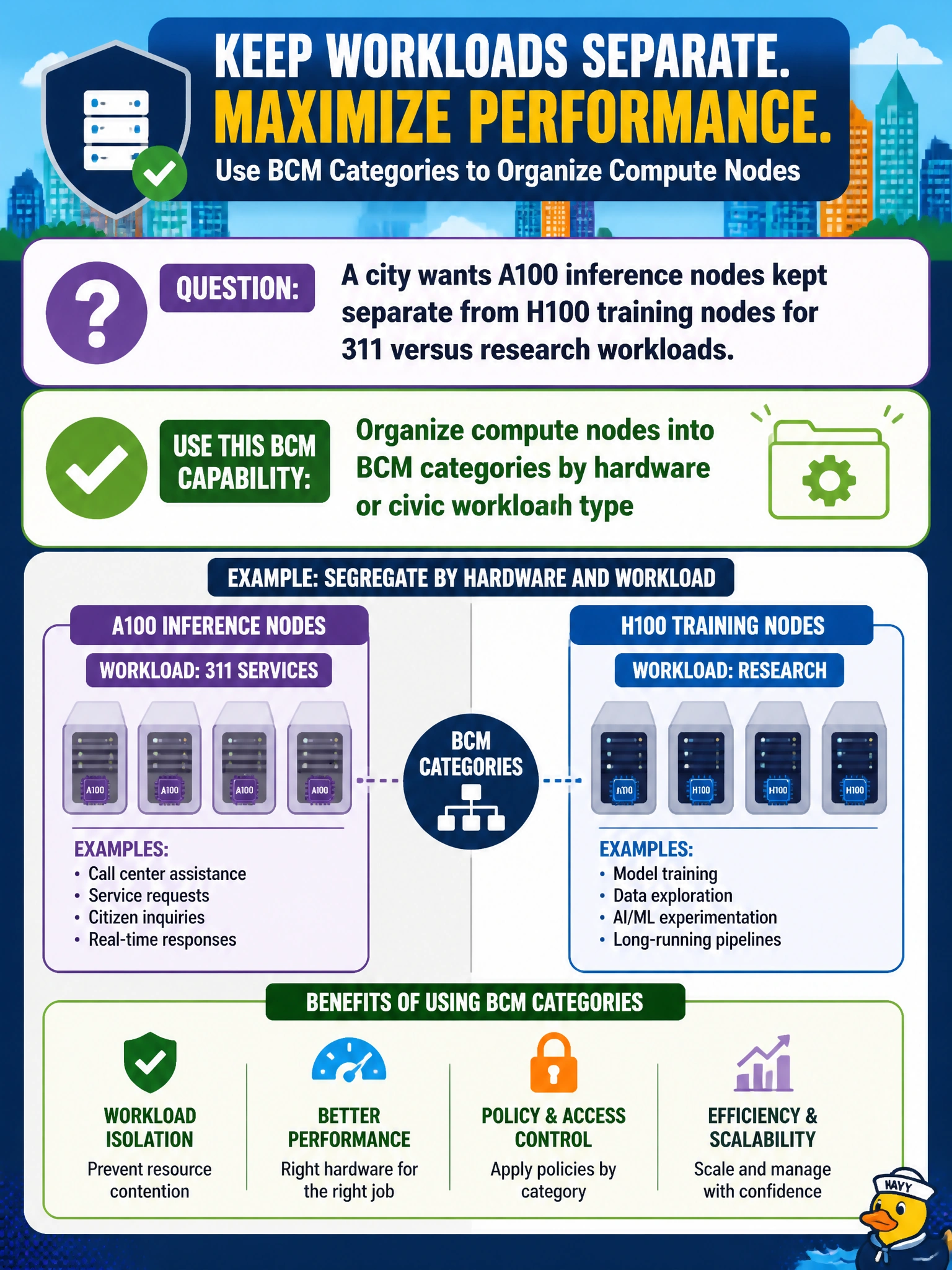
A city wants A100 inference nodes kept separate from H100 training nodes for 311 versus research workloads. What BCM capability should ops use?
Select an answer to reveal the explanation.
Short Explanation
Think labeled shelves in a city warehouse: BCM categories keep A100 inference for 311 on one shelf and H100 training on another. One big unlabeled pile invites the wrong jobs onto the wrong iron. Yanking H100s or killing GPU drivers is not how you organize a fleet.
Full Explanation
Separating A100 inference nodes from H100 training nodes for 311 versus research is a classic BCM categorization use case. Organizing compute into categories by hardware class or civic workload type lets scheduling and ops policy place 311 inference on the right shelf and keep research training on H100s. Categories make inventory and placement enforceable instead of relying on tribal knowledge. For a city platform, labeled categories are how ops prevent research jobs from starving citizen-facing 311 inference iron.
Mixing both hardware classes in one undifferentiated pool with no labels invites wrong-iron placement, noisy-neighbor effects, and hard-to-audit capacity planning. Removing H100 nodes from inventory until the next budget cycle deletes useful research capacity rather than organizing it. Disabling GPU drivers on A100s so only CPUs serve 311 traffic destroys inference performance and is not a separation strategy.
Exam caveat: hardware or workload separation on NVIDIA AI clusters is expressed through BCM categories (and related scheduling bindings), not by destroying drivers or hiding inventory. Operational check: create or verify A100-inference and H100-training categories in BCM, assign nodes correctly, bind 311 and research queues to those categories, and spot-check that sample jobs land on the intended civic hardware class.