
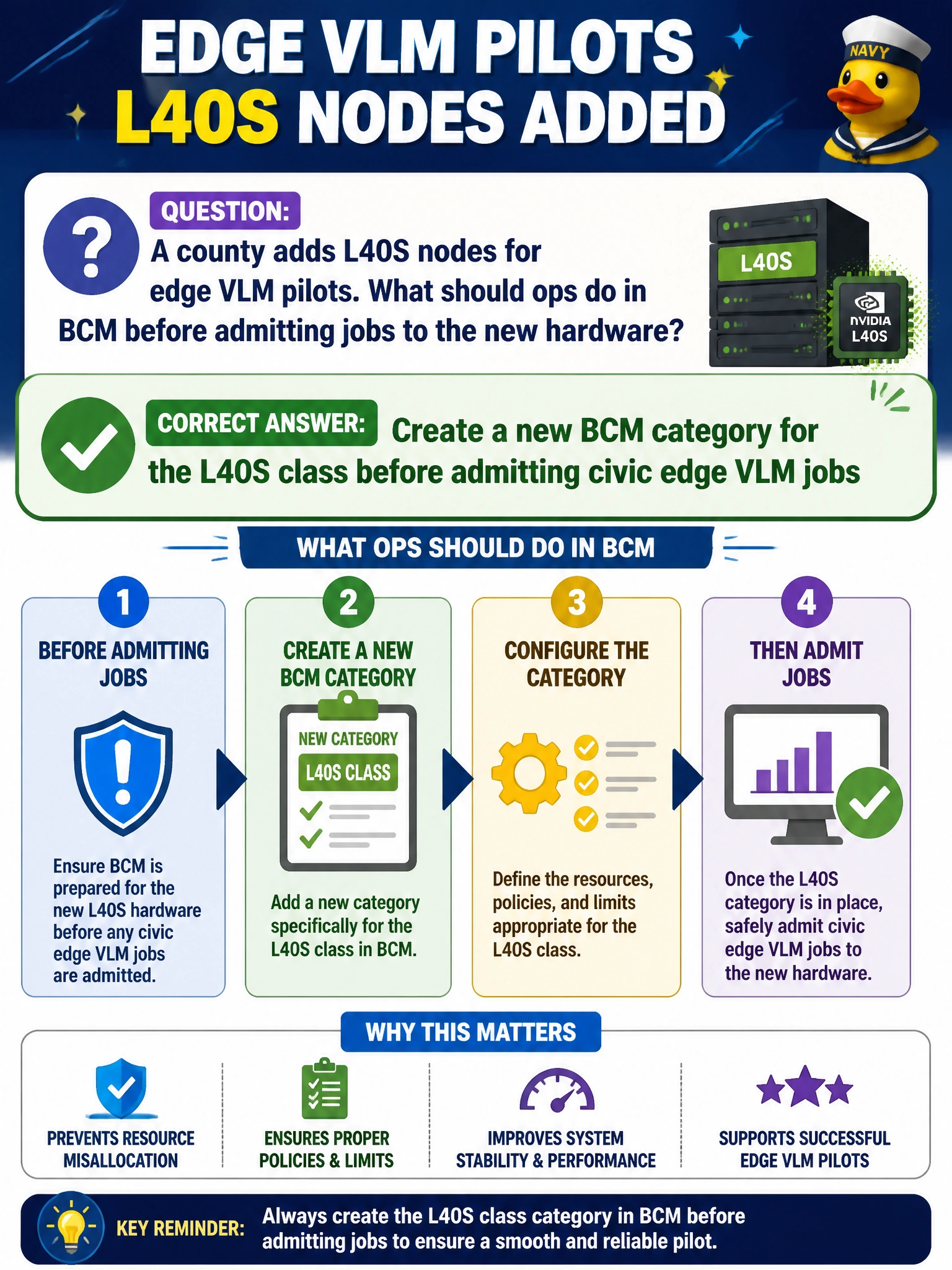
A county adds L40S nodes for edge VLM pilots. What should ops do in BCM before admitting jobs to the new hardware?
Select an answer to reveal the explanation.
Short Explanation
New L40S boxes are a new shelf—make the BCM category first, then let edge VLM jobs in. Skipping inventory or stuffing them into the H100 category is how pilots land on the wrong gear. Sticky notes are not a cluster manager.
Full Explanation
When a county adds L40S nodes for edge VLM pilots, BCM inventory and categories must recognize the new hardware class before jobs are admitted. Creating a dedicated L40S category (and associating nodes) lets scheduling, monitoring, and civic ops treat edge VLM capacity distinctly from existing H100 training pools. That sequence prevents pilot jobs from being placed or reported as if they were a different accelerator class. New SKUs without categories become invisible or mislabeled capacity in municipal reports.
Admitting production jobs immediately with no category or inventory update risks misplacement and blind spots in municipal reporting. Hiding L40S nodes from BCM and managing them with sticky notes defeats cluster management and creates untracked shadow capacity. Forcing L40S nodes into the existing H100 training category without review lies about hardware capabilities and pollutes training-pool accounting.
Exam caveat: new hardware classes should be categorized in BCM before civic workloads are admitted—inventory accuracy precedes production use. Operational check: add L40S nodes to BCM, create the L40S/edge-VLM category, verify nodes appear healthy under that category, then admit a pilot job and confirm placement and metrics reflect the new class—not the H100 pool.