
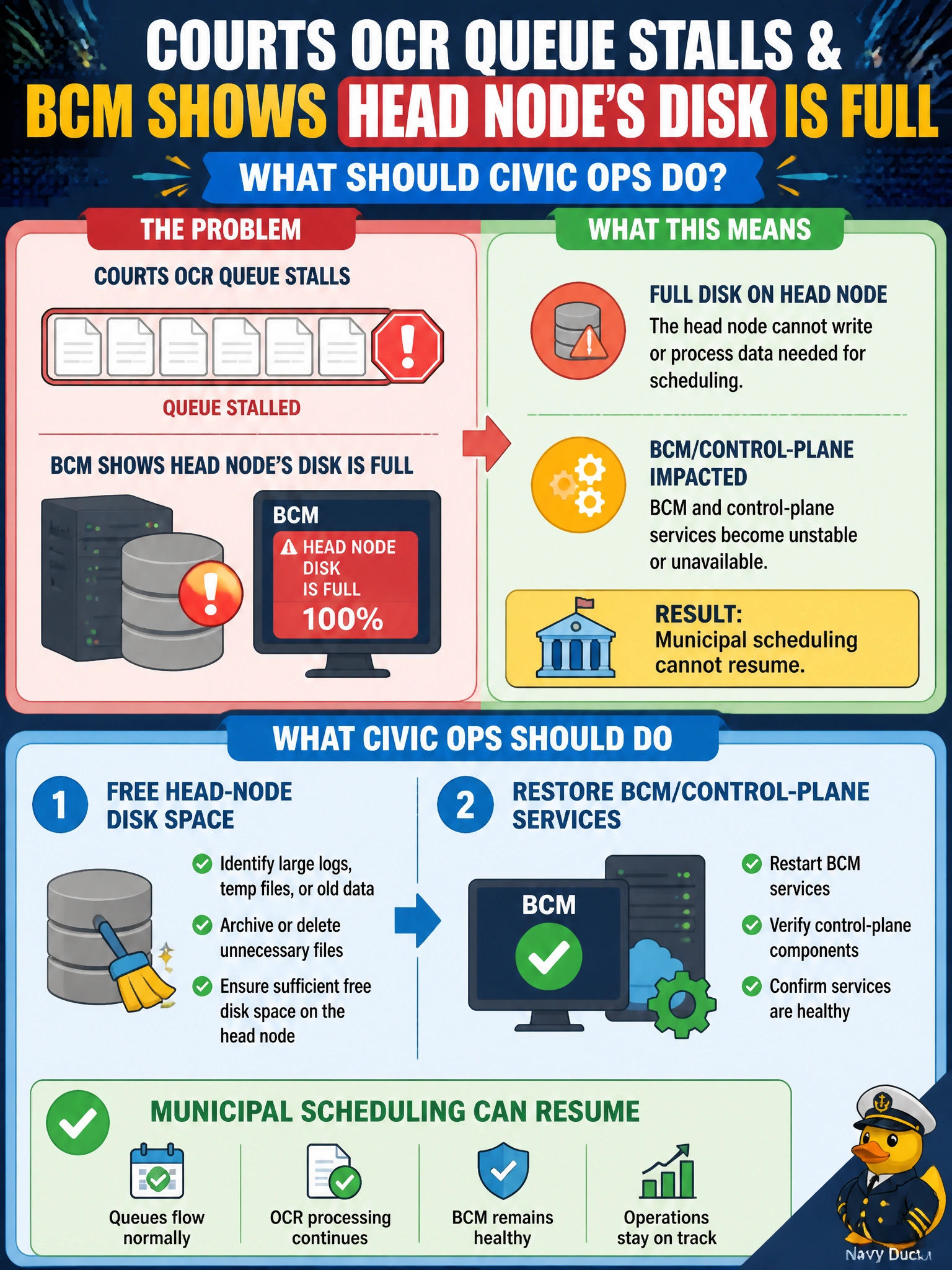
The courts OCR queue stalls and BCM shows the head node’s disk is full for scheduler state. What should civic ops do?
Select an answer to reveal the explanation.
Short Explanation
A full head-node disk can freeze the whole OCR queue even when GPUs are fine—free that space and bring BCM services back. Piling on more models or yanking GPU nodes treats the wrong patient. Ignoring control-plane disk alerts is how a small clog becomes a courthouse outage.
Full Explanation
When the courts OCR queue stalls and BCM shows the head node's disk is full for scheduler state, remediation must restore control-plane storage first. Scheduler and BCM services need head-node disk for state, logs, and admission; a full disk can freeze municipal job intake even when GPU workers are healthy. Freeing space and restoring BCM/control-plane services reopens the OCR queue without blaming accelerators. In civic batch platforms, control-plane disk is a first-class dependency for every downstream GPU job.
Adding more OCR models without freeing control-plane disk increases pressure on an already failing admission path and does not reclaim scheduler state space. Deleting all GPU nodes because disk fullness always means hardware failure misattributes a head-node filesystem condition to worker hardware and removes capacity the courts still need. Ignoring head-node disk alerts because only GPU memory matters for OCR is incorrect—OCR jobs never start if the control plane cannot schedule them.
Exam caveat: worker GPU health does not guarantee cluster progress when the head-node/control-plane disk is exhausted. Operational check: reclaim head-node disk (logs, old state, temp), restart or verify BCM/scheduler services, confirm free space remains above policy thresholds, then admit a test OCR job and watch the courts queue resume under BCM.