
Transit ETA jobs fail only on category B nodes. How should civic ops use BCM to isolate the fault?
Select an answer to reveal the explanation.
Short Explanation
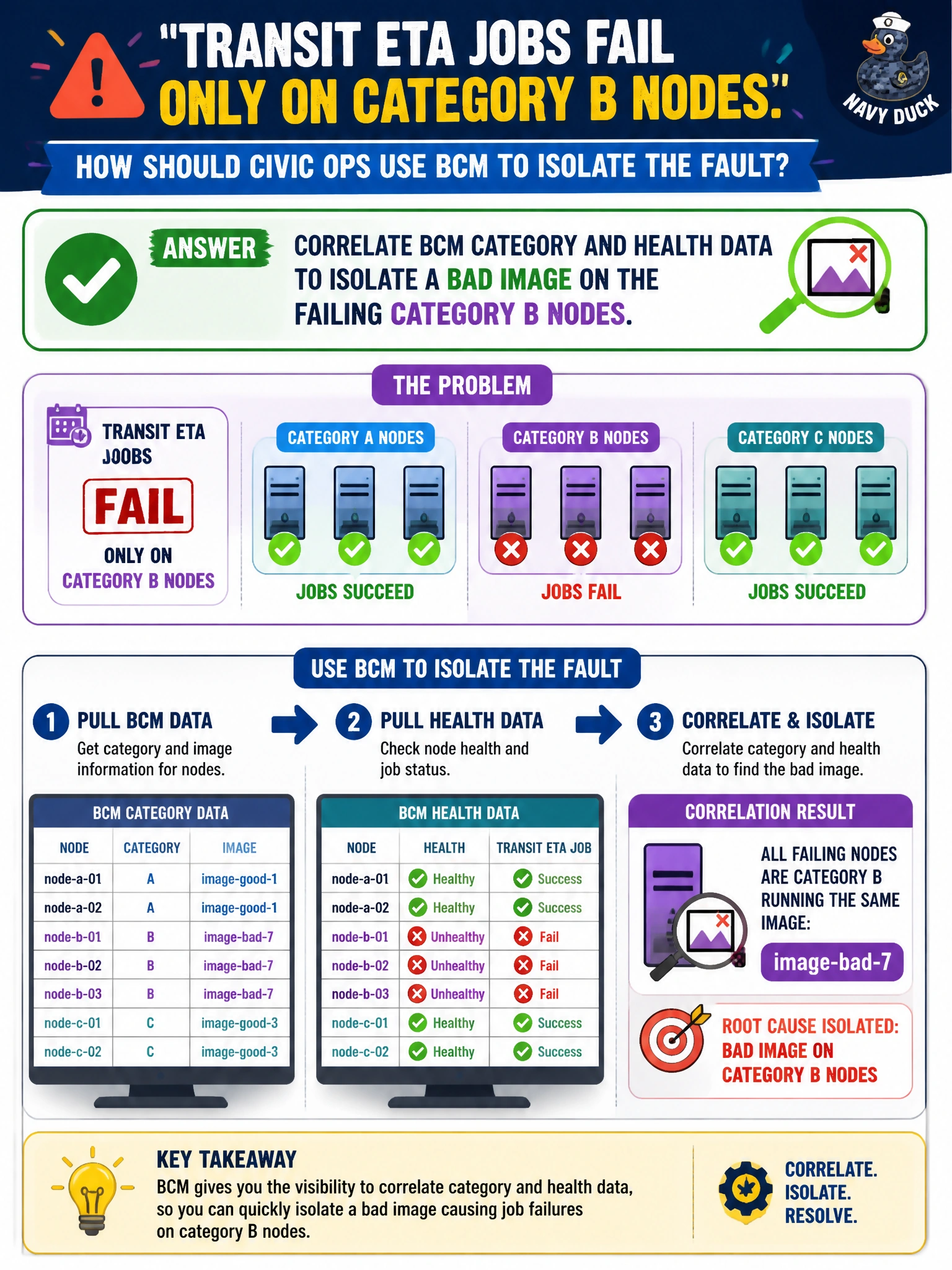
ETA jobs dying only on category B is a gift—BCM category and health data point straight at that group’s image or node state. Citywide cable swaps and ditching categories throw away that map. Parking the workload on laptops does not fix the cluster.
Full Explanation
Transit ETA failures that concentrate only on category B nodes are a strong placement signal. Correlating BCM category membership with node health and software-image state isolates whether category B carries a bad image, driver mismatch, or unhealthy hosts, which is far more efficient than citywide fabric changes. Civic ops should treat category-scoped failure as a gift for root-cause isolation before touching cables or abandoning the cluster. Category metadata exists precisely so municipal failures can be mapped to a node group instead of guessed at fleet-wide.
Replacing every InfiniBand cable citywide before checking category health is disproportionate, expensive, and ignores the category-local pattern that already narrows the fault domain. Moving all ETA jobs to laptops abandons GPU-cluster capacity and does not repair the category B image or health issue. Disabling category labels so failures cannot be mapped to node groups destroys the diagnostic boundary that made the problem isolatable.
Exam caveat: failures limited to one BCM category usually implicate that group's configuration or image—not the entire civic fabric. Operational check: in BCM, filter ETA failures to category B, compare health and image revisions against healthy categories, remediate the bad image or node state on B, then re-run ETA jobs and confirm failures no longer track that category.