
Public-health job backlog grows even though GPUs look idle. What BCM diagnosis should civic ops pursue next?
Select an answer to reveal the explanation.
Short Explanation
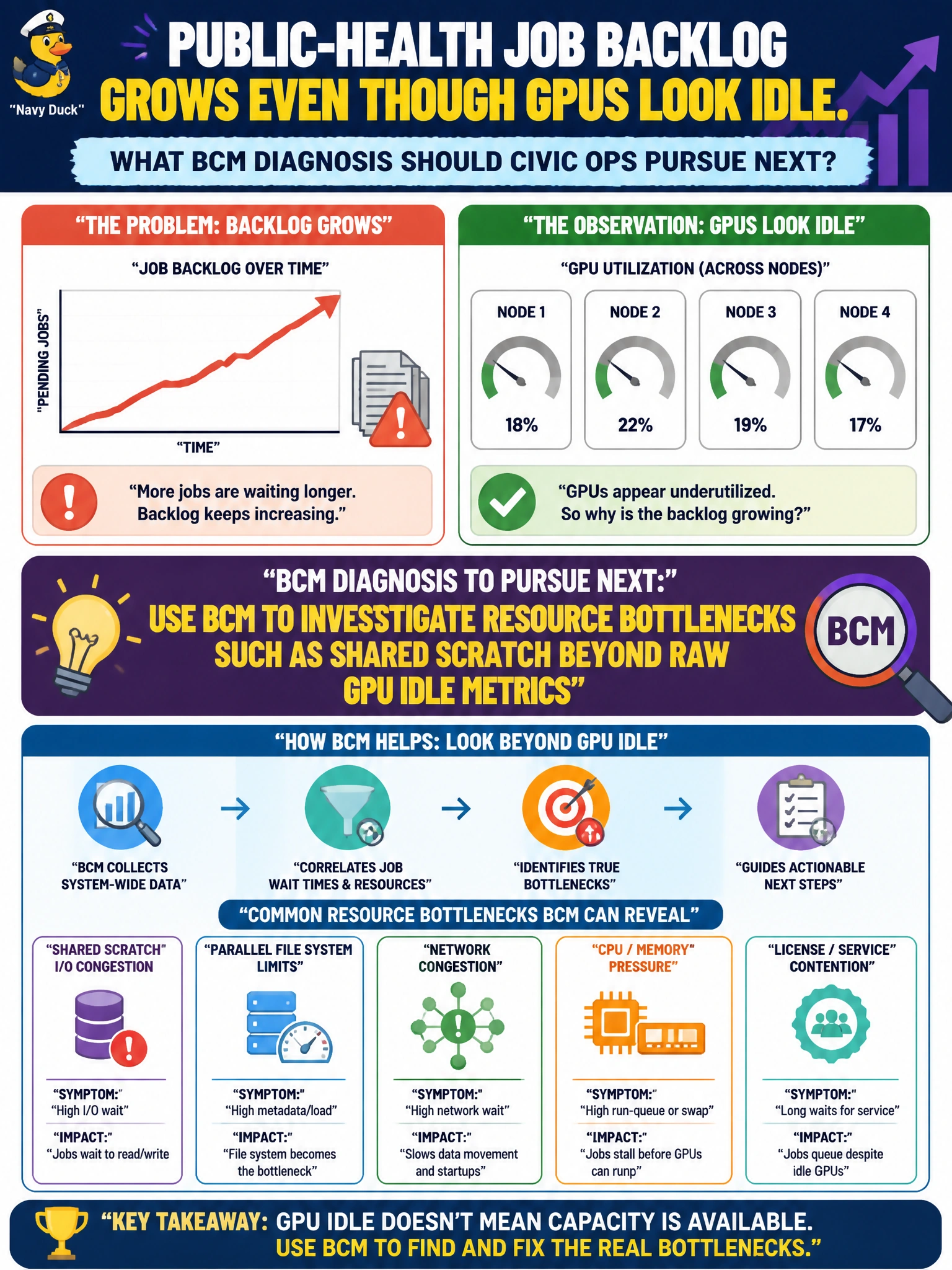
Idle GPUs with a growing public-health backlog usually means something else is clogged—often shared scratch. BCM is where you hunt that bottleneck instead of shopping for more cards on a hunch. Stuffing every job onto one node or calling it a myth just makes the pile taller.
Full Explanation
When a public-health job backlog grows while GPUs appear idle, the bottleneck is often not GPU compute. BCM diagnostic views help civic ops inspect shared scratch, I/O, interconnect, and other constrained resources that can stall admission or progress even when accelerator utilization looks low. Investigating those bottlenecks before buying hardware protects the municipal budget and restores queue throughput where the real constraint sits. Idle accelerators with a rising backlog are a classic symptom that the farm is waiting on storage or another shared dependency.
Buying more GPUs immediately without checking shared storage treats a possible I/O or filesystem saturation problem as a capacity shortage and can leave the backlog unchanged. Concluding that idle GPUs mean the backlog is a scheduling myth ignores queue depth, pending reasons, and storage wait states that BCM can surface. Forcing every job onto a single node to clear the queue creates hotspots, defeats multi-node health training patterns, and does not fix a shared scratch bottleneck that affects the whole farm.
Exam caveat: GPU idle time is not proof that the cluster is healthy—shared filesystem and other non-GPU resources commonly throttle civic AI jobs. Operational check: in BCM, correlate public-health pending/failed jobs with scratch I/O, free space, and node health; remediate the identified bottleneck, then confirm backlog drain and sustained GPU usefulness without adding cards prematurely.