
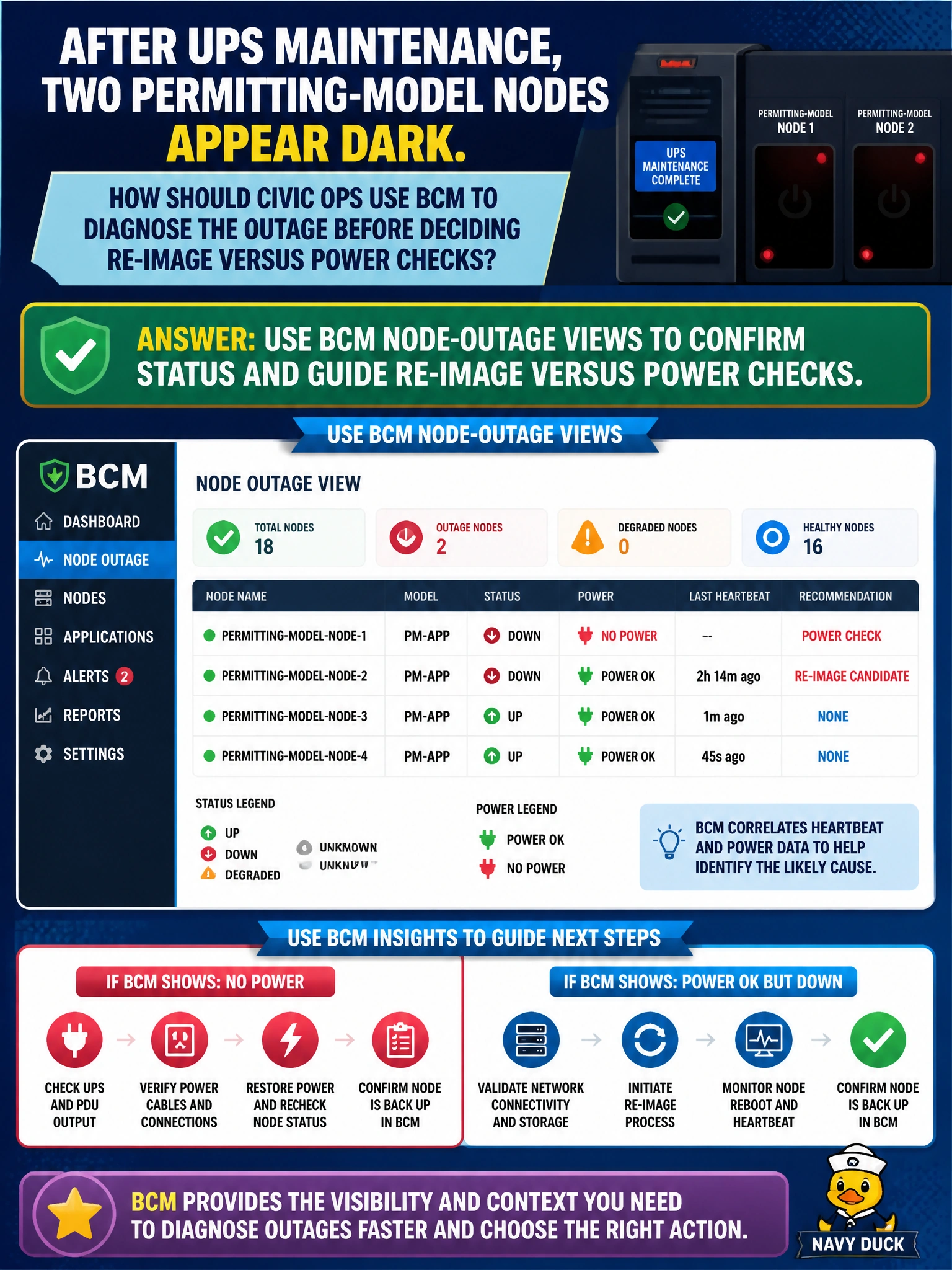
After UPS maintenance, two permitting-model nodes appear dark. How should civic ops use BCM to diagnose the outage before deciding re-image versus power checks?
Select an answer to reveal the explanation.
Short Explanation
When two permitting nodes go dark after UPS work, start in BCM’s outage view—not with a city-wide wipe. That panel tells you whether you are looking at power or an image problem before you swing a hammer. Deleting datasets or silencing alerts just hides the next clue.
Full Explanation
After UPS maintenance leaves two permitting-model nodes dark, the professional first move is BCM node-outage and health visibility—not irreversible remediation. BCM outage views correlate node power, reachability, and software-image state so civic operators can decide whether the path is a power or facilities check versus a controlled re-image. That diagnosis preserves evidence from the UPS work window and avoids treating every dark node as a corrupt dataset or a citywide software failure. For municipal permitting platforms, distinguishing facilities impact from image failure is the difference between a short outage and a self-inflicted citywide wipe.
Wiping every software image across the city without checking node state destroys forensic signal, risks cascading permitting outages, and skips the triage BCM was installed to provide. Assuming the permitting dataset is corrupt and deleting it first confuses compute-node availability with application data integrity; dataset deletion does not restore dark hosts and may erase records needed for audit. Disabling BCM monitoring so outages stop generating alerts removes the only continuous confirmation that recovery succeeded and hides follow-on failures after UPS work.
Exam caveat: dark nodes after facilities maintenance are not automatically image failures or data corruption—power-path versus software-state must be separated before destructive actions. Operational check: open BCM node-outage/health views for the two permitting nodes, confirm power and management reachability, then choose re-image only when image/OS state is implicated; re-check the same views after remediation until both nodes report healthy for municipal permitting workloads.